

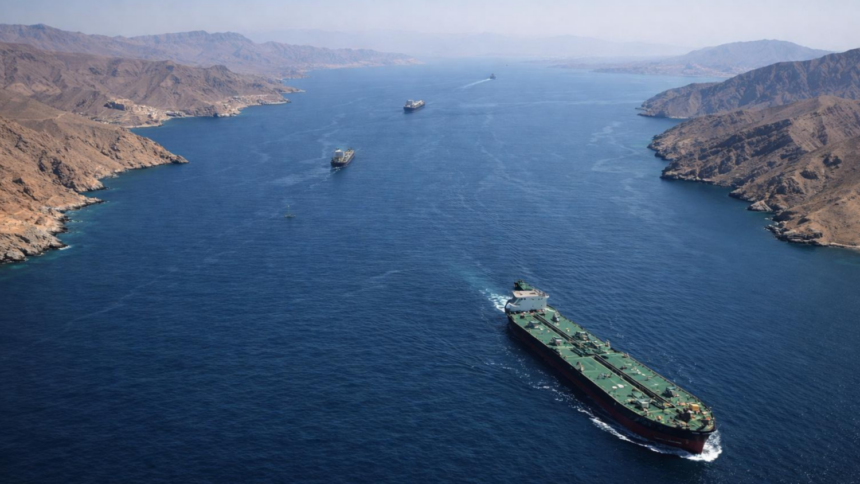
The statement by Mojtaba Khamenei, the Iranian Supreme Leader, that “control over the Strait of Hormuz is equivalent to possessing a deterrent power on the level of a nuclear weapon, and it is a vital card we will never relinquish,” is far from a passing remark. Rather, it reveals the pinnacle of Tehran’s demands in the ongoing negotiations. The significance of Hormuz extends far beyond its role as an energy corridor; in Iranian strategic thinking, it has become the true foundation of deterrence.
At the outset, several key realities must be acknowledged. Iran views the current regional landscape as temporary rather than permanent, tied largely to whatever remains of US President Donald Trump’s time in the White House – at most 30 months, including the final six months during which Trump would effectively become a “lame duck” ahead of the next presidential election. Tehran also regards the nuclear file as a supreme strategic asset that may be delayed under current pressure, but can never be surrendered – especially after the recent war reinforced the belief that, had Iran possessed a nuclear deterrent, neither Washington nor Tel Aviv would have dared to attack it.
Iran believes its nuclear programme can be technologically contained and suffocated for a limited period. Yet it also understands that once a state reaches the stage of independent technical mastery over a nuclear programme, material blockades become ineffective and may instead stimulate domestic innovation. This process was aided by neighbouring Pakistan, whose scientist Abdul Qadeer Khan previously transferred substantial nuclear expertise to Tehran. Added to this is Iran’s rugged geography, which serves as both a natural shield and a tactical advantage. The dispersal of enrichment facilities across fortified mountainous terrain and underground sites complicates aerial and satellite surveillance while significantly reducing the effectiveness of direct military action or strict international monitoring.
What applies to the nuclear file applies even more strongly to the ballistic missile programme. Both can be revived or further developed regardless of monitoring mechanisms. The real strategic prize, however, lies in controlling the Strait of Hormuz, a geopolitical opportunity Iran believes may never be repeated.
Tehran understands that Hormuz is an irreplaceable choke point. Between 20 and 21 million barrels of crude oil and petroleum products pass through it daily, accounting for nearly 20% of global oil consumption and around 30% of worldwide seaborne oil shipments. More than a quarter of global liquefied natural gas trade also transits the strait annually. Any total or partial closure – or even credible threats to maritime security – could send global oil prices soaring within hours.

Although alternatives exist, including pipeline networks through Saudi Arabia and the UAE, these can absorb only a limited share of the enormous volumes passing through Hormuz, leaving much of the world’s energy supply effectively trapped behind its narrow gates.
There are also legal constraints, particularly under the 1982 United Nations Convention on the Law of the Sea, which prohibits the imposition of transit fees. Article 38 guarantees all vessels the right to continuous and expeditious passage without restrictions or charges. The only exception appears in Article 42, which allows fees solely in exchange for specific services such as navigation assistance or rescue operations.
Yet since Tehran issued its threats and reportedly imposed fees on certain vessels, the model itself has begun inspiring other states that control strategic waterways.
Last April, Indonesian Finance Minister Purbaya Yudhi Sadewa triggered controversy when he publicly proposed charging vessels passing through the Strait of Malacca, explicitly citing the Iranian model in Hormuz. The proposal faced strong opposition from Singapore and Malaysia, forcing Jakarta to retreat. Nevertheless, the concept itself has now entered geopolitical discourse as a potential future instrument of pressure.
China, meanwhile, is watching closely. If Iran succeeds in normalising such practices, Beijing could attempt to use the precedent to justify restrictions or transit fees in the Taiwan Strait or parts of the South China Sea, treating them as internal waters or areas subject to its sovereign security jurisdiction.
The real crisis surrounding the Strait of Hormuz can be distilled into one fact: it is extraordinarily difficult to secure militarily. Tactically, it represents a nightmare for conventional naval forces. Cheap smart naval mines, fast suicide boats, and drones launched from concealed positions amid harsh terrain turn the very idea of fully securing the passage into an illusion. Although the United States maintains a significant naval presence in the region, it remains incapable of fully preventing “grey-zone” attacks carried out without clear fingerprints or through proxy actors. This reality forces insurance companies to impose severe restrictions – or even deny coverage entirely – compelling shipping companies to suspend operations voluntarily, thereby creating an effective blockade without a formal declaration of war.
Iran’s message is direct: paying transit fees – or even a regulated form of tribute – may ultimately prove less costly than the collapse of supply chains or the loss of oil tankers. This helps explain why major powers appear constrained in confronting such threats decisively.
Maritime traffic through the strait is estimated at roughly 3,000 ships per month under normal conditions. Imposing fees on even a fraction of these vessels could generate billions of dollars annually. Reports suggest the prospect may even have appealed to Trump himself, as a businessman inclined toward profitable arrangements, prompting discussions about a possible joint framework with Iran to organise transit tolls through the strait.
Hormuz possesses all the ingredients necessary to become a permanent gold mine for Iran – and for whichever powers manage to dominate it – provided they do not push matters so far that the world accelerates efforts to develop alternative routes and technologies capable of eventually diminishing the strait’s strategic relevance.
What may be unfolding is the emergence of a new maritime financial order built around the monetisation of security. The central question remains: could Hormuz ultimately become Tehran’s ultimate “joker card” – one capable of securing a grand bargain involving the comprehensive lifting of international sanctions and the recovery of frozen Iranian assets in exchange for guaranteeing freedom of navigation once again?
Prof. Hatem Sadek – Helwan University

