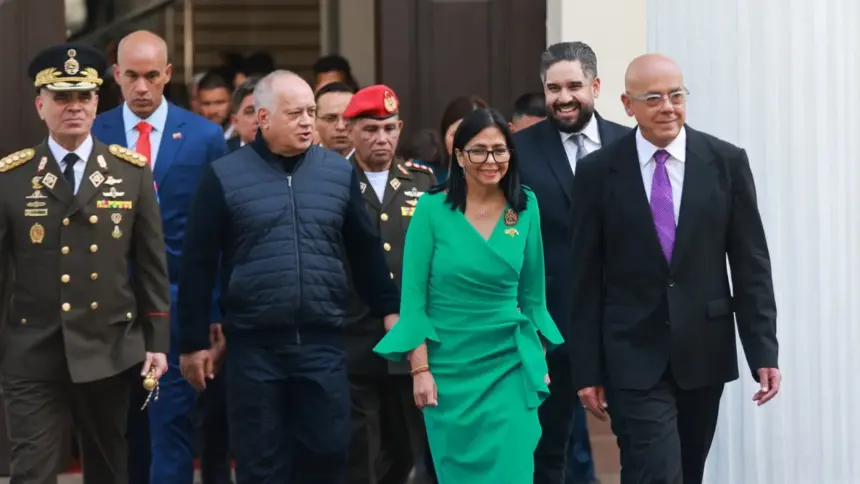
When Venezuelan Vice-President Delcy Rodríguez took the podium on 4 January — hours after Nicolás Maduro was detained by US forces from a heavily guarded military base — she delivered a fiery address denouncing what she called an “illegal assault on her country.” Standing beside Cuban officials and senior military figures, she declared: “We will not inherit a legacy of traitors and cowards.”
Within weeks, most of those flanking her that day had been removed from their posts.
The swift unravelling of the Maduro order
What has unfolded in Venezuela since Maduro’s detention on 3 January represents the most sweeping redistribution of power inside Caracas in decades, according to sources close to Rodríguez cited by The New York Times. Operating without public explanation — but frequently with White House approval, and at times at Washington’s direct instigation — Rodríguez has systematically dismantled the patronage network that sustained Maduro’s thirteen-year rule.
In the three months since his arrest, she has replaced seventeen ministers, overhauled military leadership, appointed new diplomats, and overseen the detention of at least three businessmen linked to her predecessor. She has stripped most oil contracts from Maduro’s family network, sidelined his relatives from state dealings, and opened the door to American oil and mining investors — all while governing a country that remains, by any measure, an authoritarian state.
The “why now” is unambiguous: a convergence of American coercive power and Rodríguez’s own long-cultivated political positioning has created a narrow window in which Venezuela’s governing architecture is being recast, just as global energy markets reel from the disruptions caused by the Iran conflict.
Seventeen ministers and an entire military command
The scale of the purge is without precedent in recent Venezuelan history. Among its most significant casualties is General Vladimir Padrino López — once considered one of the most powerful men in Venezuela and Maduro’s longest-serving defence minister — who was removed from his post in March and reassigned to run the agriculture ministry.
Maduro’s son, Nicolás Maduro Guerra, and the son of his wife Celia Flores — Yoser Gavidia Flores — have both been marginalised from lucrative state business dealings, according to government sources. In the same month, Rodríguez extended the purge to the armed forces, dismissing the entire Venezuelan military command.
A Venezuelan general told the Times that many within the institution view the removal of senior commanders as the opening move in a far deeper, US-led reform of the Venezuelan armed forces.
Sources close to the Rodríguez government say she coordinated a number of these replacements directly with the Trump administration, with US officials pressing her to pursue Washington’s adversaries.
The last man standing, and the risks he carries
One figure has, so far, survived the cull: Diosdado Cabello, the interior minister who allegedly oversaw the ruling party’s repressive apparatus. Cabello — who faces US charges alleging “drug trafficking” — has previously clashed with Rodríguez. Yet his ties to pro-government armed factions have made him both a valuable ally and a dangerous target.
His continued presence in government underscores the limits of Rodríguez’s authority. Not all decisions rest with her alone. After Maduro and his wife Celia Flores were seized in what sources described as an overwhelming display of force, the Trump administration reportedly threatened to strike Venezuela again should the new leadership fail to cooperate. Senior Venezuelan officials and government insiders compared Rodríguez’s rule to governance at gunpoint.
“The plan was always either everyone falls or no one falls,” a senior Maduro official told the Times.
Washington’s hand — and the question of betrayal
The apparent ease with which US forces detained Maduro from a heavily fortified base has fed persistent speculation that he was betrayed by insiders who stood to benefit from his removal. A senior Venezuelan official declared the day after the American operation that “a great betrayal” had been committed. Russian officials — who lost a key ally with Maduro’s fall — made similar remarks.
The Trump administration had been contemplating Rodríguez as a successor since 2025, maintaining indirect contact with her throughout that period, the Times reported.
The political calculus for Washington has paid off. US officials have been able to settle scores with Maduro allies who defied them, while simultaneously consolidating Rodríguez’s leadership — a transaction that has delivered tangible wins for both parties.
A socialist activist turned Washington’s praised partner
For many Venezuelans, the transformation is jarring. Rodríguez — a veteran functionary of the ruling Socialist Party who has never held elected office — has pivoted from hardline socialist activist to what US officials have publicly lauded as a cooperative partner, a shift that has united Maduro’s scattered loyalists in a shared distrust of her.
Those who were close to the former president insist he never envisioned her as a successor, viewing her as a competent administrator rather than a leader.
Her coalition reflects the shift. Rodríguez’s allies include a younger generation with weaker ties to the Chávez movement’s ideological roots — among them members of the ruling party’s aristocratic class who are more interested in the fruits of market economics than in preserving the Chávez legacy. Some former government opponents have been drawn into the fold by the opportunities on offer; Oliver Blanco, Venezuela’s new envoy to North America and Europe, previously served as a personal aide to an opposition leader.
Venezuela’s traditional economic elites — formerly aligned with the opposition but reconciled to the Chávez system — are also among those benefiting from her economic restructuring. Their bet on stability over democracy has, for now, bought them access to foreign markets and the American banking system.
Power without democracy
None of this, Venezuelan opposition figures warn, amounts to political reform. The opposition has consistently maintained that Rodríguez, rather than returning the country to democracy, is entrenching her own rule. Opinion polls suggest most Venezuelans welcome the end of Maduro’s tenure — sustained, as it was, through violence, corruption, and alleged electoral fraud — but many remain deeply sceptical of his successor.
Rodríguez, as one senior official put it, is deploying the threat of American coercion as a tool to pursue power brokers within the ruling party who were previously considered untouchable. The result is a political victory for both Trump and Rodríguez — but not necessarily for Venezuelans awaiting something more than a change in the name at the top.
In the fiery speech she gave on 4 January — the one in which she vowed not to inherit a legacy of traitors — Rodríguez was flanked by the very figures she would go on to discard. The general she called a comrade now runs a farming ministry. The party barons who stood shoulder to shoulder with her have been sidelined, detained, or cowed into silence.
Whether the woman who made that speech genuinely believes in a different Venezuela — or is simply the latest strongman in a country that has never lacked for them — remains the question that neither Washington’s approval ratings nor Caracas’s reshuffled cabinet can answer.