

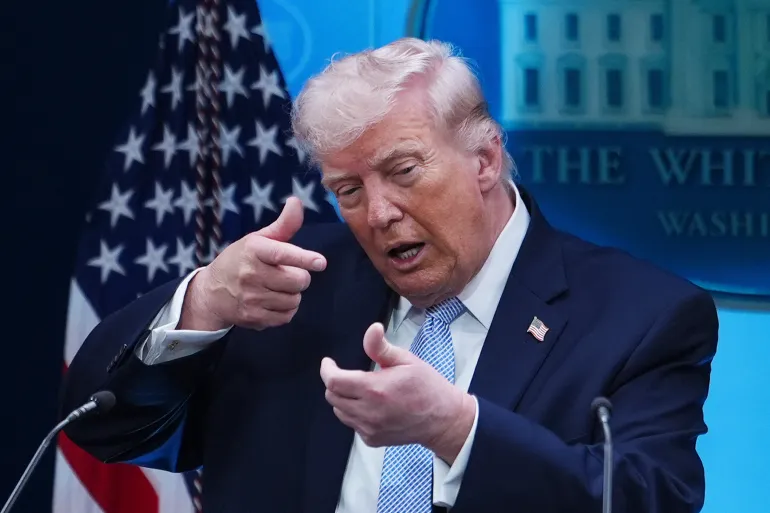
US President Donald Trump said any small Iranian attack boats approaching a US-enforced naval blockade would be “eliminated immediately,” escalating tensions as Washington’s restrictions on Iranian ports came into force following failed talks in Islamabad.
The US military said its maritime control measures apply to vessels entering or leaving Iranian ports regardless of flag, while allowing continued transit through the Strait of Hormuz for ships travelling to and from non-Iranian destinations. It added that any vessel entering or exiting the restricted zone without authorisation could be intercepted, diverted, or detained, with neutral ships also subject to inspection.
Trump’s remarks came hours after Washington’s Monday 14:00 GMT deadline for the blockade to begin. US officials provided limited initial details on enforcement, though a senior official later said the operation was under way with support from more than 15 warships, a figure that could not be independently verified.
Trump said Iran’s conventional navy was “at the bottom of the ocean,” adding that only a small number of fast attack craft had not been targeted, as they were not previously seen as a major threat. He warned that any vessels approaching US ships would be destroyed using the same “elimination” methods applied against drug trafficking operations. Iran, in response, described the restrictions as “maritime piracy.”
Tehran responded with strong rhetoric. A spokesperson for Iran’s Khatam al-Anbiya military headquarters said security in Gulf and Sea of Oman ports must either apply to all or to none. Iranian Foreign Minister Abbas Araqchi said Tehran had entered the Islamabad talks “in good faith,” but faced excessive US demands, shifting objectives, and threats of a blockade, leading to the collapse of negotiations.
Shehbaz Sharif said diplomatic efforts were continuing despite the breakdown in talks, adding that Islamabad was making a “full effort” to help resolve the conflict. Mediators from Pakistan, Egypt, and Turkey are expected to continue efforts in the coming days, with hopes of another round of negotiations before the current ceasefire expires on April 21.
In Israel, Prime Minister Benjamin Netanyahu backed the US move, saying coordination with Washington was ongoing. Qatar, by contrast, stressed the importance of preserving the ceasefire and keeping sea lanes open, warning against using maritime routes as leverage due to the potential impact on global energy and food supplies.
The secretary-general of the International Maritime Organization also said no state has the right to impede transit passage or freedom of navigation through international straits, underlining the sensitivity of the Strait of Hormuz, through which roughly a fifth of the world’s seaborne oil and liquefied natural gas passes.
The blockade has already unsettled energy and shipping markets. Estimates suggest it could disrupt around 2 million barrels per day of Iranian oil exports, while oil prices have jumped more than 7% to above $100 per barrel amid concerns over prolonged supply disruptions.

