

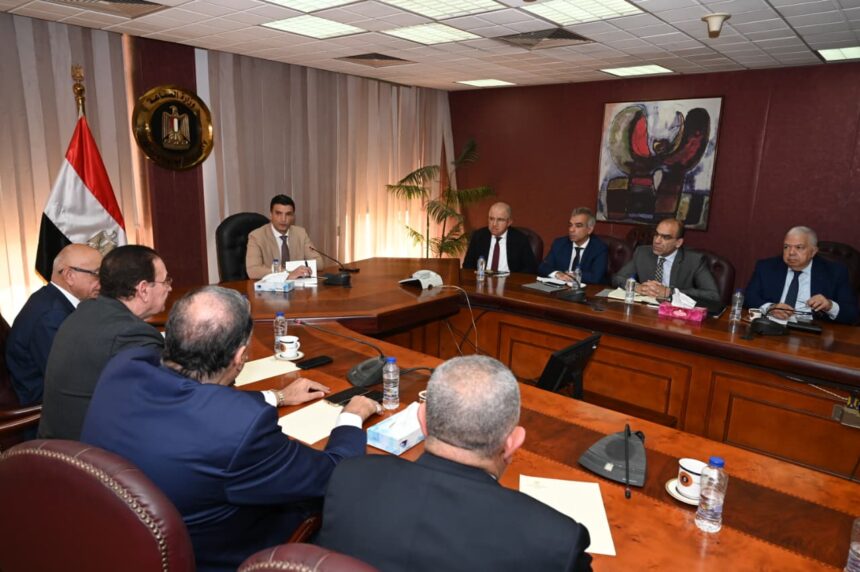
Minister of Industry Khaled Hashem held an extensive meeting with Mohamed El-Sewedy, Chairperson of the Federation of Egyptian Industries, and members of the Petroleum and Mining Chamber, led by Tamer Abdel Hamid Abu Bakr, to explore ways to maximise the value of Egypt’s mineral resources and deepen local manufacturing.
The discussions addressed key challenges facing the mining industries sector, including the need to increase value-added production, reduce carbon emissions in line with Carbon Border Adjustment Mechanism (CBAM) requirements, and expand the use of alternative fuels such as refuse-derived fuel (RDF), which remains limited due to quality concerns in the domestic market.
Participants also highlighted constraints related to mineral exploration licences, notably their short one-year duration and the limited areas allocated for exploration.
At the outset, Hashem said the mining sector holds strong potential to attract new investments, generate higher value-added output, and support local manufacturing as part of efforts to reduce imports and boost exports.
He noted that the ministry is placing increasing emphasis on CBAM compliance to enhance the competitiveness of Egyptian companies and improve their access to European and global markets. He also pointed to ongoing coordination between the ministries of Industry, Local Development, and Environment to establish an environmental registry for measuring, reviewing, and verifying carbon emissions across industrial activities.
Hashem underlined broader efforts to advance the transition towards a green economy and improve industrial efficiency, particularly amid ongoing global energy challenges. In this context, he revealed that the ministry is working with the ministries of Electricity and Renewable Energy and Petroleum and Mineral Resources to develop energy maps for industrial zones, identifying the most suitable renewable energy sources—such as solar and wind—for each area to reduce reliance on the national grid.
The minister also stressed the importance of expanding the role of energy service companies (ESCOs) in auditing factory energy consumption and recommending efficiency improvements. He added that the government is moving to enable the private sector to develop, install, and operate renewable energy systems within industrial zones.
On alternative fuels, Hashem said the ministry will coordinate with relevant authorities to diversify fuel sources used in cement and other energy-intensive industries. He also affirmed the ministry’s readiness to provide technical and research support to the Petroleum and Mining Chamber through the Mining and Marble Technology Center.
For his part, El-Sewedy highlighted the role of the Environmental Compliance Office affiliated with FEI, noting that it offers a range of services, including a revolving loan programme to finance industrial firms, access to environmentally compliant technologies, energy efficiency solutions, renewable energy applications, and waste management systems. These efforts, he said, aim to support the industrial sector in meeting Egypt’s sustainable development goals.


