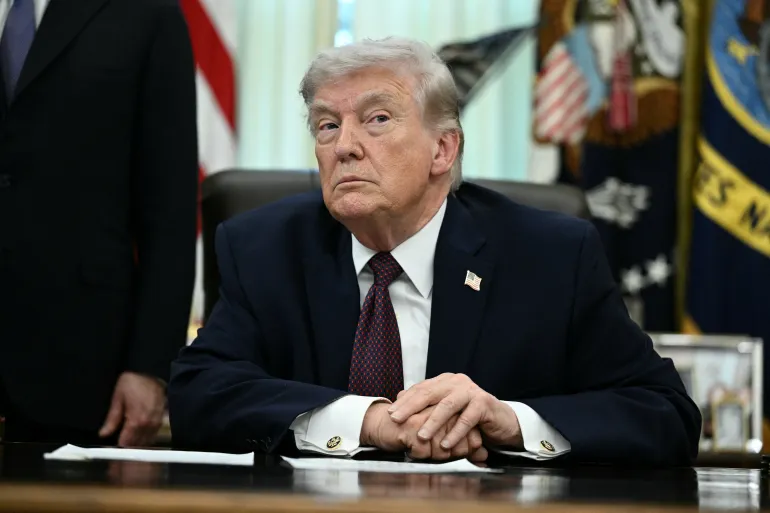
U.S. President Donald Trump said the deadline he had given Iran was close to expiring, warning that Tehran had just 48 hours to reach an agreement or reopen the Strait of Hormuz, or face what he described as “great hell,” as military escalation widened and hopes for a ceasefire dimmed with the war entering its sixth week.
Trump’s remarks came as Iran’s Revolutionary Guards said they had launched “wide and multi-faceted attacks” on Saturday morning in what they described as the 95th wave of Operation True Promise 4, using Haj Qasem, Kheibar Kaser and Qadr missiles against U.S. and Israeli targets across West Asia and the occupied Palestinian territories.
The Guards said the targets included U.S. HIMARS missile platforms on Kuwait’s Bubiyan Island, a U.S. Patriot battery north of Bahrain, U.S. troop assembly points in the United Arab Emirates, and facilities belonging to the U.S. technology company Oracle Corporation in the UAE. They also said a commercial vessel linked to Israel, the MSC Ishika, had been attacked in Bahrain, and that Bnei Brak, Petah Tikva, Tel Aviv, Ramat Gan and Kiryat Shmona had come under fire from multi-warhead missiles. Those claims could not be independently verified.
Air raid sirens sounded across wide areas of northern Israel, including Haifa, Acre, Safed and the Krayot area, following an Iranian missile barrage, the Israeli military said. Israeli media reported that some of the missiles carried cluster-style warheads, while other reports said shrapnel fell in several locations in Ramat Gan and Haifa Bay, causing fires and power outages in some areas. Reports also said one missile landed in an open area in the north while another was intercepted, with no immediate reports of casualties.
In a separate wave, the Revolutionary Guards said their aerospace force had targeted Israeli military-industrial centres and troop assembly points in southern, central and northern Israel, including Tel Aviv, Dimona, the Negev, Beersheba and Ramat Gan, as part of the 94th wave of the same operation, using heavy ballistic missiles and attack drones. They added that Yemen’s Houthis and Iraqi armed factions had also launched coordinated attacks on Israel.
Across the Gulf, Bahrain’s defence force said it had intercepted and destroyed eight drones over the past 24 hours, while Dubai’s government media office said debris from a successful aerial interception struck the façade of an Oracle building in Dubai Internet City without causing injuries. Kuwait’s electricity ministry said two electricity and water distillation facilities had sustained material damage in recent days, but added that both systems remained stable.
In another development, the Revolutionary Guards said Iranian air defences had intercepted a cruise missile carrying a 454kg warhead over Markazi province in central Iran. Iranian media circulated images they said showed the missile’s wreckage. Iran’s science minister, Hossein Simaei Sarraf, said more than 30 universities had come under attack during the war, killing 60 students and assassinating 10 university professors, according to his statement.
On the Israeli side, Israeli Army Radio said the air force had struck petrochemical plants in southwestern Iran as part of an effort to deepen damage to Iran’s military industries and economy. Channel 12 said the military had begun a new wave of strikes on petrochemical facilities, while Iran’s Mehr news agency said the Bandar Imam petrochemical complex in Khuzestan had been hit, with some sections damaged. Iranian media also reported strikes on a cement factory in southern Iran.
In a sign of mounting risks for U.S. forces, reports said Iranian forces were searching for a missing American pilot who had been aboard one of two warplanes downed in Iran and the Gulf. Two U.S. officials were quoted in media reports as saying a pilot had ejected from an A-10 Warthog hit by Iranian fire before crashing in Kuwait, while officials from both sides said a two-seat U.S. F-15E had also been shot down. The Revolutionary Guards said they were searching an area in southwestern Iran for the missing pilot, though there was no full official U.S. confirmation of his fate.
Diplomatically, The Wall Street Journal cited mediators as saying efforts led by regional countries, including Pakistan, to secure a ceasefire between Washington and Tehran had reached a dead end after Iran formally told mediators it did not want to meet U.S. officials in Islamabad in the coming days and that U.S. conditions were unacceptable. Iranian state television quoted a senior security official as saying Iran would no longer allow military equipment to be transported to U.S. bases in the region through the Strait of Hormuz, and that only a limited number of vessels would be permitted to pass in coordination with Tehran.
Iran also warned that any attack on its diplomatic missions in the region or abroad would be met with a swift and firm response. A spokesman for Khatam al-Anbiya military headquarters said Israeli embassies in the region would become legitimate targets if Iranian missions were attacked.
In Israel, the public broadcaster said official assessments pointed to preparations for two more weeks of war alongside the United States, adding that Washington’s response to the downing of a U.S. aircraft could be severe, raising the likelihood that the conflict may extend beyond the timetable initially envisioned.
Inside Iran, police in Gilan province said they had arrested 101 people since the war began, including 91 accused of spreading false news and rumours, and 10 accused of filming sensitive sites and impact locations and sharing the footage online or with opposition media.