

U.S. President Donald Trump said the United States could bring the war with Iran to an end within two to three weeks, in remarks that underscored ongoing uncertainty in Washington over how the conflict, now in its fifth week, might conclude, as fighting between Iran and Israel intensified and its fallout spread across the Gulf and key shipping lanes.
Trump told reporters at the White House that a U.S. withdrawal could occur “within two weeks, maybe within two weeks, maybe three,” adding that Tehran would not be required to reach an agreement as a precondition for de-escalation. The White House later said Trump would deliver a national address with a “major update on Iran.”
The remarks came as the United States continued to reinforce its military presence in the region. U.S. media, citing officials, reported that the aircraft carrier USS George H. W. Bush (CVN-77) was en route to the Middle East to join the USS Abraham Lincoln (CVN-72) and the USS Gerald R. Ford (CVN-78), potentially bringing the number of U.S. carriers deployed in the region to three. Thousands of troops from the 82nd Airborne Division have also begun arriving, according to U.S. officials.
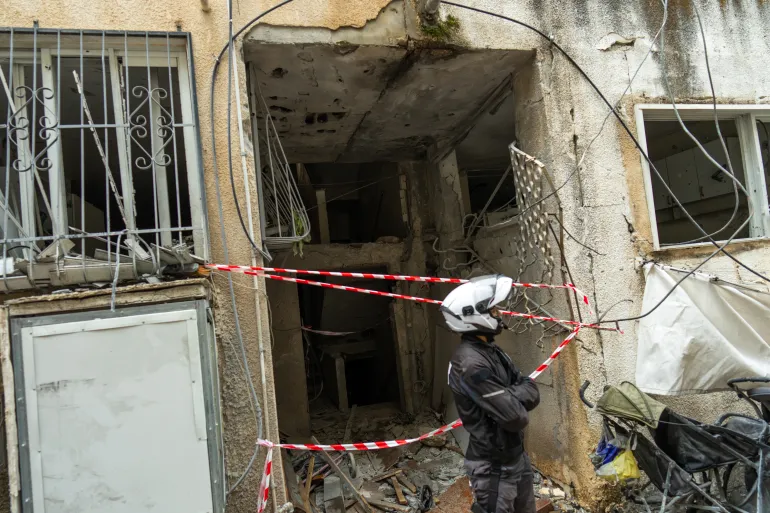
On the battlefield, Iran and Israel continued to exchange missile fire as U.S.-Israeli strikes targeted Tehran and other Iranian cities. Iran responded with missile barrages on Israel that wounded 14 people, including an 11-year-old girl in serious condition, according to Israeli emergency services. Israel’s health ministry said the number of people evacuated to hospitals since the war began on Feb. 28 had risen to 6,286, while the Institute for National Security Studies estimated the death toll at 29.
The Israeli military said it had carried out more than 800 attack sorties against Iran since the start of the war, deploying over 16,000 munitions. It added that its air force had conducted more than 2,000 aerial refuelling operations and that a target bank developed after the previous confrontation with Iran included more than 5,000 new targets.
Iran’s Islamic Revolutionary Guard Corps said it had launched coordinated attacks using more than 100 missiles and drones against U.S. and Israeli targets as part of what it described as the 89th wave of “Operation True Promise 4.” It said the strikes targeted sites in Israel as well as U.S. bases and facilities in Bahrain, Kuwait, and the United Arab Emirates, including radar systems, oil tankers, and military infrastructure. These claims could not be independently verified.
Iran’s military also said it had intercepted communications and monitored social media indicating fires and damage at facilities linked to Rafael Advanced Defense Systems following drone strikes on military infrastructure and weapons sites, although this account could not be independently confirmed.
The war’s impact has extended across Gulf states. The UAE defence ministry said its air defences intercepted five ballistic missiles and 35 drones from Iran on Wednesday, adding that since the start of hostilities it had dealt with 438 ballistic missiles, 19 cruise missiles, and 2,012 drones. State news agency WAM reported that an Indian national was wounded in Umm Al Quwain by falling interceptor debris, while drone wreckage fell on a farm in Fujairah, killing one person, according to reports.
In Bahrain, authorities said four missiles and 19 drones had been intercepted and destroyed over the past 24 hours, bringing the total intercepted since the attacks began to 186 missiles and 419 drones. Kuwait’s interior ministry said bomb disposal teams had handled 13 incidents involving falling shrapnel from defensive interceptions, while Jordan’s military said it had intercepted two drones and one missile launched from Iran in the past 24 hours, with no injuries reported.
In Qatar, the defence ministry said the country had been targeted by three Iranian cruise missiles, adding that two were intercepted while the third struck an oil tanker chartered by QatarEnergy in Qatari economic waters. No casualties were reported after the crew was evacuated. The United Kingdom Maritime Trade Operations also reported that a tanker off Qatar had been struck by two projectiles, one of which caused a fire that was later extinguished.
A source familiar with the matter told the Financial Times that an Amazon Web Services facility in Bahrain had been damaged in an Iranian attack. The company declined to comment on specific incidents but said its regional infrastructure had come under repeated attacks during the conflict.
Inside Iran, the semi-official Fars News Agency reported that steel industrial complexes in central and southwestern Iran sustained heavy damage in U.S.-Israeli strikes, including facilities linked to Mobarakeh Steel Company in Isfahan and Chaharmahal and Bakhtiari. The Associated Press also reported that an airstrike had hit the former U.S. embassy compound in Tehran, where witnesses described shattered windows inside the site.
At the same time, prospects for de-escalation remained uncertain. Iranian Foreign Minister Abbas Araqchi said Tehran had not yet decided whether to enter talks with the United States, describing the level of trust as “zero,” although he confirmed that messages were still being exchanged with U.S. envoy Steve Witkoff through Iran’s foreign ministry. He stressed that this did not amount to formal negotiations.
In separate remarks to the Daily Telegraph, Trump said he was seriously considering withdrawing the United States from NATO, citing what he described as allies’ failure to support U.S. military action against Iran. He called the alliance a “paper tiger,” comments likely to deepen concerns over the broader geopolitical fallout from the war.
