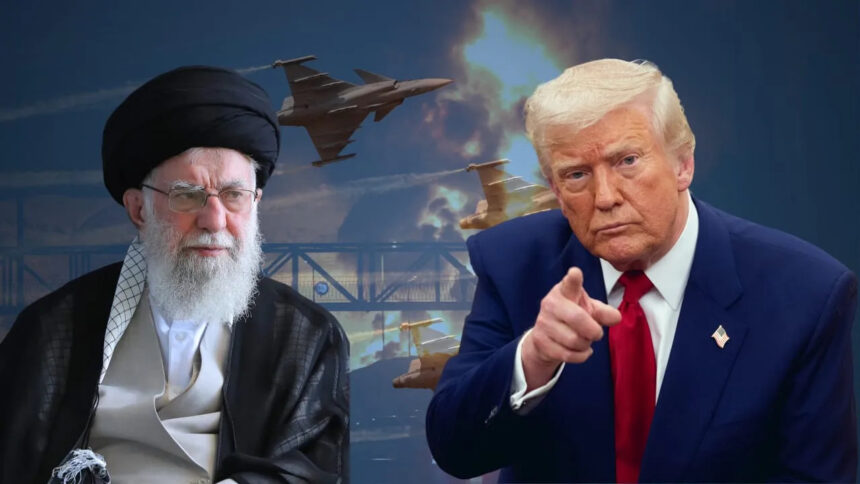
The American strike on Iran is not merely a passing military event to be read in terms of deterrence or tactical calculation. It is a revealing moment—one that exposes a deeper structure: how political truth is reproduced discursively before it is imposed on the ground. When Donald Trump addressed the Iranian people, declaring, “We are with you, and this is your opportunity to take control,” he was not simply commenting on a military operation. He was redefining its meaning. In that moment, the event ceased to be a strike against a sovereign state and became—within presidential discourse—an ethical alignment with a “people” against a “regime.” It is precisely here that Michel Foucault’s thought, as articulated in The Archaeology of Knowledge, becomes indispensable.
Foucault was less concerned with issuing moral judgments about actions than with examining the conditions that make certain actions sayable, acceptable, even necessary within a given discursive order. The question is not whether the strike was justified. The question is: how did it become possible to present it as legitimate—indeed, as moral? How did bombing become “empowerment,” intervention become an “opportunity for the people,” and regime change come to be framed as a natural response to unfolding events?
What Trump enacted was not merely conventional political rhetoric but a reordering of the foundational concepts of the international system. Sovereignty—stabilised after World War II as a legal immunity of the state—was reframed as a conditional value tied to representation of “the people.” Military intervention, once treated as a dangerous exception, was presented as an instrument of liberation. War, which he had pledged to end, was redefined so that it was no longer the problem; rather, the “regimes that generate threat” became the problem.
Here lies the paradox that provoked domestic outrage: a president who promised to end wars now stands at the centre of a new military strike. Yet a Foucauldian reading suggests that what appears as contradiction may in fact be redefinition. If war is no longer understood as military engagement per se, but as the by-product of a threat-producing regime, then striking that regime can be framed as a step toward peace rather than a departure from it.

This shift does not occur in a vacuum. The recent Munich Security Conference report pointed to the growing logic of world reordering based on power and the capacity to impose will, rather than on multilateral rules and institutions. The strike on Iran fits within this broader context, where force is not simply a tool of policy but becomes a criterion of political truth itself. When realism is defined as decisiveness, and hesitation as weakness, the standards by which actions are judged shift before the actions themselves do.
In this light, Christiane Amanpour’s warning about the “normalisation of deviation” takes on deeper resonance. It is not merely violence that becomes normalised, but the very definition of deviation that is reconstituted. When an act is repeated, justified, and framed as necessary, it moves from exception to norm, from breach to practice. Foucault would describe this as a transformation in the episteme—the underlying structure that determines what counts as rational and legitimate knowledge.
Once that epistemic ground shifts, actions are no longer measured by old standards but by new criteria produced within an emerging discourse. Yet discourse, as Foucault reminds us, does not move in a single direction. Within the United States, the meaning of “America First” has returned as a site of contestation. Does it signify retrenchment and reduced military entanglement, or does it justify pre-emptive strikes to secure the homeland? Here, power circles back upon its own prior language, and the slogan that once unified an electoral base becomes a battlefield of interpretation.
A power that redefines truth must continually reinterpret itself to avoid being undone by its own formulations. This tension is not incidental but intrinsic to the dynamics of truth production in the public sphere. What is most consequential is not simply a shift in policy but a shift in the concepts that give policy meaning. Sovereignty is no longer absolute immunity but a morally conditioned status. Peace is no longer the absence of war but the elimination of threat.
Democracy is no longer merely an electoral mechanism but a broad mandate to rewrite rules. Media truth is no longer a field of debate but a terrain of alignment, where dissent can be recast as disloyalty or weakness. When these concepts are reformulated, subsequent economic, military, and diplomatic policies follow not as abrupt departures but as logical extensions.
What the strike on Iran reveals, then, is not only a transformation in foreign policy but a reconfiguration of the relationship between power and truth. Force is not used merely to impose reality; it produces the interpretation of that reality, and that interpretation in turn regenerates the legitimacy of force. Within this circular dynamic, new “truths” emerge that redefine what is possible and acceptable in public life.
From a Foucauldian perspective, this is neither madness nor randomness but a coherent system of discursive engineering in which words precede actions, prepare the terrain for them, and render them seemingly inevitable. When the language of war, nation, enemy, and people shifts, maps are redrawn not only with bombs but with concepts.
The deeper Foucauldian question, then, is this: who holds the authority to define reality today? Who decides when bombing counts as liberation, and when peace becomes war by other means? The answer lies not solely on battlefields but within the discursive structures that make battle conceivable, intelligible, and legitimate.
What Trump is undertaking exceeds policy change; it is an attempt to reshape the truths themselves so that they align with the world he seeks to impose. The old shorthand of labeling him “reckless” or “irrational” no longer suffices. This is not impulse without awareness, but a project aimed at redefining the foundational concepts of the global political order. Policies may shift with administrations, but transformations in public discourse—in the meanings of sovereignty, rule of law, press freedom, constitutional norms, and international cooperation—leave deeper and more enduring marks.
Thus, the question of patriotism itself is reopened: does it mean withdrawal, or does it mean pre-emptive force to secure the homeland? The discourse that once unified a base can become a site of fracture—not merely because facts change, but because meanings are reconstructed. From Foucault’s vantage point, the gravest dimension of the moment is not the strike itself but the conceptual reengineering it inaugurates: sovereignty redefined as conditional, peace redefined as threat elimination, democracy redefined as a mandate to rewrite rules, and media truth reframed as a struggle of loyalty rather than legitimate debate.
When such concepts shift, subsequent policies—economic, military, diplomatic—emerge as logical continuities rather than shocks. Here philosophy precedes political analysis. Political analysis reads events; philosophical analysis uncovers the structures that produce them and anticipates their trajectories. With a leader acutely aware of how language shapes perception and directs collective consciousness, understanding discursive transformation becomes essential to understanding the future itself. What is unfolding appears not merely as a redistribution of influence, but as a prelude to redefining the architecture of the international system and the character of American governance in the years ahead.
Dr Marwa El-Shinawy – Academic and writer