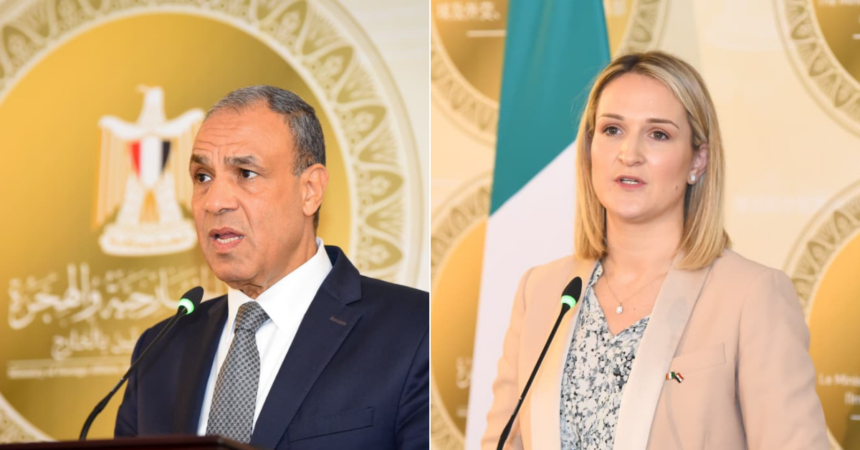
Egyptian Foreign Minister Badr Abdelatty called on Monday for the formation of a temporary Palestinian technocratic committee to manage daily affairs in the Gaza Strip and the establishment of an international stability force in accordance with UN Security Council Resolution 2803.
During political consultations in Cairo with Helen McEntee, Ireland’s Minister for Justice, Trade and Defence, Abdelatty detailed efforts to transition to the second phase of the US President’s regional peace plan. He emphasised the unity of Palestinian territories between the West Bank and Gaza, warning against any measures that would divide the Strip or undermine the two-state solution.
Abdelatty welcomed a European proposal to support Egyptian efforts in training Palestinian police elements and praised Ireland’s “principled positions” regarding the recognition of a Palestinian state and its defence of Palestinian rights in international forums.
McEntee described Egypt as a “pivotal and essential partner” for the European Union, praising Cairo’s role in supporting the Palestinian cause and its continuous efforts to achieve calm and alleviate humanitarian suffering in Gaza.
The discussions also addressed bilateral economic cooperation, with Abdelatty expressing Egypt’s desire to organise the recruitment of trained Egyptian labour to Ireland. He called for increased trade volume and Irish investment in the Egyptian market, specifically in renewable energy, telecommunications, information technology, and artificial intelligence.
The ministers reviewed the progress of relations following the visit of the Egyptian President to Dublin in December 2024, highlighting existing cooperation in education and the potential for expansion into the agricultural sector.
On regional security, Abdelatty condemned Israel’s recognition of “Somaliland,” stating the move violates international law and undermines the sovereignty and territorial integrity of Somalia. He warned that such escalation threatens stability in the Horn of Africa and the Red Sea.
Regarding Sudan, the Egyptian minister reaffirmed support for the country’s unity and national institutions, calling for an immediate humanitarian truce and a comprehensive ceasefire. He condemned “gross violations” against civilians in El Fasher and North Kordofan and stressed the need for unhindered humanitarian access.
Abdelatty also addressed the conflict in Yemen, reiterating Egypt’s support for the sovereignty of the Republic of Yemen. He advocated for a comprehensive political solution through an inclusive Yemeni-Yemeni dialogue to end the suffering of the Yemeni people and prevent further regional instability.
On the issue of water security, Abdelatty stressed that Egypt would take “all necessary measures” in accordance with international law to protect its water security. He rejected unilateral actions in the Eastern Nile Basin and called for cooperation based on international legal frameworks to safeguard the interests of all Nile Basin countries.
McEntee affirmed Ireland’s commitment to continued coordination with Egypt, noting Cairo’s vital role in maintaining regional security and stability.