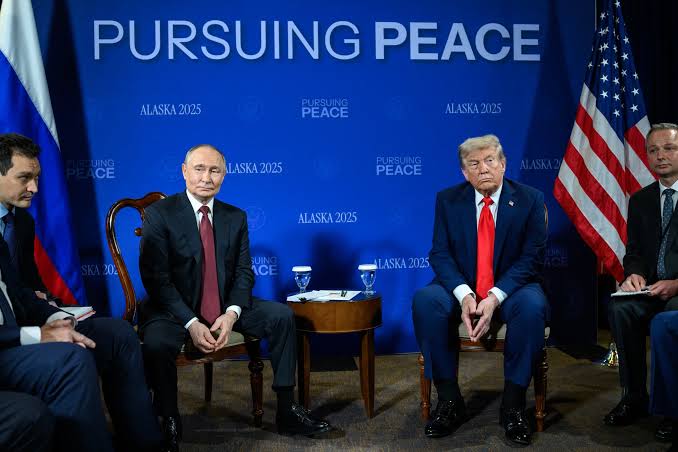
US President Donald Trump and Russian President Vladimir Putin have agreed to facilitate the entry of more than 4.8m tonnes of Russian diesel into US and global markets, bypassing recent American sanctions to lower domestic fuel costs ahead of November midterm elections.
The arrangement, confirmed following a 90-minute phone call on October 9, marks a sharp reversal of Washington’s strategy to economically isolate Moscow. To enact the deal, the US Treasury Department issued an immediate temporary license exempting Russian diesel loaded onto tankers by Friday from sanctions until April 2027. This bypasses the Lindsey Graham Act signed last month, which mandated 100 per cent tariffs on major importers of Russian energy and targeted Russia’s “shadow fleet.”
Trump announced the arrangement on his Truth Social platform following a 90-minute phone call late on October 9. “I have just concluded a highly successful discussion with President Vladimir Putin, of Russia,” the US leader wrote.
Under the agreement, Russia will supply more than 300,000 tonnes of diesel immediately, followed by 500,000 tonnes in November, 1m tonnes directly afterwards, and an additional 3m tonnes within a short period.
Russian Deputy Prime Minister Alexander Novak confirmed the immediate policy shift. “Being one of the key suppliers of diesel fuel to the global market, Russia, on its part, also immediately begins lifting restrictions on diesel exports ahead of the schedule,” Novak said.
“I want to thank President Putin. We have massive amounts of oil coming into our country, and it is the diesel that we want. So, thank you to him,” Trump said prior to a campaign rally. He did not address the war in Ukraine or sanctions in his initial remarks, stating instead that “lowering prices for Americans, especially our farmers, ranchers and truck drivers, is my highest priority.”
The average price for a gallon of diesel in the US currently stands at $6.28, down from a record $6.52 on September 22.
Sanctions exemption and domestic backlash
Following the announcement, the US Treasury Department issued an immediate temporary license allowing the supply of Russian diesel to the global market. Under the license, US sanctions will not apply until April 2027 for Russian diesel shipments loaded onto tankers by Friday. This marks the first easing of sanctions on diesel beyond the standard 30-day period since the Ukraine conflict began in February 2022.
The move bypasses the sweeping Lindsey Graham Act signed by Trump last month, which mandated 100% tariffs on the largest importers of Russian oil or natural gas, banned new US investments in Russia, and targeted Russia’s “shadow fleet” of tankers. Prior to this, the US had not imported Russian diesel since March 2022, following a ban implemented by former President Joe Biden.
Democratic lawmakers fiercely condemned the agreement. Senate Majority Leader Chuck Schumer, alongside Senators Jeanne Shaheen and Elizabeth Warren, issued a joint statement calling the move a betrayal of Ukraine, European allies, and US national security.
“Enough. The president must end his war with Iran instead of funding the Russian war machine,” the three Democrats said.
Senator Richard Blumenthal stated the decision “makes us complicit in Putin’s war against Ukraine,” adding that the deal is “a stain on our nation’s reputation, an insult to the memory of Lindsey Graham, and directly contradicts the intent of Congress in the bipartisan sanctions bill we passed.”
Representative Don Beyer described the announcement as “infuriating,” writing: “This is what everyone who was willing to listen warned about: Trump absolutely cannot be trusted when it comes to Russia.”
Ukraine settlement discussions
While Trump focused on energy, Kremlin Spokesman Dmitry Peskov stated that the majority of the phone call was devoted to a settlement in Ukraine, at the initiative of the US side.
“During the conversation, the Russian president responded with understanding to some proposals from the US side regarding steps aimed at de-escalation,” Peskov said.
Simultaneously, US Special Presidential Envoy Steve Witkoff and Trump’s son-in-law Jared Kushner met with Ukrainian, European, and NATO officials in Miami. Witkoff described the meetings as “constructive talks” aimed at de-escalating the war before winter. Discussions covered long-term security arrangements, winter preparation, grain exports, and post-war reconstruction, including Kyiv’s potential accession to the European Union.
However, Ukrainian President Volodymyr Zelensky sharply criticised the US-Russia diesel agreement, calling it “unfortunately, a weak decision from strong partners.”
“I think our team is simply being used as a smokescreen, and this is certainly not fair, and not the way partners should treat each other,” Zelensky said, asserting that the deal serves Russian interests, allows Moscow to prolong the war, and demonstrates a lack of respect for the US.
US Ambassador to the United Nations Mike Waltz confirmed the Trump administration is communicating with both Ukraine and Russia to halt attacks on grain, fertiliser, and diesel infrastructure, noting that Trump “remains absolutely determined to end this war.” Waltz indicated the US is asking Ukraine to cease certain attacks due to their impact on the global economy, pointing out that diesel powers global agriculture and aviation.
Battlefield dynamics and diplomacy
Russian Presidential Aide Yury Ushakov told reporters the call was substantive and friendly, noting that “nobody wanted to hang up first.” The call was arranged after Witkoff reached out on October 7 to convey Trump’s birthday wishes to Putin.
Despite the dialogue on de-escalation, Putin informed Trump that Russia’s goals in its special military operation remain unchanged. Ushakov stated that Kyiv’s attempts to disrupt Russian parliamentary elections had undermined the possibility of immediately resuming trilateral negotiations between the US, Russia, and Ukraine.
“Vladimir Putin spoke in detail about the measures we are taking in response to terrorist attacks by the Kiev regime, which has opted for escalation and every possible means of prolonging the conflict,” Ushakov said, adding that Putin emphasised Russian forces “have full control of the initiative and are advancing confidently.”
A Kremlin statement noted that during discussions on the global energy sector, the Russian side reaffirmed its readiness to supply oil and petroleum products, with Putin expressing confidence that it would have a positive impact on the global economy. Ushakov declined to specify whether the US offered concessions for the fuel supplies.
Iran and humanitarian cooperation
The leaders also discussed the situation regarding Iran. “Vladimir Putin specifically emphasized that diplomatic options on the Iran track have by no means been exhausted: an agreement with Tehran can and should be reached through negotiations,” Ushakov said, noting that Moscow’s offer to transfer Iran’s enriched uranium to Russia remains on the table.
Additionally, Putin thanked US First Lady Melania Trump for her contribution to reuniting children with their families in Russia and Ukraine. The leaders agreed that Russian Human Rights Commissioner Yana Lantratova will maintain regular contact with Melania Trump’s staff regarding the humanitarian situation in Alyoshki, in the Kherson Region.
Putin and Trump both expressed satisfaction with the current communication channels between their intelligence services and relevant agencies, and indicated they may hold an in-person meeting at the upcoming APEC summit in China.