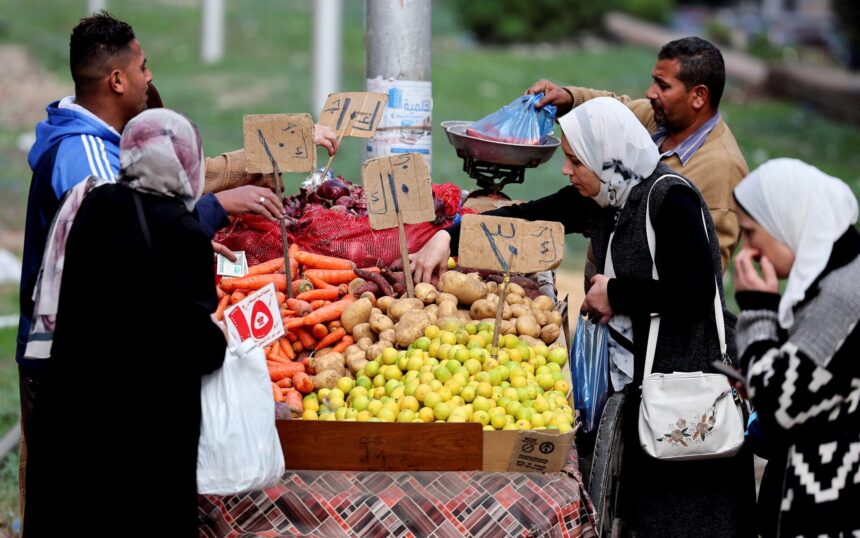
Egypt’s annual urban inflation rate fell to 13.9% in September, down from 14.5% in August 2026, according to the Central Agency for Public Mobilisation and Statistics (CAPMAS). However, monthly inflation accelerated to 1.3% in September, compared with 0.1% in August, driven primarily by higher vegetable and food prices.
In a statement issued on Saturday, CAPMAS attributed the monthly increase primarily to a 15.1% rise in vegetable prices. Prices also increased by 0.4% for grains and bread, 2.5% for meat and poultry, 1.2% for fish and seafood, 0.4% for dairy products, cheese and eggs, 0.3% for oils and fats, 2.6% for fruit, 0.2% for sugar and sugary foods, 0.3% for coffee, tea and cocoa, 0.5% for mineral and carbonated water and natural juices, and 0.1% for tobacco.
Prices also rose by 1.7% for fabrics, 0.6% for ready-made clothing, 1.8% for clothing cleaning, repair and rental services, and 1.2% for footwear.
Actual rentals for housing increased by 0.9%, while housing maintenance and repair costs recorded a similar rise. Water and miscellaneous housing-related services rose by 0.1%, while electricity, gas and other fuels increased by 0.5%.
Prices of furnishings, household equipment, carpets and other floor coverings rose by 1.1%, while household textiles increased by 0.6%. Household appliances rose by 0.4%, glassware, tableware and household utensils by 0.8%, tools and equipment for homes and gardens by 0.8%, and goods and services for routine household maintenance by 1.5%.
In the healthcare sector, prices increased by 1.2% for outpatient services and 0.7% for hospital services. Vehicle prices rose by 0.3%, while telephone and fax equipment increased by 0.4%. Cultural and recreational services rose by 0.4%, newspapers, books and stationery by 1%, ready-made meals by 0.3%, personal care by 0.7%, and personal effects by 1.2%.
By contrast, prices fell by 1.1% for audio-visual, photographic and information-processing equipment and by 0.6% for package holidays.
Annual headline inflation across Egypt as a whole reached 12.8% in September, compared with 12.7% in August, according to CAPMAS.
The Central Bank of Egypt (CBE) has revised down its inflation outlook, expecting annual headline inflation to remain stable in the third quarter of 2026 before declining gradually towards its target of 7%, plus or minus 2 percentage points, in the second half of 2027. The revised outlook reflects recent inflation developments that have been more favourable than previously expected.
In a statement issued by its Monetary Policy Committee (MPC) on 24 September, the CBE said the downward revision to its inflation forecasts would reinforce the prevailing monetary conditions, which it described as sufficiently restrictive, providing further support for the expected disinflationary path.
However, the bank warned that the balance of risks surrounding the inflation outlook remained tilted to the upside, reflecting renewed regional hostilities. These risks could affect domestic inflation through the pass-through of fiscal consolidation measures and global food price increases exceeding expectations, particularly if international energy prices remain elevated for an extended period.
On the same day, the MPC decided to keep its key interest rates unchanged at 19% for overnight deposits, 20% for overnight lending, and 19.5% for the credit and discount rate and the main operation rate.
The decision marked the fifth consecutive meeting at which the CBE had maintained rates, following similar decisions on 20 August, 9 July, 21 May and 2 April.
The CBE’s key interest rates serve as the main indicator of the short-term direction of Egyptian pound interest rates.
The MPC said its decision reflected its assessment of the latest inflation developments and outlook, alongside changes in the risks surrounding inflation. It reaffirmed that it would continue to assess monetary conditions in light of economic developments affecting the expected inflation path and the associated risks, adding that it would not hesitate to use the tools at its disposal to safeguard price stability.