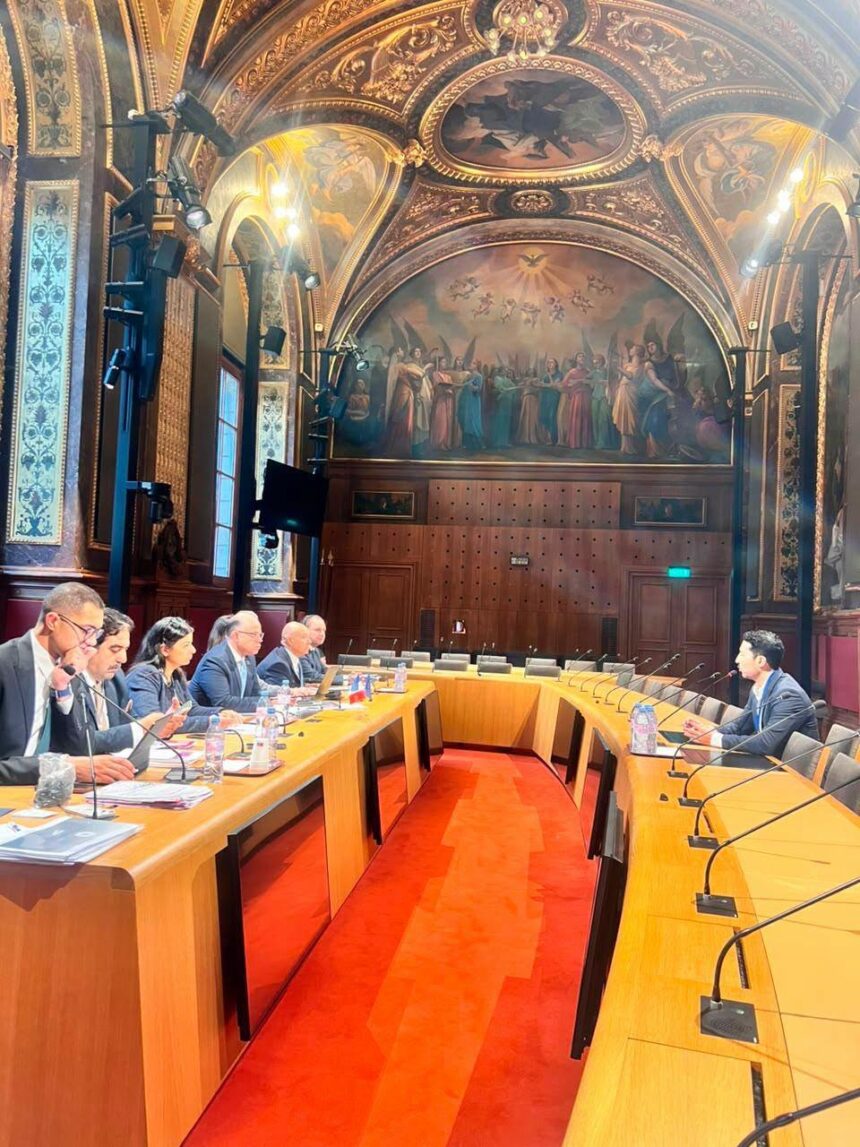
Egypt’s minister of investment and foreign trade discussed expansion and investment opportunities with six French and international companies in Paris, aiming to attract capital that adds value to the economy and connects Egyptian production to global value chains.
During the Egyptian-French Business Forum, Minister Mohamed Farid Saleh held talks with representatives from Roullier, Salins, Airbus, SEMMARIS, Mistral AI, and Rosetta Omics.
The meetings covered the companies’ respective operational areas, including phosphate industries and fertilisers, salt production and manufacturing, aviation, agricultural and food logistics, and artificial intelligence, as well as opportunities to deepen local manufacturing and increase exports.
Attendees included Jean-Christophe Roubin, director of international and public affairs at Groupe Roullier, and Bertrand Ambroise, director of international business at SEMMARIS, alongside other corporate executives.
Farid briefed the investors on the Egyptian economy’s development, noting that macroeconomic indicators are experiencing stability despite the repercussions of regional tensions. He presented the economic opportunities available across multiple sectors and the ongoing reform agenda aimed at developing the business environment, streamlining procedures, and improving the efficiency and competitiveness of investor services.
The minister emphasised that the government’s current focus is on enhancing digitalisation to improve governance and facilitate investor procedures related to incorporation, licensing, operations, production, and exporting. He added that ensuring equal opportunities—described as “leveling the playing field” for all investors—serves as a key mechanism to stimulate and attract investments.
Farid affirmed the ministry’s commitment to continuing its preparation and promotion of the Egyptian market’s investment opportunities to global companies and institutions. This includes coordinating with relevant state authorities according to the specific nature and development phase of each project, to support increased investment, production, and exports while deepening local manufacturing.