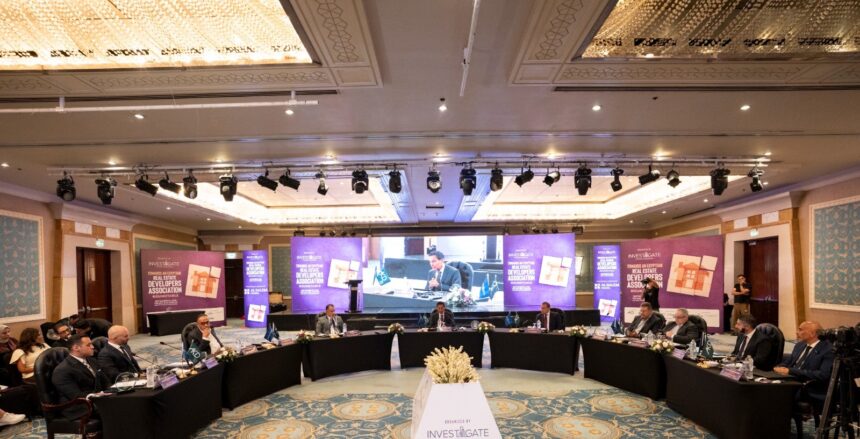
The establishment of an Egyptian federation of real estate developers is gaining momentum as developers, government officials and industry experts discuss a proposed framework aimed at strengthening regulation, governance and coordination across the country’s real estate market.
The issue was discussed during a recent industry roundtable that brought together senior government officials, developers and specialists to examine the potential role of a professional body in representing developers, supporting self-regulation and improving cooperation with government and regulatory authorities.
Invest-Gate held its 29th roundtable, titled “Towards an Egyptian Real Estate Developers Federation,” bringing together industry stakeholders to discuss the proposed establishment of a professional body for real estate developers amid the sector’s continued expansion and diversification, as well as growing challenges related to evolving regulations, rising development costs, financing constraints and changing customer expectations.
Participants said a unified professional body could provide a structured platform for dialogue with government institutions, contribute to the development of regulatory policies and establish clearer professional standards for real estate development.
The proposed federation could also support governance and transparency, facilitate knowledge and data sharing, and provide mechanisms for addressing disputes and common challenges facing developers.
Draft law under discussion
The discussions are taking place as the government works on a draft law regulating the real estate market and establishing the proposed professional body.
The draft includes provisions covering developer registration and classification, professional standards, governance, representation, customer protection and the regulation of real estate development activities. Participants discussed the appropriate structure of the federation and how it could complement the government’s regulatory role.
Amr ElKady, Founder and Managing Director of AKD Advisory, said discussions around the federation are based on three main pillars: the draft law, previous discussions and proposals concerning the federation, and Prime Ministerial Decree No. 2184 of 2022.
Khaled Sedeik, Chairperson of the Urban Development Fund, said that four years after the issuance of the 2022 decree, there is a need to determine how its provisions can be translated into a comprehensive legal framework that reflects changes in the market.
Sedeik said the real estate sector contributes around 20% of national output and therefore requires coordinated efforts from both the government and private sector to improve its efficiency.
He said the proposed federation should help regulate relationships between government authorities, developers and consumers, protect the reputation of serious developers and address practices that could negatively affect the market.
He also called for clear and fair criteria for classifying developers based on project size, financial and technical capabilities, and experience.
Developer classification and financing
Participants said a classification system could help distinguish developers according to their capabilities and experience, while providing banks and financing institutions with clearer information when assessing companies and projects.
Tarek Shoukry, Chairperson of the Real Estate Development Industry Chamber and Chairperson of the economic affairs committee at the House of Representatives, said the proposed classification system should be expanded to provide greater differentiation between developers based on their capabilities, project size and track record.
He said the federation could help regulate the market through three main areas: developer classification, buyer protection and dispute resolution.
Financing was another major issue raised during the discussions. Sedeik called for diversified financing mechanisms and for financing to be disbursed in tranches linked to project implementation rates to ensure that funds are directed towards projects that are progressing.
He also called for greater availability of real estate financing from the early stages of projects, including discussions with the Central Bank of Egypt on mechanisms suited to the needs of developers and the market.
May Abdel Hamid, CEO of the Social Housing and Mortgage Finance Fund, also highlighted the need to expand the role of mortgage finance and strengthen mechanisms that support different segments of buyers.
She noted that the number of financing entities participating in mortgage finance initiatives has increased from three or four banks at the beginning of the initiative to more than 31 financing entities.
Abdel Hamid also called for clearer market data and the development of a House Price Index, arguing that the lack of reliable data remains a challenge, particularly in promoting Egyptian real estate in international markets.
Calls for greater market transparency
Participants called for the development of a comprehensive real estate database covering market activity, prices, transactions and available units.
Tarek Azmy Elsheikh, Director of the Urban Training and Studies Institute at the National Housing and Building Research Center, said stronger legal protection, secure property titles, and the implementation of a National Real Estate Identification Number and electronic real estate registry would be important to strengthening confidence in the market.
He also called for greater oversight of project accounts, regular monitoring of construction progress and stronger financial governance to protect investors and support the entry of foreign investment funds into the Egyptian market.
Elsheikh also highlighted the importance of improving Egypt’s real estate transparency. He said Egypt ranked 61st globally in the 2026 Global Real Estate Transparency Index, compared with Saudi Arabia at 28th and Dubai at 17th.
He identified institutional regulation, the legal framework and financial safeguards as three areas requiring further development, including electronic property registration, escrow accounts, alternative dispute-resolution mechanisms and greater disclosure of market information.
Escrow accounts and buyer protection
Several participants supported the concept of separating project funds from developers’ broader financial activities to ensure that customer payments are used for their intended projects.
Raymond Ahdy, CEO of Wadi Degla, supported the idea of escrow accounts while stressing the need for mechanisms to address changes in currency values, construction costs and other project variables.
Simon Walley, Lead Financial Sector Specialist at the World Bank, discussed international experience in managing real estate market risks, citing China’s response to its property crisis.
He said the Chinese model included independent escrow accounts for individual projects, with customer funds separated from developers’ other activities. The system allows project completion rates to be monitored and provides authorities with mechanisms to respond to delays, including penalties or the replacement of developers when necessary.
Self-regulation and industry representation
Tarek ElGamal, Chairperson of Redcon Properties, said the federation should have independent funding and a continuously updated database reflecting developments in the market.
He also proposed establishing the federation as an Egyptian joint-stock company, allowing it to generate revenues that could be invested in information infrastructure and artificial intelligence technologies.
Raymond Ahdy raised questions about whether the federation should function as a regulator or a self-regulatory organisation (SRO), as well as the scope of its independence and membership.
He also called for greater clarity over whether membership would cover residential developers alone or extend to industrial and tourism developers.
The roundtable addressed the potential for the federation to support real estate exports, attract international investment, encourage innovation and digital transformation, and facilitate partnerships and knowledge exchange at regional and international levels.
Participants also linked better market transparency and stronger investor protections to Egypt’s ability to attract foreign capital.
Elsheikh said improving legal security, property registration, financial oversight and dispute-resolution mechanisms could strengthen investor confidence and create greater opportunities for international investment funds to enter the market.
At the same time, developers stressed the need for the regulatory framework to account for the financial and operational challenges of project development, including high financing costs, exchange-rate fluctuations and changes in construction costs.
Raymond Ahdy identified high interest rates and exchange-rate instability as two of the main challenges affecting real estate activity and investment costs.