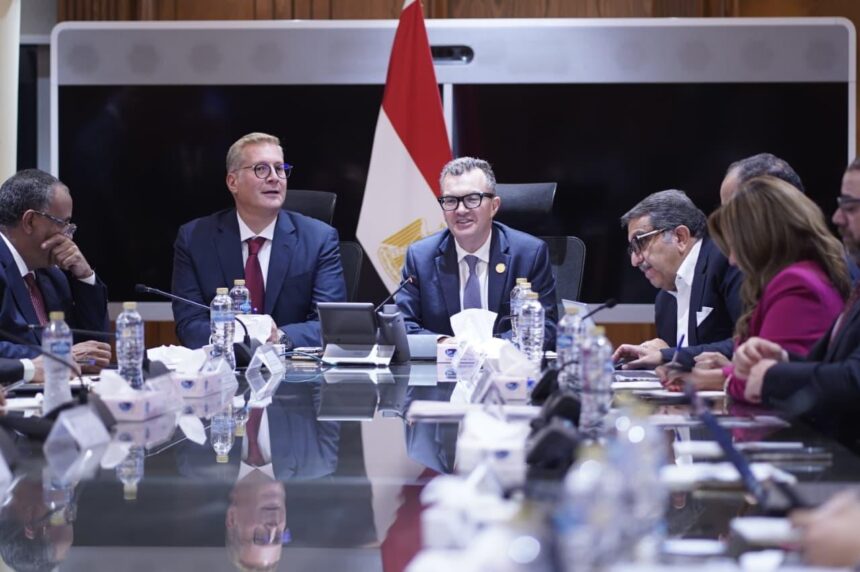
Planning and Economic Development Minister Ahmed Rostom and Petroleum and Mineral Resources Minister Karim Badawi held a meeting to review performance indicators for the petroleum sector and the latest developments in efforts to increase production and investment, as well as several issues related to improving services provided to citizens.
During the meeting, Rostom said the petroleum sector is one of the country’s vital economic sectors, given its pivotal role in meeting the domestic market’s energy needs and supporting various productive and service activities and sectors, as well as its contribution to attracting investment, increasing state resources and generating greater added value for the economy.
He stressed the importance of efforts to develop the sector and improve its production efficiency in a way that supports the national economy and contributes to achieving sustainable development goals.
Rostom praised the petroleum sector’s pivotal role in supporting the national economy and contributing to economic growth, pointing to a marked improvement in the sector’s performance and the high growth rates recorded by petroleum refining. Refining activity grew by 22.4% in the third quarter of FY2025/2026 and by 8.7% during the fiscal year as a whole.
The Planning Minister also praised national efforts to boost investment in the petroleum and energy sector and the successful payment of outstanding dues to foreign partners, which he said had helped restore confidence in the investment climate in this vital sector and paved the way for increased investment in exploration and field development, supporting higher domestic production and strengthening the sector’s ability to meet market needs.
For his part, Badawi said the petroleum sector is continuing on a positive growth trajectory and overcoming challenges, as reflected in the Planning Ministry’s indicators, with crude oil production returning to growth, petroleum refining activity expanding and the decline in gas production being brought under control in preparation for a return to growth.
Badawi said these results reflect the significant efforts of workers across the sector, noting that the payment of partners’ outstanding dues had restored the flow of investment needed for field development and exploration after the accumulation of those arrears had contributed to declining production.
He said increasing domestic oil and gas production is a top ministry priority through the development of existing fields and intensified exploration for new discoveries, with the aim of meeting the needs of citizens and state sectors and reducing imports.
Regarding services provided to citizens, Badawi said expanding natural gas connections to homes as an alternative to butane cylinders is a priority, providing a more convenient and lower-cost service and improving quality of life.
He also highlighted efforts to convert vehicles to run on natural gas and increase the number of natural gas filling stations to make the service more accessible and reduce fuel costs for motorists.
On diversifying energy sources, Badawi said the ministry is coordinating with the Ministry of Electricity to implement the state’s strategy and increase the contribution of renewable energy to electricity generation, reducing gas consumption and helping lower the gas import bill.
He added that projects to connect Cypriot gas fields to Egyptian infrastructure strengthen Egypt’s role as a regional energy hub, maximise the economic benefits from existing facilities and secure additional gas supplies for the domestic market.
The meeting also reviewed natural gas growth rates, as well as the performance of the petroleum sector, which is recording positive growth rates.
Officials also reviewed indicators for the expansion and development of vehicle fuel service and filling stations as part of efforts to improve services provided to citizens in their daily lives, keep pace with urban growth, and extend services to remote and desert areas and new communities.
The number of such stations increased from 2,900 in 2014 to 4,107 in FY2025/2026.