

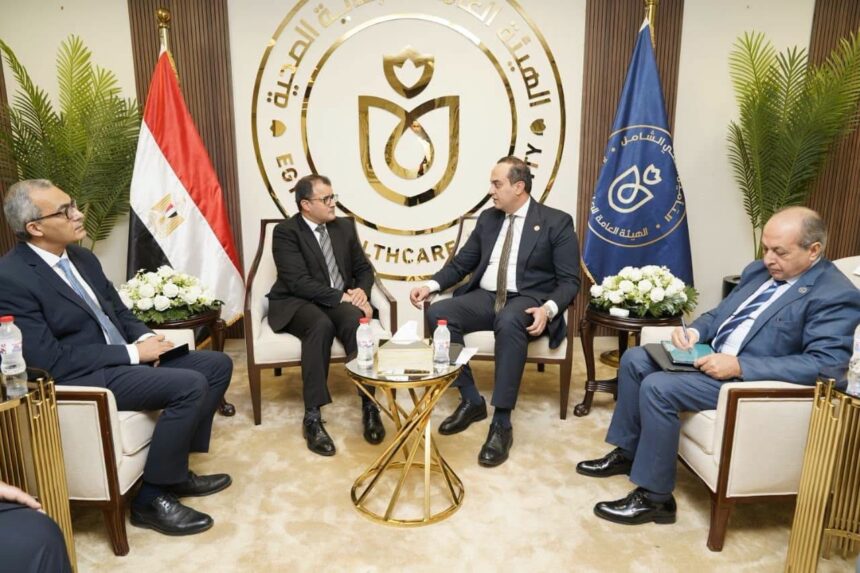
The Chairperson of the Egypt Healthcare Authority, Ahmed El-Sobky, met with Mohamed Sherif, Assistant Foreign Minister for African Affairs, to discuss strengthening health and investment partnerships with African nations, leveraging Egyptian medical capabilities to support health diplomacy and expanding medical tourism.
The talks also covered transferring Egypt’s experience in implementing its comprehensive health insurance system, with the aim of reinforcing Egypt’s presence on the continent and opening new avenues for cooperation.
El-Sobky highlighted the authority’s readiness to launch a package of initiatives supporting healthcare in Nile Basin countries and the Horn of Africa through alliances with a number of Egyptian investors and by drawing on existing Egyptian projects across the continent.
He said these efforts would build on Egypt’s expertise in managing and operating health facilities, governance, quality standards and digital transformation, supporting the transfer of Egypt’s comprehensive health insurance model and building the capacity of African medical personnel according to each country’s needs.
He also pointed to the authority’s virtual hospital, described as the first of its kind in Africa and the largest in the Middle East, as a strategic tool for supporting Egyptian initiatives on the continent. The facility offers remote specialist medical consultations, training and expertise exchange, and links African health institutions with Egyptian medical expertise.
On medical tourism, El-Sobky said the two sides had reached preliminary agreement on preparing a joint working paper, in coordination with the Ministry of Foreign Affairs, to launch a programme for treating African patients in Egypt at discounted rates under the “We Care for You in Egypt” initiative.
The paper would identify priority markets and medical services and explore mechanisms for training and transferring Egyptian expertise to fellow African nations.
For his part, Ambassador Sherif said medical and economic diplomacy represent two key pillars for strengthening Egyptian-African partnerships, stressing the importance of tailoring development and investment opportunities to each region’s economic and social characteristics and linking them to Egyptian capabilities and expertise.
He also reviewed opportunities to build on existing economic ties and Egyptian projects in Africa to expand cooperation in the health sector.
He noted that the distinction of Egyptian medical services and the historical standing of its health and educational institutions across Africa offer wide opportunities to attract patients and develop relationships with African health institutions. He underscored the importance of building an international marketing identity for Egyptian medical services to highlight their competitiveness in target markets.
Achieving these goals, he added, would require integrated institutional coordination to ease visa and travel procedures, improve air connectivity, and provide comprehensive treatment and accommodation programmes to facilitate the movement of patients and medical expertise between Egypt and African countries.
The two sides agreed in principle to prepare a joint working paper identifying priority countries and markets, mechanisms for implementing the discounted treatment programme, coordination with Egyptian embassies to facilitate patient arrivals, and training pathways.
The paper will also outline the expansion of health and investment alliances, including deploying the virtual hospital for consultations and capacity-building, with implementation phased according to the needs of target countries.


