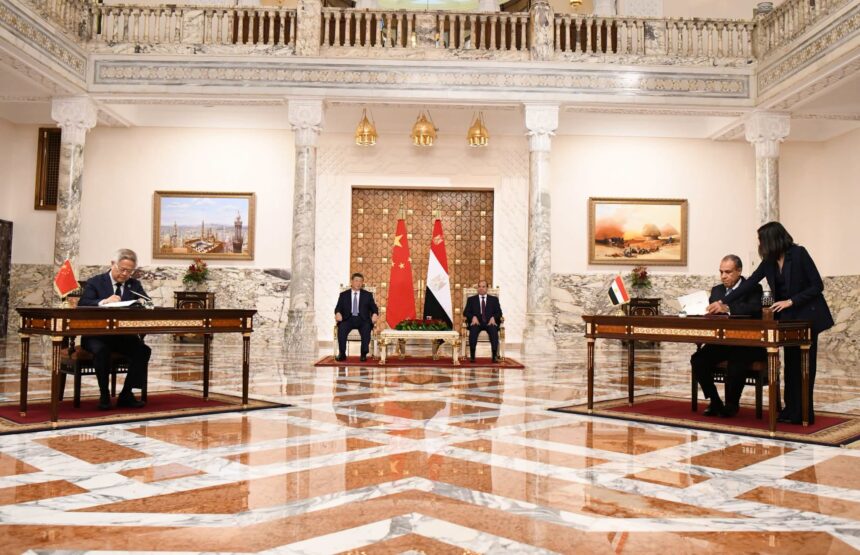
Egypt and China have agreed to launch the third phase of the Egyptian-Chinese industrial zone in the Suez Canal Economic Zone and increase their local currency swap agreement, the two nations announced during a state visit by Chinese President Xi Jinping.
“I take this opportunity to announce the agreement to launch the third phase of expansions of the Egyptian-Chinese industrial zone in the Suez Canal Economic Zone, which launches a new phase of business in key sectors such as renewable energy, automobile manufacturing, textiles and chemical fibres,” Egyptian President Abdel Fattah al-Sisi said at the start of bilateral talks.
Xi committed to encouraging Chinese companies to increase their investments in the Egyptian market, citing its strategic location, and pledged to continue transferring technical expertise in infrastructure, energy, manufacturing and agriculture.
According to a joint statement outlining the Executive Programme of the Comprehensive Strategic Partnership (2024-2028), the countries will align Egypt’s Vision 2030 with China’s Belt and Road Initiative. The stated goal is to transform Egypt into a regional hub for industry, logistics, clean energy and the digital economy connecting Asia, Africa and Europe.
The two sides agreed to actively explore localising industries, specifically highlighting electric vehicles, shipbuilding, solar panels, wind towers, and water desalination. The partnership will also expand into advanced technologies, including cloud computing, data centres, the data-based economy, semiconductors, cybersecurity, space applications, remote sensing, and critical mineral supply chains.
To support these joint initiatives, the leaders welcomed the renewal and increased value of their bilateral currency swap agreement, encouraging further settlement of trade and investment transactions in local currencies.
The joint statement highlighted ongoing financial cooperation, such as the issuance of Chinese Panda bonds, and urged financial institutions in both countries to back investments in industrial development, infrastructure, and the green and digital transitions.
Addressing trade relations, Egypt and China agreed to work toward a more balanced trade relationship by continuing consultations on an “early harvest” agreement. This aims to facilitate the entry of more Egyptian products into the Chinese market in accordance with Chinese standards. In this context, Egypt praised recent Chinese measures to exempt African countries from customs duties.
Beyond heavy industry and finance, the nations pledged to expand cooperation in tourism—including hotel construction and resort management—alongside enhanced ties in media, culture, higher education, scientific research and youth exchanges.