

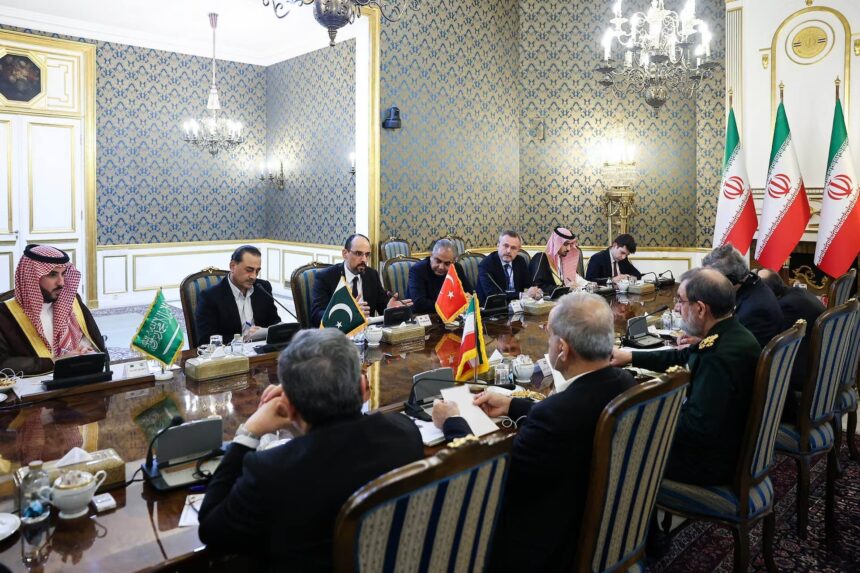
Top defence officials from Saudi Arabia,Turkey, and Pakistan met with Iranian leaders in Tehran on Monday to de-escalate the ongoing crisis between the United States and Iran and prevent further military confrontation.
Saudi Defence Minister Prince Khalid bin Salman, Pakistani Army Chief Marshal Asim Munir, and Turkish Intelligence Chief Ibrahim Kalin held meetings with Iranian officials, including President Masoud Pezeshkian and National Security Chief Mohsen Rezaei.
The talks represent the first high-level contact between Iran and the three nations since a war sparked by US and Israeli strikes on Iran in February spread to Saudi Arabia and Yemen. The meetings also follow the escalation of attacks against Saudi targets last month by Yemen’s Iran-backed Houthis.
The Tehran meetings occur amid fears of a fresh US-Israeli offensive, with speculation growing that US President Donald Trump could order new strikes on Iran after next week’s midterm elections.
The Makkah Pact, signed in August, is a mutual defence pact stipulating that an attack on one member is deemed an attack on all. The coalition unites Pakistan’s nuclear capabilities, Turkey’s military strength, and Saudi Arabia’s financial resources.
Saudi Foreign Ministry official Rayed Krimly announced on the X platform that the meetings aim to lower tensions,encourage diplomatic solutions, and support mediation efforts by Qatar and Pakistan. Pakistan has served as a key intermediary between Washington and Tehran since the war began.
A statement from the Saudi Foreign Ministry described the visit as an extension of the Kingdom’s role in establishing regional peace. The ministry stressed the importance of opening negotiation channels to prevent a return to military escalation, paving the way for an agreement to end the crisis and achieve security.
A senior Pakistani security official said the primary focus of Monday’s meeting was to build a regional non-aggression network. The official noted the agenda also included US-Iran talks, Houthi attacks on Saudi Arabia, the Strait of Hormuz,and a US blockade of Iranian ports.
Iranian Foreign Ministry spokesperson Esmaeil Baghaei told reporters that the meeting, which was proposed when Munir visited Tehran last week, could serve as a first step towards establishing regional security mechanisms. Baghaei said discussions would include Israel’s expansionist policies, developments in the Palestinian territories and Lebanon, and the repercussions of US and Israeli military action against Iran.
An Iranian official stated there would be no discussion of Iran’s nuclear programme at the meeting. The official said the issue would not be addressed until Tehran’s demands for ending the war are met, which include ending the US blockade of Iranian ports and lifting sanctions on Iranian oil exports. Conversely, US Vice President JD Vance has stated that Iran must reduce nuclear enrichment to end the war.