

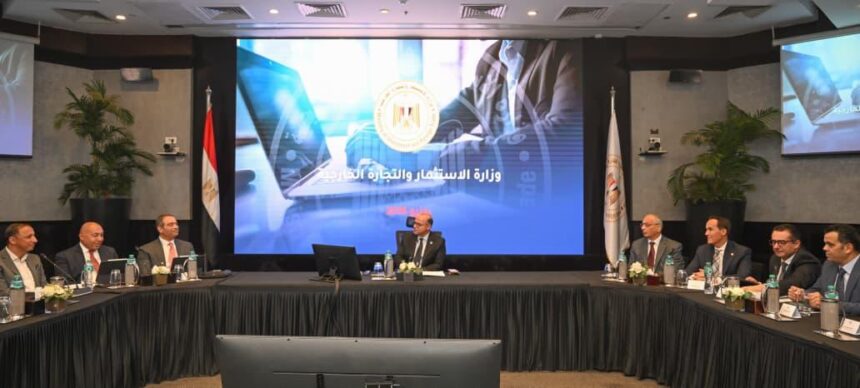
Egypt’s Minister of Investment and Foreign Trade, Mohamed Farid, met with members of the Egyptian Private Equity and Venture Capital Association (EPEA) during the association’s Capital Call initiative to discuss the government’s investment reform agenda and private-sector priorities.
The session brought together representatives from more than 50 investment, financial, and banking institutions to explore measures aimed at strengthening Egypt’s investment climate, boosting competitiveness, and accelerating economic growth.
The meeting, attended by over 60 participants representing more than 15 strategic sectors—including private equity, venture capital, banking, investment banking, industry, automotive, fintech, healthcare, education, energy, logistics, consulting, and asset management—underscored the government’s commitment to maintaining an open and continuous dialogue with the private sector.
Discussions focused on three key pillars: the legislative and regulatory framework governing investment; financing tools and mergers and acquisitions; and opportunities to deepen public-private partnerships in priority economic sectors.
Speaking during the event, Farid said the government is working to build an investment environment based on trust, where the private sector is viewed as a key partner in achieving sustainable growth. He noted that investment policies are being developed in alignment with both investors’ needs and the state’s development priorities.
“The government’s relationship with the private sector is a genuine partnership aimed at building a stronger and more competitive economy,” Farid said. “Together, we can achieve higher growth rates, create more jobs, and enhance Egypt’s economic competitiveness.”
The minister highlighted ongoing efforts to improve the business environment by simplifying procedures, reducing administrative burdens, and increasing predictability for investors. He stressed that many of the challenges facing businesses stem from implementation issues rather than legislative shortcomings.
As part of the government’s digital transformation agenda, Farid announced progress on the development of the Economic Entities Platform, a unified digital gateway that will streamline company incorporation, licensing, approvals, and follow-up procedures through a single electronic system. The platform aims to eliminate duplication, accelerate processes, and improve the overall investor experience.
On state asset offerings, the minister said the government would continue implementing its privatization and state ownership program gradually, based on market conditions and the readiness of each company.
Farid also emphasized the importance of strengthening equity-based financing mechanisms and reducing reliance on debt instruments. He revealed plans to launch several specialized investment funds, in cooperation with Egypt’s sovereign wealth fund, to support industry, sports talent development, and startups.
Addressing structural challenges in the financial market, the minister pointed to the limited number of domestic institutional investors as a key obstacle to market depth and sustainable capital formation. He stressed the need to expand and diversify the local institutional investor base to better support private equity, venture capital, and long-term investment activity.
The minister further announced a review of several technical and regulatory issues of concern to investors—including preferred shares, shareholder agreements, and modern financing instruments—with the aim of removing unnecessary restrictions and improving market flexibility.
Regarding Egypt’s regional expansion strategy, Farid said the government is encouraging private-sector investments across Africa, particularly in education, healthcare, and logistics, while working to strengthen logistics infrastructure and facilitate access to African markets.
He also highlighted efforts to modernize Egypt’s export development strategy by diversifying support mechanisms, improving product quality, increasing awareness of export opportunities, and enhancing exporters’ access to information through the recently launched Foreign Trade Information Portal.
The minister pointed out that the draft law governing International Financial Centers is currently under parliamentary review and is expected to create a business environment aligned with international standards, enhancing Egypt’s attractiveness as a regional financial and investment hub.
Participants concluded the meeting with a series of recommendations aimed at strengthening Egypt’s investment environment. Key proposals included setting clear approval timelines for healthcare and education projects, accelerating the digitalization of capital increase procedures, improving transparency around the state offering program, and streamlining approvals for data centers.
They also called for faster implementation of solar energy projects in industrial zones and the development of comprehensive market intelligence databases to support Egyptian companies seeking expansion opportunities across Africa.
Farid reaffirmed the ministry’s commitment to maintaining regular consultations with the business community to further strengthen Egypt’s investment environment and attract both local and foreign investment.


