

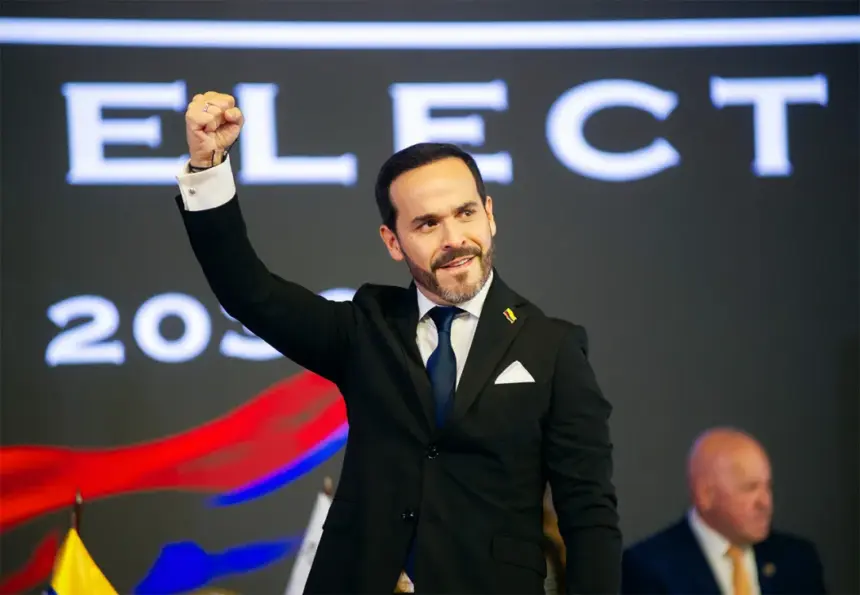
New right-wing Colombian President Abelardo de la Espriella was sworn into office on Friday, vowing in his inaugural address to launch a fierce crackdown on drug trafficking, end peace talks with armed groups, and implement strict austerity measures to restore economic confidence.
De la Espriella, 48, an ally of US President Donald Trump, is a political newcomer who previously worked as a lawyer representing well-known right-wing paramilitary groups. He succeeds leftist Gustavo Petro after narrowly winning a June runoff election against leftist Senator Ivan Cepeda, running on pledges to fight armed groups, slash the government’s size by up to 40 per cent, and revive the oil and gas sector.
His election forms part of a broader right-wing shift across Latin America, where weakened economies and rising crime in countries such as Peru, Argentina, Chile, Ecuador, Bolivia, and Panama have altered voter priorities, propelling once-fringe far-right candidates to power amid a global surge in right-wing nationalism.
De la Espriella blamed Petro for the expansion of armed factions, pledging to deliver a tougher military response and construct mega-prisons. Petro has not recognised the election result and called for rallies in major cities.
Inauguration and Hardline Pledges
Breaking with over a century of tradition, De la Espriella became the first Colombian president to take the oath of office outside the Congress building in the capital, Bogota. The ceremony was held amid heavy security at a university auditorium in the southwestern city of Cali. He later addressed assembled troops at the nearby Pichincha military base.
“I have come to turn a long chapter of national surrender, and to begin with the people the deepest transformation of our destiny,” De la Espriella said during his 75-minute speech. “I am sending a firm message to the Colombian people: it is time to restore order, authority, and freedom.”
He presented criminal gangs and drug-linked terrorist groups with two options: “Submit to the rule of law or face the firm response of the Colombian state and its security forces,” declaring that the option of peace talks was “completely exhausted.”
“It is time to permanently eradicate the scourge of illicit crops,” he continued, announcing plans to use aerial spraying with herbicides that do not harm human health or the environment to destroy coca. Furthermore, he noted that one of his first acts as president would be joining the “Americas Shield” programme established by Trump.
In June, Trump congratulated De la Espriella on his election via the Truth Social platform, writing: “I congratulate ‘El Tigre’ (The Tiger) Abelardo de la Espriella on his election as the new President of Colombia. It has been a great honour to endorse him, and I look forward to working with him to build a strong relationship between Colombia and the United States of America, bringing new levels of prosperity and progress to both countries.”
Economic Reforms and Dignitaries
On the economy, the new president committed to freezing public spending and pursuing tax reform to simplify the country’s payments system and boost investment and employment, while retaining some popular social programmes introduced by Petro.
“I want to tell business leaders in Colombia, large, medium, and small, that this government will be your partner in investing in Colombia,” he said. “Once again, it will be a safe and profitable decision for you.”
Investors have broadly welcomed his market-friendly platform, though expectations of swift change are tempered by financial constraints and high public debt. The head of the stock exchange has urged measures to facilitate the participation of foreign and retail investors, reduce transaction costs, abolish dividend taxes, and increase the publicly traded float of the state energy company Ecopetrol to 20 per cent.
Meanwhile, oil and mining unions expressed optimism but stressed the need for rapid changes for Colombia to boost gas production and address other urgent needs. A Thursday report by the consultancy Colombia Risk Analysis suggested the new administration would focus heavily on security and anti-corruption efforts during its first 100 days.
The inauguration was attended by international dignitaries including King Felipe VI of Spain, and the presidents of Argentina, Ecuador, and Chile. The United States sent a delegation led by Acting Attorney General Todd Blanche.
