

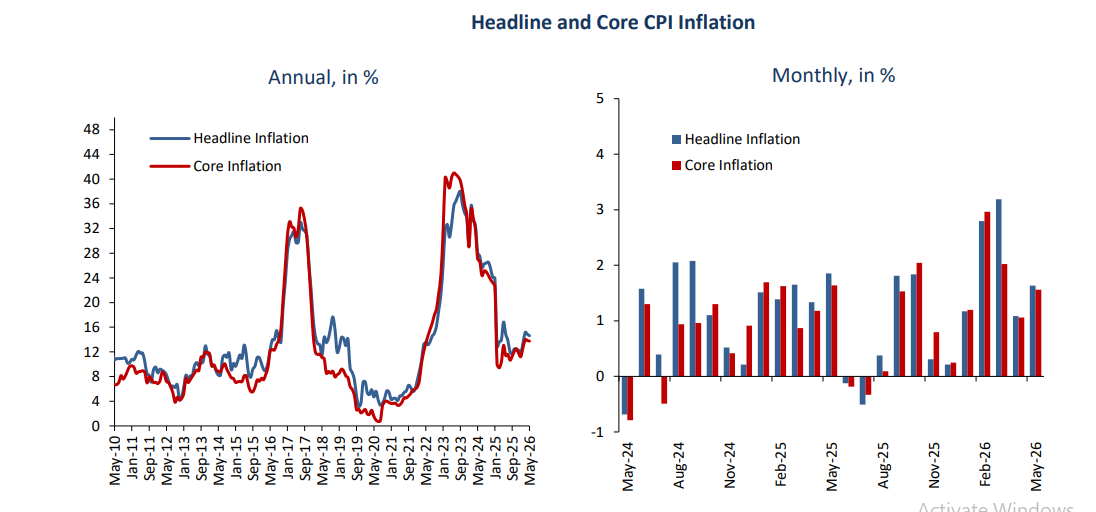
Annual urban headline inflation edged down to 14.6% in May 2026 from 14.9% in April, according to the Central Bank of Egypt (CBE). The slight moderation was primarily driven by a slowdown in non-food inflation, which eased to 19.1% from 20.1% over the same period, supported by a favourable base effect.
The decline in non-food inflation more than offset an increase in food inflation, which rose to 7.6% in May from 6.7% in April, reflecting the seasonal impact of Eid Al-Adha and heightened volatility in fruit and vegetable prices.
On a monthly basis, urban headline inflation accelerated to 1.6% in May, compared with 1.1% in April and 1.9% in May 2025. The increase was largely driven by food items—particularly poultry, meat and fruits—as well as selected non-food components, including household electricity consumption, rents, and ADSL and mobile internet services.
Annual core inflation remained unchanged at 13.8% in both May and April 2026, as higher core food inflation was offset by lower retail inflation, while services inflation remained broadly stable. Meanwhile, monthly core inflation rose to 1.6% in May from 1.1% in April, matching the rate recorded in May 2025. The increase was mainly driven by services and core food items, in line with seasonal demand associated with Eid Al-Adha.
Annual rural headline inflation declined to 11.4% in May from 12.0% in April. Consequently, annual nationwide headline inflation—calculated as a weighted average of urban and rural inflation—slowed to 13.0% from 13.4%.
Key drivers of monthly inflation in May 2026
Monthly food inflation reached 2.4%, contributing 0.86 percentage points (p.p.) to headline inflation. The increase was mainly driven by:
- Volatile food prices, which rose by 6.7% and contributed 0.45 p.p. to monthly inflation. Fresh fruit and vegetable prices increased by 14.9% and 2.6%, respectively, both exceeding their typical seasonal patterns.
- Core food prices, which increased by 1.5%, contributing 0.42 p.p. The rise was largely attributable to higher prices for beef (2.8%), poultry (5.2%), and seafood (2.1%), which together contributed 0.44 p.p. to headline inflation, reflecting stronger seasonal demand during Eid Al-Adha. By contrast, egg prices declined by 8.2%, subtracting 0.11 p.p. from inflation, in line with their usual seasonal pattern.
Monthly non-food inflation recorded 1.2% in May, contributing 0.77 p.p. to headline inflation. This was mainly driven by:
- Services inflation, which rose by 1.7%, supported by increases in rents, ADSL and mobile internet charges, and spending at restaurants and cafés. Services contributed 0.51 p.p. to monthly headline inflation.
- Retail inflation, which increased by 1.4%, contributing 0.20 p.p. This reflected higher prices for clothing and footwear, household cleaning products, and personal care items.
- Regulated items inflation, which stood at 0.3%, contributing 0.07 p.p. to headline inflation. The increase reflected a 2.1% rise in household electricity tariffs announced in April, alongside a modest increase in tobacco prices.
Monthly core inflation reached 1.6%, reflecting the combined impact of these developments. Services contributed 0.71 p.p. to monthly core inflation, while core food and retail items added 0.58 p.p. and 0.28 p.p., respectively.
Key drivers of annual inflation in May 2026
Annual food inflation accelerated to 7.6% in May from 6.7% in April, contributing 2.99 p.p. to annual headline inflation. The increase was driven by:
- Volatile food prices, which rose by 25.8% year-on-year, contributing 1.65 p.p. to annual headline inflation. Unlike the monthly trend, this increase reflected higher vegetable prices compared with a year earlier, partly offset by lower fruit prices.
- Core food inflation, which increased by 4.4%, contributing 1.34 p.p. to annual headline inflation. The rise was mainly driven by higher prices for beef, seafood and dairy products, despite declines in egg and sugar prices.
Annual non-food inflation eased to 19.1% in May from 20.1% in April, contributing 11.64 p.p. to annual headline inflation. This was driven by:
- Services inflation, which rose by 25.5% year-on-year, contributing 6.92 p.p. to annual headline inflation. Increases in rents, spending at restaurants and cafés, private transport fares and medical services were the main contributors. However, these were partly offset by lower costs for Hajj and Umrah trips, which typically rise ahead of the pilgrimage season before easing afterwards.
- Regulated items inflation, which recorded 14.2%, contributing 3.04 p.p. to annual headline inflation. The increase reflected higher prices for tobacco products, liquefied petroleum gas (LPG), natural gas, public transport fares, petroleum fuels and electricity.
- Retail inflation, which reached 11.5%, contributing 1.68 p.p. to annual headline inflation. The increase was driven by higher prices for clothing, personal care products, household cleaning products, books and automobiles.
Annual core inflation remained stable at 13.8% in both May and April, reflecting the combined impact of the aforementioned components. Services and retail items contributed 9.58 p.p. and 2.32 p.p. to annual core inflation, respectively, while core food inflation accounted for 1.85 p.p. of the overall reading.


