

It is no longer possible to view the wars raging across the world as separate crises linked only by temporal coincidence. The international landscape reveals clear interconnections among most conflict flashpoints, as if they were pieces of a single tableau reflecting the profound transformation underway in the international system. The map of contemporary conflicts appears more akin to interlocking rings within a broader process of reshaping the balance of power inside the international order. The protracted crises stretching from the Middle East to Eastern Europe, and from the Red Sea to the Indo-Pacific region, can no longer be understood solely through their local contexts; they are increasingly bound up with the strategic rivalry among the major powers and with the struggle over influence, resources, technology, supply chains, and, most importantly, the arms industry itself. At the center of these interconnected crises stands the United States, whose actions have generated concrete links between otherwise disparate regions.
For example, Washington’s military aid to Ukraine has not only affected the balance of power in Eastern Europe but has also influenced global energy prices, strained relations with China, and led to corresponding increases in American military deployments in East Asia. In the Middle East, US support for Israel amid the war in Gaza has provoked reactions from Iran and its regional allies, whose responses have disrupted maritime security in the Red Sea and drawn American naval forces further into the region, complicating the US strategic position vis-à-vis Russia and China. Similarly, American efforts to strengthen security partnerships in the Indo-Pacific, such as through the AUKUS alliance and increased arms sales to Taiwan, have heightened tensions with Beijing and contributed to a global environment in which crisis theatres resonate with one another.
Since the end of the Cold War and the United States’ emergence as the sole leader of the global system, Washington has never ceased employing military force, economic sanctions, or security alliances to preserve its strategic position. This interweaving of military, economic, and diplomatic actions creates feedback loops that connect local wars with wider shifts in the international system. As a result, a growing number of scholars of international relations now ask whether American foreign policy contributes to containing crises or to producing and managing them in a manner that ensures the continuation of American hegemony.
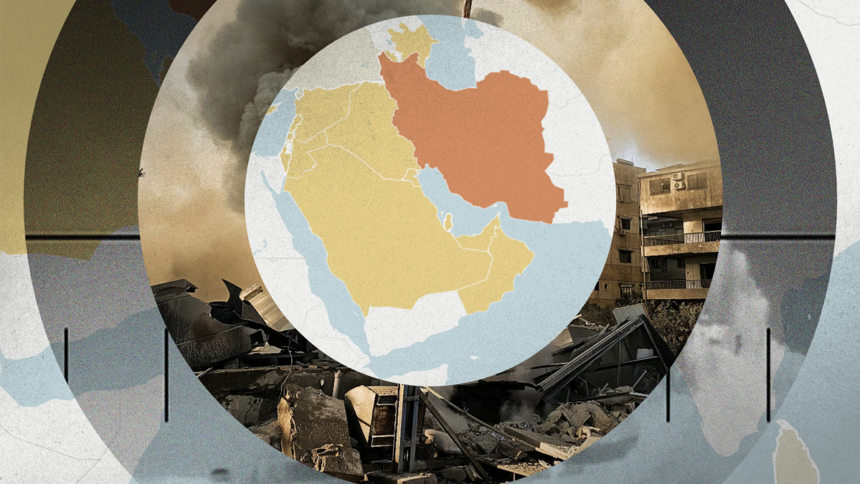
If the Middle East today represents the world’s most volatile region, recent developments indicate that the area has entered a phase entirely different from that which it knew in previous decades. After years of managing conflict through proxies, the confrontation between Iran and Israel has become more direct, and the Arabian Gulf has transformed from a mere logistical support arena and network of military bases into a central element in the regional deterrence equation. Recent events have demonstrated that any escalation between Tehran and Israel is no longer confined to the two parties; its effects rapidly extend to the security of navigation in the Gulf and the Red Sea, to global energy markets, and to the American military presence deployed across the region. Moreover, the United States’ reliance on its network of bases and defensive alliances in the Gulf means that any large-scale confrontation is capable of drawing in other regional actors, whether directly or through existing security commitments, thereby raising the probability that any limited war could escalate into a broad regional crisis that would be difficult to contain.
This perspective becomes clearer when examining the war in Gaza, which is no longer merely a confrontation between Israel and the Palestinian factions but has become part of a wider network of regional and international competition. Since the outbreak of the war, the United States has provided Israel with unprecedented military, political, and intelligence support, has dispatched aircraft carriers and additional forces to the region, and has used its diplomatic influence to shield its ally in international forums. Reports by the Congressional Research Service and the Council on Foreign Relations have documented the scale and evolution of this support, affirming that the American-Israeli relationship constitutes one of the most firmly established strategic alliances in American foreign policy. Critics of this policy argue that such support has not only enhanced Israel’s military capabilities but has also contributed to prolonging the war and diminishing the prospects of reaching a political settlement, while expanding the scope of the conflict to encompass fronts in Lebanon, Syria, Iraq, Yemen, and the Red Sea.
As the circle of confrontation widens, the Arabian Gulf is no longer insulated from the repercussions of the conflict; rather, it has become one of its most critical keys. The presence of major American bases, air-defense systems, and oil and gas export routes has made Gulf security an integral component of American national security. Conversely, Iran regards this military deployment as a strategic pressure factor that encircles it from the south, which explains the rising tensions linked to maritime corridors, the Arabian Sea, and the Strait of Hormuz. With every round of escalation, fears increase that the Gulf states—even if unwilling to enter the war—may become parties to it by virtue of geography and existing military alliances, potentially transforming the nature of the conflict in the Middle East from a limited dispute into a regional confrontation with global ramifications.
The Russian-Ukrainian war has revived one of the oldest debates in international relations: Was the war the result of a unilateral Russian decision, or did it follow years of Western policies that disregarded Russian warnings? Here, the name of the American political scientist John Mearsheimer, one of the foremost theorists of the realist school, comes to the fore. He sparked widespread controversy with his famous 2014 article “Why the Ukraine Crisis Is the West’s Fault.” After the outbreak of the war, he reaffirmed in his writings and lectures that NATO’s eastward expansion, together with increasing Western military and political support for Ukraine, created a strategic environment that Moscow perceived as an existential threat. In his article “Playing with Fire in Ukraine,” Mearsheimer warned that the continuation of these policies could lead to a catastrophic confrontation with Russia, arguing that disregarding the security interests of great powers is a sure recipe for war.
This argument is not confined to Mearsheimer alone. A study published in the Springer journal International Politics entitled “NATO Enlargement and US Grand Strategy” concluded that NATO expansion did in fact contribute to the deterioration of American-Russian relations, even if it was not the sole factor behind the outbreak of the war. Likewise, a study issued by SOAS University of London entitled “Ironclad US Commitment to NATO?” argued that the Ukrainian crisis represents the cumulative outcome of thirty years of Western policies that gradually pushed Russia toward a sense of strategic encirclement. These studies do not absolve Russia of responsibility for its decision to use force; rather, they reject the interpretation that places the entire burden on one party while ignoring the geopolitical context that preceded the war.
In the same vein, the researcher Florian Zollmann draws attention to another dimension of no less importance: the role of Western media in shaping the dominant narrative. In his study published in the journal Media, War & Conflict entitled “A War Foretold,” Zollmann contends that a substantial portion of Western media marginalized the discussion of NATO expansion and its impact on the crisis, focusing almost exclusively on the official Western narrative, thereby narrowing the space for public debate about the structural causes of the war.
When one turns to the wider map of the world, a more expansive picture of simultaneous conflicts emerges—conflicts in which the United States has so far been the primary beneficiary. Sudan is enduring one of the most complex civil wars of the modern era; Libya continues to suffer political and military division; the Sahel region of Africa is witnessing a surge in coups and armed conflicts—all of which reinforce the American presence. Meanwhile, confrontations persist in eastern Democratic Republic of the Congo over strategic mineral wealth. In the Red Sea, freedom of navigation has become an issue of international security, through which the United States has strengthened its military and naval presence to protect strategic waterways and maintain its influence over one of the world’s most important trade routes.

In Asia, the Taiwan Strait remains the most dangerous flashpoint of rivalry between the United States and China. Washington regards the strengthening of its military and political ties with Taipei and the intensification of its naval presence in the western Pacific as part of a deterrence policy. At the same time, Beijing sees these moves as a violation of the “One China” principle and an attempt to contain its strategic rise—thereby increasing the likelihood of friction between the two powers. The South China Sea continues to witness American freedom-of-navigation operations and the growth of security alliances such as AUKUS, together with enhanced cooperation with Japan, South Korea, and the Philippines—policies that many realist scholars interpret as part of an American containment strategy toward China. At the same time, Beijing regards them as provocative steps aimed at limiting its regional influence. In addition, the Korean Peninsula remains one of the arenas where American-Chinese competition intersects with the security calculations of North Korea, rendering East Asia as a whole one of the regions most susceptible to shifting from strategic rivalry to confrontation should deterrence equations break down.
Viewed from a broader perspective, it becomes difficult to ignore that American foreign policy has frequently been driven more by the logic of preserving global hegemony than by the management of crises themselves. In his celebrated book The Tragedy of Great Power Politics, Mearsheimer explains that great powers do not act primarily out of moral principles but according to calculations of power and the maximization of influence—an explanation that accounts for the behavior of the United States as well as that of Russia and other major powers. The American scholar Stephen Walt, in his book The Hell of Good Intentions, argues that post-Cold War American foreign policy has been characterized by a clear excess of military intervention and attempts to reshape states by force, often producing counterproductive results that weakened regional stability rather than strengthened it. The American historian Andrew Bacevich, in his book America’s War for the Greater Middle East, adds that the series of wars waged by the United States in the Middle East since the 1980s failed to achieve their stated objectives and instead contributed to successive cycles of instability and violence whose effects spread across most of the region.
From another angle, the persistence of these crises confers upon the United States a set of strategic gains that several researchers discuss, including the preservation of its leadership role within NATO, the reinforcement of allies’ dependence on the American security umbrella, the increase in global demand for the American arms industry, the consolidation of military presence along vital maritime corridors, and the acquisition of greater influence over energy markets and global supply chains. This does not mean that these gains are achieved without cost; the United States also bears substantial financial, military, and political burdens. Nevertheless, many scholars maintain that the continuation of international tension ultimately enhances Washington’s geopolitical position relative to its competitors.
No understanding of this picture is complete without addressing the economic dimension. More than six decades ago, President Dwight Eisenhower, in his farewell address of 1961, warned of the growing influence of what he termed the “military-industrial complex,” cautioning that the interpenetration of military institutions and arms manufacturers could steer foreign policy in ways that serve long-term economic and political interests. That address has become one of the most frequently cited texts in the study of international relations, particularly in light of the continued record rise in global military expenditure, which is documented annually by reports of the Stockholm International Peace Research Institute (SIPRI). These reports show that the United States still leads the world in military spending and arms exports, and that American companies occupy the top ranks among the world’s largest arms producers.
Nevertheless, reducing the global scene to the notion that the United States alone stands behind all wars would be an oversimplification lacking in accuracy. Russia bears responsibility for its decision to invade Ukraine; Israel is responsible for its military choices in Gaza; Iran bears responsibility for its regional policies; and other regional and international powers participate to varying degrees in fueling conflicts. At the same time, concrete examples reveal how US actions have at times escalated or de-escalated conflicts. For instance, the 2003 invasion of Iraq by the United States, justified based on weapons of mass destruction, is widely recognized as having destabilized the region and contributed to the rise of sectarian violence and the emergence of extremist groups such as ISIS. Similarly, the surge in Afghanistan in 2009, while intended to quell the Taliban insurgency, resulted in a temporary increase in violence before ultimately failing to secure long-term stability.
On the other hand, there have also been cases where US diplomatic intervention contributed to de-escalation, such as the 1995 Dayton Accords that ended the war in Bosnia, or the role played by American mediation in the 1978 Camp David Accords between Egypt and Israel. More recently, the decision to provide substantial military aid to Ukraine following the Russian invasion has drawn criticism for potentially prolonging the conflict. At the same time, supporters contend it has deterred further aggression. What a wide range of academic literature does affirm, however, is that American policies—whether through the expansion of military alliances, armed interventions, unlimited support for certain allies, or the management of power balances—have in many cases been a principal factor in creating escalatory environments or in prolonging the duration of conflicts.
For this reason, the most pressing question today is not whether a Third World War in the traditional sense is imminent, but whether the world is already living through a new kind of world war whose fronts are distributed across Gaza, Iran, the Gulf, Lebanon, Syria, Iraq, Yemen, the Red Sea, Ukraine, Sudan, Libya, the Democratic Republic of the Congo, the Sahel, Taiwan, the Korean Peninsula, and the South China Sea, and which is being waged simultaneously with military, economic, media, cyber, and technological weapons. Whereas previous world wars divided the world into two clear camps, the present conflict is more complex: economic interests, energy, supply chains, artificial intelligence, cyberspace, and financial influence are all intertwined, so that every local crisis becomes part of a wider strategic competition over leadership of the international system.
This may well be the true challenge facing the world today. Conflicts are no longer merely disputes over borders or resources; they have become instruments for the redistribution of power at the international level. In this context, it does not appear that any party will emerge as an absolute victor, for the continuation of wars may yield tactical gains for certain powers. Yet, at the same time, it drives the entire international system toward an unprecedented state of uncertainty—one that may bring the world closer to a continuous, low-intensity world war, even if it is never formally declared. What is certain is that the future of the international order will not be decided on a single battlefield, but through the sum of these interconnected crises, which together now constitute the greatest process of redrawing the maps of power and influence since the end of the Second
Dr. Marwa El-Shinawy – Academic and writer


