

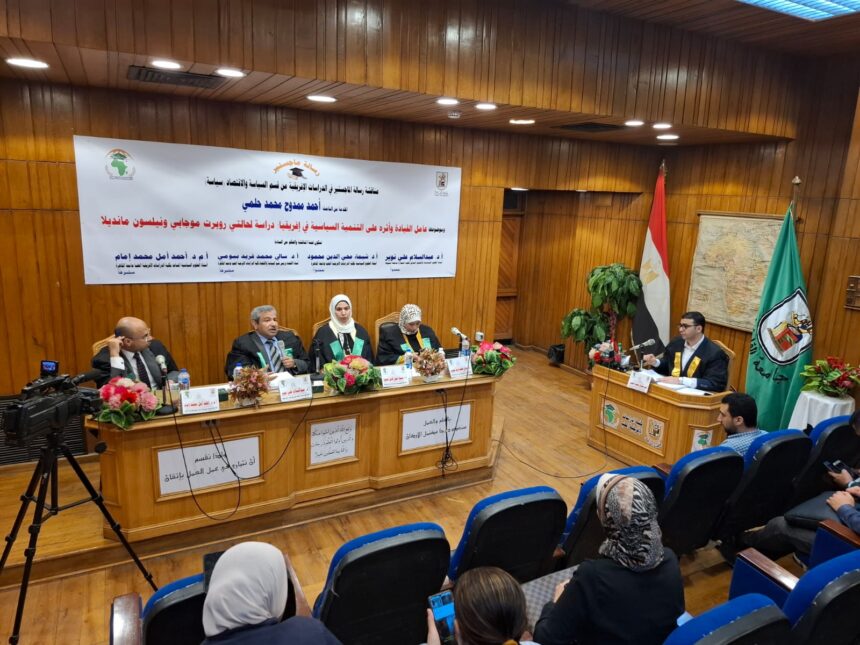
An analysis of the divergent governance models of Robert Mugabe and Nelson Mandela has concluded that political leadership is an active force capable of redirecting the course of development in post-liberation African states, according to a master’s thesis awarded with distinction at Cairo University.
Submitted by journalist and political researcher Ahmed Mamdouh Helmy, the research examined the relationship between leadership patterns and political transformations within post-independence African nations. The thesis was discussed by the Department of Politics and Economics at the university’s Faculty of African Graduate Studies.
The study argued that political leadership in Africa should not be viewed merely as a reflection of institutional structures or historical and social contexts. Instead, it operates as an active force capable of redirecting political evolution within the limits of each country’s historical and social realities.
To illustrate this, the research utilised a comparative study of Mugabe in Zimbabwe and Mandela in South Africa. The study explained that the two experiences represent contrasting models of leadership practice, serving as a revealing example of the divergent paths taken by post-liberation states.
Although both leaders began from a common starting point rooted in national struggle, national liberation movements, revolutionary legitimacy, and charismatic leadership, they moved toward distinct models of governance and institution-building. These differing approaches to state management ultimately produced markedly different outcomes regarding political stability and development, highlighting the direct influence of leadership on the continent’s development trajectories.
Following the defence session, the examination committee awarded Helmy a master’s degree with distinction, praising the study’s academic rigour and its balanced analytical treatment of a prominent issue in African political studies.
The academic session was chaired by Professor AbdelSalam Noweir, Professor of Political Science and former Dean of the Faculty of Commerce at Assiut University, who served as an examiner. The committee also included Professor Shaimaa Moheyeldin, Professor of Political Science at the Faculty of African Studies, as an examiner. Professor Sally Farid, Professor of Economics and Head of the Department of Politics and Economics at the faculty, and Dr. Ahmed Amal, Professor of Political Science at the faculty, served as supervisors.

