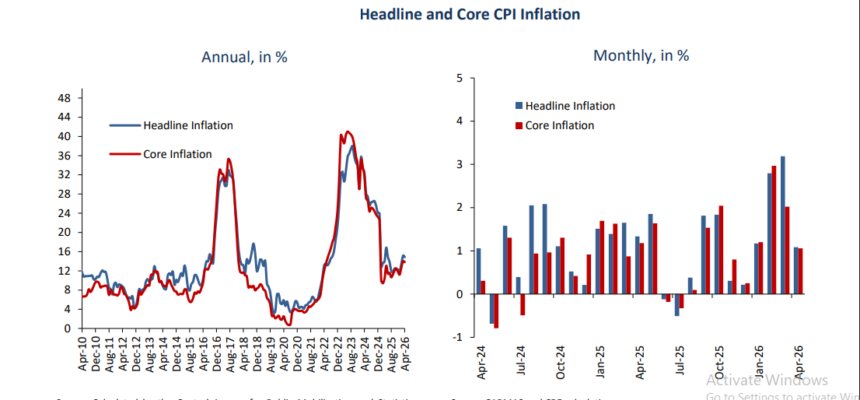
Annual urban headline inflation slowed to 14.9% in April 2026, down from 15.2% in March, according to the Central Bank of Egypt (CBE), which attributed the moderation primarily to easing non-food inflation despite a rebound in food price pressures.
Annual non-food inflation declined to 20.1% in April from 21.5% in March, helping drive the overall slowdown. In contrast, annual food inflation accelerated to 6.7%, compared with 5.8% a month earlier, largely due to an unfavourable base effect and a sharp increase in volatile food inflation to 26.2% from 15.9%, despite slower growth in core food prices.
On a monthly basis, urban headline inflation eased to 1.1% in April, compared with 3.2% in March and 1.3% in April 2025. The decline was mainly driven by lower food inflation, which recorded negative 0.7%, supported by falling core food prices and slower increases in volatile food items.
Monthly non-food inflation remained broadly stable, as higher inflation in services and retail goods partially offset slower growth in regulated prices. The moderation in regulated-price inflation reflected the absence of new price adjustments in April following fuel price hikes implemented in March.
Annual core inflation edged down to 13.8% in April from 14% in March, reflecting lower core food and retail inflation despite a slight increase in services inflation. Monthly core inflation also slowed to 1.1%, compared with 2% in March and 1.2% in April 2025.
Meanwhile, annual rural headline inflation remained largely unchanged at 12% in April, compared with 11.9% in March. Nationwide headline inflation—representing the weighted average of urban and rural inflation—stood at 13.4%, broadly stable from 13.5% in the previous month.
Main drivers of monthly inflation in April
Monthly food inflation registered negative 0.7%, subtracting 0.25 percentage points (p.p.) from headline inflation.
Volatile food prices rose by 2.9%, contributing 0.19 p.p. to monthly inflation, driven by increases in fresh fruit and vegetable prices of 4% and 2.3%, respectively, though both remained below seasonal trends.
Poultry and egg prices recorded notable declines of 14.7% and 2.9%, respectively, marking their first monthly drop since December 2025. The CBE said this likely reflected a reversal of seasonal pressures linked to Ramadan and holiday demand. Together, these categories reduced monthly headline inflation by 0.86 p.p.
Monthly non-food inflation reached 2.1%, contributing 1.3 p.p. to headline inflation, mainly due to higher services and retail prices.
Services inflation increased by 3.3%, adding 0.95 p.p. to monthly inflation, driven by higher rents, Hajj and Umrah travel costs, and increased spending at restaurants and cafés. The CBE noted that the latter may reflect second-round effects from recent fuel and commercial electricity price increases.
Retail inflation rose by 1.8%, contributing 0.25 p.p., supported by higher prices for clothing and footwear, household cleaning products, and personal care items.
Inflation in regulated items increased by 0.6%, contributing 0.14 p.p., following an average 23.8% rise in railway and metro fares.
Monthly core inflation stood at 1.1%, with core food reducing inflation by 0.61 p.p., while services and retail items contributed 1.32 p.p. and 0.36 p.p., respectively.
Main drivers of annual inflation
Despite lower monthly food inflation, annual food inflation accelerated to 6.7% in April, mainly due to base effects. Food prices contributed 2.64 p.p. to annual headline inflation.
Volatile food inflation surged to 26.2%, contributing 1.60 p.p., driven primarily by higher vegetable prices, partly offset by declining fruit prices.
Core food inflation increased by 3.4%, adding 1.04 p.p. to annual inflation, reflecting higher prices for beef, seafood, and dairy products despite declines in poultry and egg prices.
Annual non-food inflation eased to 20.1% in April but remained the largest contributor to overall inflation, accounting for 12.23 p.p. of headline inflation.
Services inflation climbed to 25.6%, contributing 6.95 p.p., driven by rising rents, private transport costs, restaurant spending, Hajj and Umrah travel, healthcare services, and personal care expenses.
Inflation in regulated items reached 15.1%, contributing 3.26 p.p., reflecting higher annual prices for tobacco, LPG, natural gas, petroleum fuels, public transportation, and medical products.
Retail inflation recorded 14.1%, contributing 2.02 p.p., supported by rising prices for clothing, household cleaning products, vehicles, engine oils, and personal care items.
Annual core inflation eased slightly to 13.8% from 14% in March. Services and retail categories remained the main contributors, accounting for 9.62 p.p. and 2.79 p.p., respectively, while core food contributed a modest 1.44 p.p. to annual core inflation.