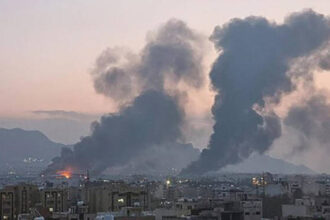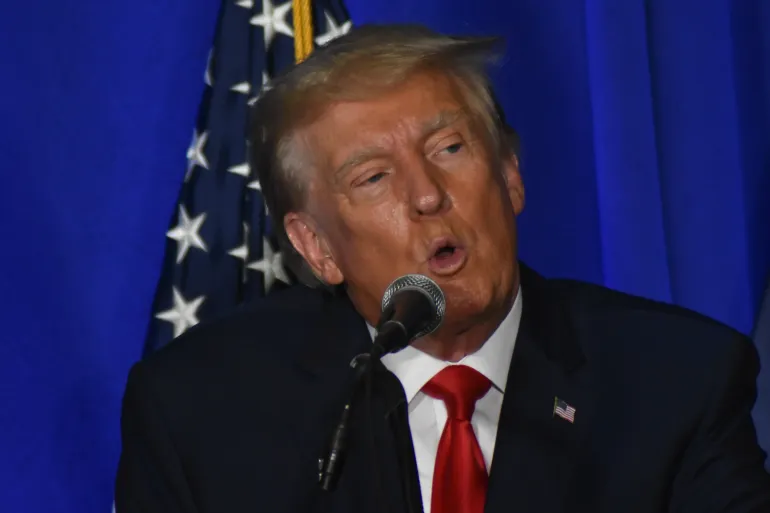
U.S. President Donald Trump again hinted at possible renewed military escalation against Iran as tensions rise in the Gulf and the Strait of Hormuz despite ongoing diplomatic contacts and efforts to preserve a fragile ceasefire between the two sides.
Trump posted on his Truth Social platform late on Saturday an image of warships, including a boat carrying the Iranian flag, alongside the phrase “The calm before the storm,” in what observers viewed as a possible signal of looming military action against Iran, particularly around the strategically vital Strait of Hormuz.
The post came shortly after Trump returned from China, where he discussed the Iran war and other global issues with Chinese President Xi Jinping, amid growing international pressure on Washington to avoid a broader regional conflict.
Tehran responded sharply. Iranian armed forces spokesperson Brigadier General Abolfazl Shekarchi warned that any new attack on Iran would result in the United States receiving “even harsher and more severe blows,” adding that American interests and forces would face “new and devastating attack scenarios” if Washington acted on its threats.
Iran’s defense ministry spokesperson Reza Talaei Nik also said Iranian armed forces were “fully prepared to respond to any threat or aggression,” as Tehran intensified both military and political messaging regarding Gulf shipping security.
Iranian state television announced new procedures for ships transiting the Strait of Hormuz, requiring ship owners to submit transit requests through their foreign ministries to Iran’s foreign ministry, which would then forward them to the Revolutionary Guards navy for evaluation of the vessel’s route, ownership and cargo. Transit permission would be granted only if the vessel was not linked to a “hostile state.”
The move points to unprecedented Iranian tightening of shipping controls in the strait, through which roughly one-fifth of global oil trade passes, raising renewed concerns over maritime security and energy supplies.
In a separate development, the UAE defense ministry said its air defenses dealt with three drones entering the country’s airspace from the western border area. Two drones were intercepted, while the third struck a power generator outside the inner perimeter of the Barakah nuclear power plant in the Al Dhafra region, though no casualties were reported.
The ministry said investigations were underway to determine the source of the attack and stressed that the armed forces remained on full alert to confront threats targeting the country’s security.
South Korea’s foreign ministry said Foreign Minister Cho Hyun sought clarification from his Iranian counterpart Abbas Araqchi over an attack on a South Korean cargo ship near the Strait of Hormuz. A South Korean official was quoted as saying the likelihood that another party besides Iran was responsible was “low.”
In Israel, Yedioth Ahronoth reported that the Israeli military had moved to maximum alert over the possibility of renewed war with Iran, adding that the government was awaiting Trump’s decision amid growing assessments that Tehran may reject U.S. conditions for ending the conflict and addressing Iran’s nuclear program.
The newspaper also said the United States and Israel were “strongly preparing” for the possible resumption of hostilities, echoing an earlier New York Times report that the Pentagon was preparing for renewed war because key U.S. objectives — especially concerning Iran’s nuclear program — had not been achieved.
At the same time, Tehran sought to project domestic unity and regional backing. Iranian President Masoud Pezeshkian told Pakistan’s interior minister that the United States and Israel had aimed to “topple the regime” but had failed to anticipate that the Iranian people would stand by their country and government. He also praised Pakistan’s role in helping sustain the ceasefire and expressed hope that Islamabad’s efforts would support regional peace.
As mutual threats continue, shipping restrictions tighten and military readiness increases across the region, fears are growing that the current ceasefire may prove only a temporary pause in a conflict whose core disputes remain unresolved.