

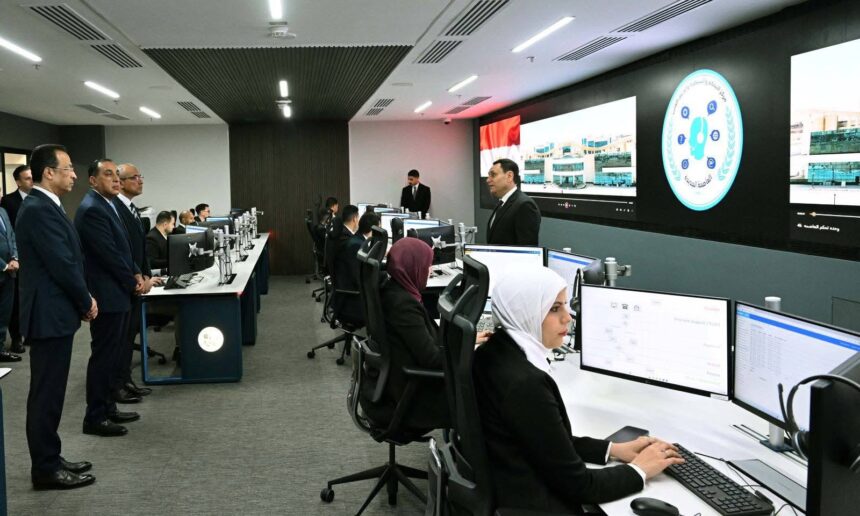
Egyptian Prime Minister Mostafa Madbouly inspected the new Control, Command and Technical Support Centre in the New Administrative Capital’s Government District on Wednesday, a facility managing what officials describe as the Middle East’s largest technological infrastructure serving 50,000 government employees.
Accompanied by Minister of Communications and Information Technology Raafat Hindi, Centre Director Mohamed Gamal Al-Nuairi, New Capital Company General Manager Major General Ahmed Fahmy, and various engineers, Madbouly reviewed the site that centralises the district’s digital operations.
Upon arrival, Madbouly stated that the information and communications technology sector is a basic pillar for building a digital state and achieving economic growth. He noted the state’s efforts to enhance digital innovation, artificial intelligence, and citizen services, alongside attracting investments and increasing digital exports.
Madbouly remarked that the New Capital was once a “dream” sought to be achieved. He attributed its realisation to continuous day-and-night work, scientific planning, and significant support from President Abdel Fattah El-Sisi, highlighting the collaboration between state institutions, national private companies, and leading global tech firms to create a smart city reliant on digital solutions.
Hindi affirmed that constructing an advanced technological infrastructure to the highest technical standards is fundamental to a digital society. He added that the ministry is expanding data centres to solidify Egypt’s position as a regional data industry hub and encouraging investment in advanced technologies, primarily cloud computing.
During a tour of the main technical support hall, Al-Nuairi delivered a presentation explaining that the implemented information infrastructure is necessary for government entities to access technological services from the state’s main data centre at the Strategic Command. The connectivity operates on both the closed government cloud (G-cloud) and the public government cloud (P-cloud).
Al-Nuairi detailed the scale of the network, which includes 6,800 network devices distributed across 953 main and sub-assembly rooms to provide 300,000 data outlets. The system serves ministries and government entities with over 27,000 digital telephones, more than 1,000 digital televisions, over 22,000 wireless stations, 14,000 surveillance cameras, 1,245 meeting rooms, 114 electronic gates, and 50,000 computers allocated for 50,000 relocated government employees.
To manage this environment, Al-Nuairi explained, a smart centralised mechanism was established to monitor performance, proactively predict issues, and resolve faults swiftly without exacerbation. The facility comprises several departments encompassing designs, new projects, and technological infrastructure; network security; proactive monitoring and preventive maintenance; technical support and crisis management; documentation and reporting; databases and backup; work quality efficiency monitoring; alongside technical inspection and repair.
Fault reports are analysed to improve performance and develop future plans. The centre operates round-the-clock with a daily presence of 40 specialised engineers. Continuous coordination occurs among technical support teams within the centre, those deployed across government buildings, and staff at the Strategic Command’s main data centre.
The primary technical support level focuses on predicting problems, monitoring networks, and establishing alternative communication routes to ensure uninterrupted government services.
Madbouly also inspected the second level of technical support, which specialises in complex problem-solving. He toured the main services halls responsible for reviewing wireless stations, the entry and exit monitoring system, technology infrastructure assembly cabinets, security equipment, the assembly rooms’ camera operations, and the data security hall.
Concluding the tour, Madbouly thanked the centre’s officials, stating that these advanced technologies strongly indicate the Egyptian state has taken serious steps toward digital transformation, ultimately serving the administrative apparatus and improving citizen services.

