

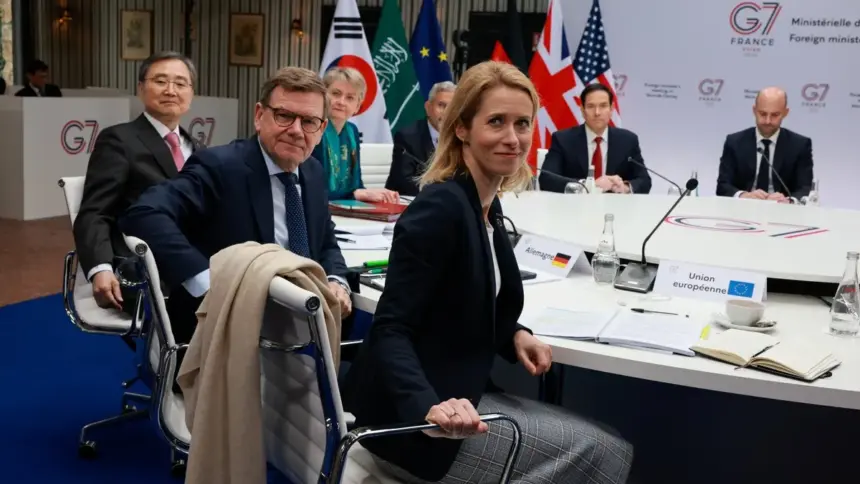
The room was full of allies. Cameras were absent. And when Kaja Kallas, the European Union’s foreign policy chief, turned to Marco Rubio and demanded to know when the United States would finally lose patience with Russia, the American secretary of state’s reply landed like a grenade.
“If you think you can do it better, go ahead,” Rubio shot back, his voice audibly raised. “We’ll step back.”
That exchange — described to Axios by three sources who witnessed it at the G7 foreign ministers’ meeting in France last Friday — has crystallised what Western officials and analysts have quietly feared for months: the transatlantic alliance forged over eighty years of shared security architecture is fracturing in real time. And the war in Iran, now consuming American diplomatic bandwidth and military resources, has accelerated a crisis of trust that Ukraine’s war exposed but did not create.
The Confrontation: An Alliance Argument in Full View
The Kallas–Rubio confrontation did not erupt without context. During the G7 session dedicated to Ukraine, Kallas — Estonia’s former prime minister and one of Europe’s most hawkish voices on Russia — reminded Rubio of a commitment he had made at the previous year’s meeting: that if Russia continued to obstruct American-led peace efforts, Washington would lose patience and take additional steps against the Kremlin.
“A year has passed, and Russia has not moved,” she told him, according to the sources. “When does your patience run out?”
Rubio’s response, suggesting the Europeans could simply take over diplomacy if they believed they could manage it better, drew immediate alarm from other European foreign ministers present, several of whom intervened to stress their continued desire for American engagement in mediation efforts. By the end of the meeting, Rubio and Kallas held a brief bilateral exchange on the sidelines in an attempt to defuse the atmosphere.
A ‘Frank Exchange’ — or Something More?
Speaking to journalists after the meeting, Rubio offered a strikingly different version of events. “These meetings are mostly thanking America for the role it has played,” he said, “and appreciation for the mediation role we tried to play in this war between Russia and Ukraine. No one is yelling or raising their voice or saying anything negative.”
A State Department official offered a more measured gloss: “This was a frank exchange of views — and that is the point of diplomacy.”
The gap between those characterisations and the accounts of the three first-hand witnesses is itself revealing — a microcosm of the broader information management challenges now surrounding transatlantic relations on Ukraine.
The Deeper Fracture: European Fear of a US–Russia ‘Grand Bargain’
The G7 altercation is the most vivid public symptom of a deeper structural anxiety now gripping European capitals. According to sources who spoke to The Times, senior officials in Britain and across the EU have grown increasingly alarmed by the possibility that the United States, now pivoting major resources toward the Levant, could strike a bilateral deal with Russia — one that trades European security guarantees for American strategic interests elsewhere.
“It is no longer the worst-case scenario that the Americans step back from European security,” one senior European official told The Times. “The worst-case scenario is that they step back and then turn against us.”
European officials expressed explicit concern, according to the same sources, that President Donald Trump may be contemplating a “grand bargain” with Moscow conducted over Europe’s head — something they described as unthinkable five or six years ago.
A new report published Friday by members of the British parliament reinforced the alarm, warning that Europe must be capable of fighting alone in “worst-case scenarios” — a formulation that would have been inconceivable in NATO communiqués a decade ago.
The Iran Variable: How a New Front Widened an Old Fault Line
The war in Iran has not merely distracted Washington from Ukraine — it has actively complicated the transatlantic equation. European anxiety intensified after the United States granted waivers permitting the sale of Russian oil at higher price bands, a decision read by European capitals as an implicit concession to Moscow timed alongside the Levantine military campaign.
On Ukraine specifically, American diplomatic momentum appears to have stalled. A senior Ukrainian delegation travelled to Miami last weekend for talks with Trump envoys Steve Witkoff and Jared Kushner. Ukrainian officials afterwards indicated that little substantive progress had been made and that Washington’s focus remained almost entirely fixed on Iran.
Trump’s ‘Paper Tiger’ Broadside: NATO Under the Sharpest Attack Yet
If the G7 episode reflected private tensions, President Trump’s public remarks at the Future Investment Initiative conference in Miami on Thursday marked a new escalation in his running assault on the Atlantic Alliance.
“I am very frustrated with NATO,” Trump declared. “They didn’t come to help the United States” in the Iran campaign. He described asking French President Emmanuel Macron for assistance and being told ships would be dispatched — but only after hostilities ended. A similar response, he said, came from British Prime Minister Keir Starmer regarding aircraft carriers: “Maybe in a month or two.”
“That is NATO,” Trump said, “and I always said NATO was a paper tiger.” He added, “We help NATO, but they will never help us.”
Germany, ‘Not Our War’ — and a Pointed American Rejoinder
Trump said German Chancellor Friedrich Merz had told him that the Iran conflict was “not our war and has nothing to do with us” — a position Trump pointedly contrasted with America’s continued support for Ukraine, which he argued Washington could equally have declined. “If I were president, that war would never have happened,” he added.
Trump also criticised NATO members for failing to answer his call to reopen the Strait of Hormuz, calling them “cowards” and repeating that the alliance without American participation amounted to little more than a diplomatic fiction.
The remarks follow a year of sustained pressure by Trump on European allies over defence spending and trade, as well as threats — treated increasingly seriously in Brussels and London — to advance territorial claims over Greenland.
The Architecture of Mutual Distrust
What Paris and Miami have together produced this week is not an isolated diplomatic incident but a condensed portrait of a structural realignment: the United States under Trump is operating as a transactional power in a system built on the assumption of a rules-based, multilateral architecture underwritten by American commitment.
The sources who spoke to Axios were careful to frame the Kallas–Rubio exchange as evidence not of personal animosity but of structural distrust — a sentiment now widespread across capitals that have, for decades, calibrated their defence postures on the assumption that Article 5 guarantees are unconditional.
The emerging European response — accelerated independent rearmament, the development of bilateral security compacts outside the NATO framework, and parliamentary calls for strategic autonomy — suggests that at least some European governments have begun treating American commitment as a variable rather than a constant.
Outlook: A Long-Deferred Reckoning
In the brief bilateral conversation that followed the G7 session, Rubio and Kallas reportedly worked to smooth the surface. But the underlying terrain had not changed. A year after the commitment Kallas cited was made, Russia remains in Ukraine, American patience has produced no publicly quantifiable cost for Moscow, and the Iran conflict has reshuffled every geopolitical priority.
For European governments watching Trump’s Miami remarks alongside the Paris confrontation, the strategic calculus has shifted. The question Kallas asked — “when does your patience run out?” — may increasingly be the one Europe is directing not at Washington, but at itself.

