

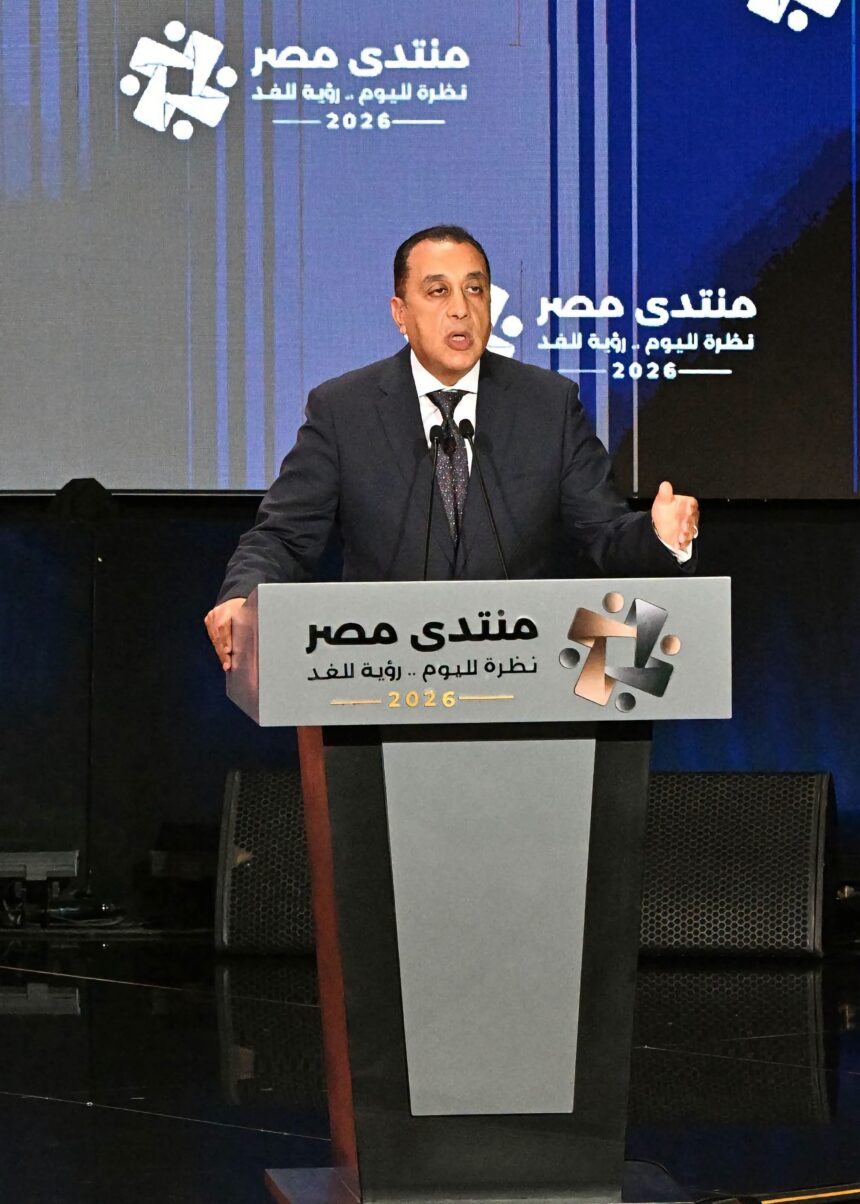
Prime Minister Mostafa Madbouly outlined a series of recommendations on wages, housing, education, agriculture, industry, investment and energy at the closing session of Egypt Forum 2026 on Saturday, setting out proposed priorities for the government’s development agenda in the coming years.
The six-day forum, held from October 19 to 24 under the theme “A Look at Today, A Vision for Tomorrow,” brought together government officials, experts and citizens to discuss national development priorities and the challenges facing the country.
The recommendations include raising the minimum wage to EGP 15,000 by fiscal year (FY) 2029/30, expanding cultivated land to 12.5 million feddans by 2030, providing one million housing units over four years and creating employment opportunities across several sectors.
Wages and household incomes
The recommendations call for raising the minimum wage from EGP 8,000 to EGP 15,000 by FY2029/30 and increasing average employee wages by at least 50% by the end of the same fiscal year.
They also propose a phased plan to provide financial incentives for managers in line with their responsibilities, with minimum wage reaching EGP 15,000 within two years.
The recommendations further call for improving the incomes of university faculty members and their assistants.
Agriculture
The forum recommended expanding cultivated land to 12.5 million feddans by 2030 and increasing government procurement prices for strategic crops. The proposed wheat procurement price would rise to EGP 2,650 per ardeb from EGP 2,500, while the price of sugar beet grown in newly reclaimed areas would increase to EGP 2,300 from EGP 2,000.
Another proposal involves launching an initiative to support agricultural activity during the 2026/27 winter season, covering land preparation for wheat cultivation across one million feddans held in plots smaller than two feddans.
Under the initiative, farmers would receive agricultural mechanisation services at a 50% discount.
The recommendations also call for exempting farmers from fines for water wastage incurred through rice cultivation in violation of regulations.
Entrepreneurship and information technology
The forum recommended tasking the Ministry of Planning with launching an initiative to support the creation of at least five $1bn companies over the next five years, with the potential to expand regionally and internationally.
It also called for expanding employment opportunities in information technology and telecommunications, targeting 200,000 jobs by 2030.
Public finances
The recommendations call for adopting binding ceilings on public debt, external debt and sovereign guarantees, while reducing public debt and debt-servicing costs.
They also set a target of reducing the budget debt-to-GDP ratio to approximately 69.5% by the end of June 2030.
Budget allocations for services benefiting citizens are proposed to increase to approximately EGP 4.8trn from EGP 2.3trn starting in FY2029/30, without imposing additional tax burdens on citizens or the middle class.
Investment and exports
The forum recommended integrating export rebate programmes and increasing export support for promising sectors. It also called for expanding shipping support for targeted markets to improve the competitiveness of Egyptian products and facilitate their access to foreign markets.
Another proposal involves introducing a programme offering financial incentives to local and foreign companies engaged in service exports, including entrepreneurship-related activities.
The programme aims to create one million high-income jobs and double service exports.
Industry and manufacturing
The recommendations include launching a support system for distressed factories by registering affected businesses, identifying the causes of their difficulties and determining appropriate solutions, including partnerships, financing and technical assistance.
They also call for accelerating implementation of the Productive Village initiative, which aims to establish industrial clusters in 1,000 villages by 2030 based on their respective comparative advantages.
Another proposal is to introduce an executive programme to deepen local manufacturing in priority industries by designating eligible industrial zones and complexes for tax and customs incentives, flexible industrial land payment arrangements and streamlined licensing procedures.
These incentives would be conditional on increasing the local component of production.
The forum also recommended a package of industrial incentives covering local manufacturing, the Young Manufacturers initiative, support for distressed factories and the Productive Village programme.
A separate financing initiative for young manufacturers would be launched in cooperation with Tahya Misr Fund to increase the number of factories, create direct jobs and improve living standards.
Energy
The recommendations call for expanding renewable energy projects to bring installed capacity to approximately 30 gigawatts by the end of 2028.
They also propose implementing a national programme through 2030 to increase domestic oil and natural gas production, targeting natural gas output of approximately six billion cubic feet per day and combined crude oil and condensate production of around 700,000 barrels per day.
Another target is to connect an additional 3.2 million housing units to the natural gas network by June 2030.
The forum also recommended launching an initiative to convert factories, agricultural and irrigation equipment, government buildings, schools and universities to new and renewable energy sources.
The conversion programme would be financed through concessional mechanisms allowing beneficiaries to cover costs from annual electricity bill savings. Repayments would be funded by the monthly savings generated, without imposing additional financial burdens on beneficiaries.
Education
The recommendations call for expanding the number of Egyptian-Japanese schools from 103 to 500 within three years.
They also propose eliminating evening school shifts according to a phased timetable, with primary schools targeted by 2027, preparatory schools by 2028 and secondary schools by 2029.
Other measures include developing and equipping all special education schools within two years and introducing a professional licensing programme for teachers based on a professional competency framework. Teachers who obtain the licence would receive additional financial benefits.
The forum also recommended developing 600 technical schools in partnership with the private sector and labour market representatives, supported by financial incentives for participating partners.
Housing and urban development
The recommendations include launching a national programme to provide approximately one million housing units across different income categories over four years, with estimated investments of EGP 1trn, in cooperation with Tahya Misr Fund.
The programme would include several housing models, including new rental housing, rent-to-own units, social housing, social housing developed in partnership with private developers, housing for factory workers, and units for middle- and upper-middle-income households.
The forum also called for expediting the adoption of legislation regulating Egypt’s real estate market to govern contractual relationships between citizens and property developers and strengthen market discipline.
Infrastructure and roads
The recommendations call for allocating EGP 5bn annually to extend and reinforce utility networks in cities, villages, hamlets and other residential communities across Egypt’s governorates.
They also propose launching a national programme to upgrade local roads across the governorates, with estimated costs of approximately EGP 42bn.
Another recommendation is to establish a clear timetable for completing bridges, tunnels and other infrastructure works needed to eliminate level crossings along railway lines by the end of 2030.
Environment
The forum recommended preparing urgent amendments to Environmental Law No. 4 of 1994 to explicitly criminalise arbitrary and unregulated tree cutting and the removal of vegetation cover.
It also called for developing and implementing a national strategy extending to 2050 to double vegetation cover across Egypt’s governorates.