

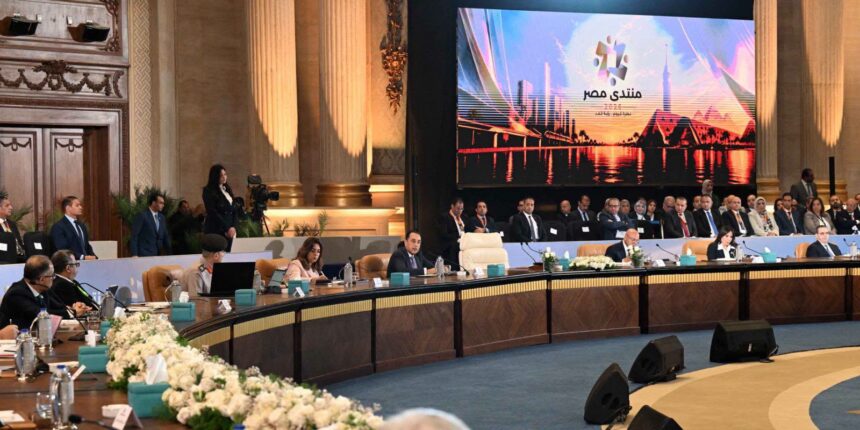
Egyptian Prime Minister Mostafa Madbouly forcefully defended the government’s massive expenditure on national projects, particularly in construction, transport, and the establishment of new cities, stating that the nation’s urbanised area has doubled to 14% to accommodate rapid population growth.
Speaking at the opening of the second day of the “Egypt Forum 2026” on Tuesday during a session titled “Urban Development,” Madbouly responded directly to public concerns regarding the economic and social returns of these projects, and whether the focus on new cities like the New Administrative Capital and New Alamein came at the expense of existing urban centres.
Madbouly traced the problem back to the concentration of Egypt’s population on a highly limited area. He noted that in the early 20th century, the population was less than 10m on the same landmass that now holds 110m people. This concentration, he said, led to the rapid growth of slums, the loss of agricultural land, and the deterioration of services between the 1970s and 2011, giving Egyptian cities some of the highest crowding rates globally.
The premier asserted that the creation of new cities was a “vital necessity.” He stated that the current strategy is based on the “National Urban Development Plan for Egypt to 2052,” finalised in early 2012 by Egyptian experts. Under this plan, 27 of 39 planned new cities have been or are being built, with the remaining 12 to follow.
Addressing claims that the new cities are empty, Madbouly cited electricity meter data indicating that between 14m and 15m Egyptians permanently reside in these areas, supported by over 350,000 commercial, industrial, and administrative meters. He noted that the population of New Cairo approaches 3m, while 6th of October City houses 2m.
On the New Administrative Capital, Madbouly explained that the decision to relocate government headquarters was driven by the historic congestion of central Cairo, which caused an estimated $8 bn to $10 bn in annual losses due to slow traffic, pollution, and wasted fuel. He stated that the current location was chosen based on extensive studies conducted between 2007 and 2008, which identified it as the optimal choice among five alternatives to drive eastward urban expansion.
Regarding New Alamein, the prime minister contrasted the government’s approach with previous decades, where the North Coast was utilised merely as a two-month summer retreat. He highlighted that New Alamein was built on a former minefield and attracted 1m tourists this year, reflecting a vision to create year-round cities featuring economic, industrial, and service activities.
Madbouly rejected the assertion that new cities neglect older areas, pointing out that since 2014, the state has eradicated over 350 unsafe areas, relocating more than 350,000 families to suitable housing. He also highlighted the “Decent Life” initiative, which targets 4,600 rural villages housing 60m people. The first phase, covering 1,477 villages, cost over EGP 450 bn. He added that rural sanitation coverage has jumped from roughly 11% in 2014 to over 60% today, reaching up to 40m people.
Furthermore, Madbouly announced that the state has built more than 2m housing units for low- and middle-income segments since 2014 to combat the housing crisis, noting that President Abdel Fattah al-Sisi has directed the government to continue implementing such projects to meet the needs of a growing population.
The prime minister concluded that the construction sector, linked to over 100 industries, was crucial in reducing unemployment from 13.5% in 2014, stressing that delaying these infrastructure projects by 15 or 20 years would have multiplied their costs by up to five times, rendering them unfeasible.


