

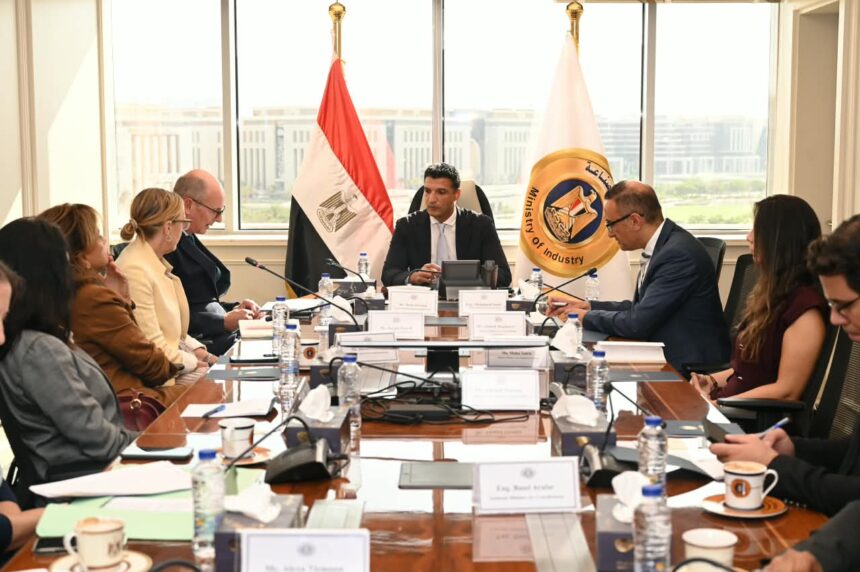
Egypt’s Minister of Industry Khaled Hashem met with Mark Bowman, Vice President for Policy and Partnerships at the European Bank for Reconstruction and Development (EBRD), and Jacqui Powell, the bank’s Managing Director for the Corporate Sector, along with their accompanying delegation.
The meeting focused on EBRD projects in Egypt and ways to strengthen cooperation in industry, the green economy, water efficiency, and support for small and medium-sized enterprises (SMEs).
The discussions addressed the EBRD’s role in supporting a competitive, resilient, and sustainable private sector in Egypt, with industry positioned as a key driver of economic growth and an important pillar of efforts to reduce carbon emissions.
The bank has focused in recent years on financing low-carbon industrial investments, including projects based on emerging and new technologies.
The meeting also reviewed the EBRD’s support for greater private-sector reliance on renewable energy, in line with Egypt’s plan to increase the share of renewables in its energy mix to 45% by 2028.
The two sides discussed the bank’s green economy projects in Egypt and the activities of the Climate Investment Funds (CIF), which aim to provide large-scale concessional green financing to developing and emerging economies, promote sustainable and low-carbon development, and strengthen climate resilience by addressing financing gaps and stimulating private-sector investment.
Egypt was among seven countries selected to receive up to €250m in concessional financing from the CIF. The EBRD is the leading international financial institution in the initiative and is working closely with the Egyptian government on its implementation.
Hashem said Egypt’s industrial strategy aims to increase the sector’s reliance on renewable energy through the Shams El-Senaa initiative, which supports the installation of solar power plants at factories, as well as the Solar Energy Transition in the Industrial Sector (SETI) initiative, implemented in cooperation with the United Nations Development Programme (UNDP).
SETI seeks to install solar energy systems at state-owned industrial facilities, alongside efforts to improve energy efficiency in factories.
The minister added that the ministry is also working to reduce industrial water consumption by promoting the use of closed-loop water systems in factories and increasing demand for related treatment plants and systems. This, he said, would help attract international companies seeking to localise their production in Egypt.
Hashem expressed the ministry’s interest in receiving technical support from the EBRD for private-sector companies responsible for installing these systems, particularly as the ministry seeks to apply them across industrial zones.
He noted that several foreign companies have recently entered the Egyptian market to invest in solar power equipment and electric vehicle battery production.
The minister also highlighted the ministry’s efforts to strengthen supply chains in the iron and steel industries and secure the scrap required for production, while enhancing cement manufacturing capabilities, increasing the use of alternative fuels, and improving fuel efficiency in industrial operations.
He added that the ministry had recently introduced several measures to facilitate the investment process for small industrial investors. These include easing access to industrial land through a rent-to-own system, allowing investors to direct their initial resources towards factory construction, machinery, equipment, and production lines rather than paying the full land price upfront.
The ministry is also expanding access to industrial land under usufruct arrangements, simplifying industrial licensing procedures by reducing requirements related to the unified insurance policy, and providing new financing and preliminary feasibility study services.
Hashem said that the ministry also seeks to cooperate with the EBRD on developing a financing programme to provide infrastructure and utilities to underserved industrial zones through private-sector companies. The programme would initially be implemented in one industrial zone before being expanded to other areas.
For his part, Bowman described Egypt as a key partner for the EBRD and said the bank is committed to strengthening cooperation with the country to support industrial competitiveness.
He said there are significant opportunities for joint work in green industrial transformation, renewable energy, resource efficiency, and private-sector development.
Through policy support and investment, the bank aims to help Egyptian companies seize new opportunities, enhance their competitiveness, and accelerate the transition towards a more sustainable and low-carbon economy, Bowman said.
He added that reducing carbon emissions in the industrial sector should be viewed as part of a broader industrial transformation rather than as a series of separate investments. The bank’s support, he noted, is closely aligned with Egypt’s national climate commitments and long-term industrial development objectives.
The EBRD is working to integrate financing into a coordinated approach combining policy support, technical assistance, and investment, Bowman said, adding that this alignment would help reduce policy-related risks, improve the quality and direction of potential projects, and create conditions for greater private-sector participation.


