

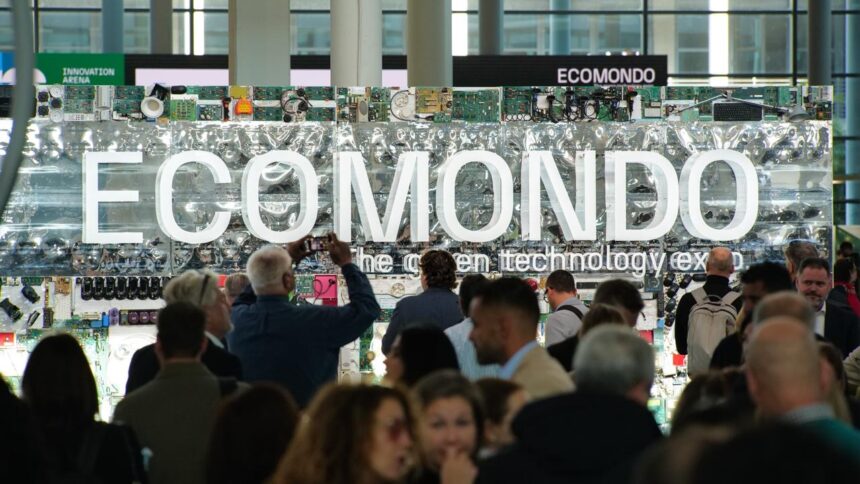
Italian Exhibition Group (IEG) is set to expand the international scope of Ecomondo in 2026, with the 29th edition of the green, blue and circular economy event scheduled to take place from 3 to 6 November at the Rimini Expo Centre in Italy.
The 2026 edition will introduce a revamped exhibition layout, including an entire hall dedicated to the textile supply chain, while expanding areas focused on waste and resource regeneration and reorganising its water and Blue Economy offering.
The event will also place greater emphasis on artificial intelligence, digital technologies, bioeconomy, bioenergy and the regulatory changes shaping Europe’s ecological transition.
IEG said Ecomondo is seeking to attract a growing number of international buyers, delegations and industry associations in cooperation with Italy’s Ministry of Foreign Affairs and International Cooperation (MAECI) and the Italian Trade Agency (ICE).
The international expansion is being supported by a multi-country roadshow covering Spain, Morocco, Germany, Hungary and Canada, aimed at strengthening commercial and institutional relationships and widening Ecomondo’s global network.
The network also includes Ecomondo Mexico, focused on the Latin American market, and Ecomondo China, which this year evolved into a forum held in Shanghai on 11–12 June. It also encompasses the Green Med Expo & Symposium, held in Naples from 27 to 29 May 2026.
European regulation takes centre stage
Ecomondo’s 2026 conference programme, curated by its international Technical and Scientific Committee, will feature an expanded number of summits, conferences and conventions held in English, reflecting the event’s growing international audience.
The programme will examine several major European regulatory and policy initiatives affecting businesses operating across the circular and green economy.
Among the dossiers expected to feature prominently are the Circular Economy Act, the EU Bioeconomy Strategy, Biotech Act II, the Pact for the Mediterranean, the RESourceEU Action Plan and the Critical Raw Materials Act. New provisions concerning Extended Producer Responsibility (EPR) will also be discussed.
The programme will involve European and international institutional partners, including the European Commission, the Organisation for Economic Co-operation and Development (OECD) and the UN Food and Agriculture Organization (FAO).
Cooperation with the Mediterranean and Africa will remain another major theme, alongside discussions on healthy and circular cities and the role of emerging technologies in accelerating the ecological transition.
Artificial intelligence and other digital technologies will receive particular attention for their potential applications in areas ranging from environmental monitoring and resource management to more efficient industrial processes.
Bioeconomy and bioenergy will also form a significant part of the agenda, reflecting their growing role in efforts to develop lower-emission and more circular production systems.
During the first two days of Ecomondo, the States General of the Green Economy will return, organised by the Foundation for Sustainable Development in collaboration with Italy’s Ministry of the Environment and Energy Security and promoted by the National Green Economy Council. Its second plenary session will be conducted entirely in English.
Dedicated textile hall among key additions
One of the main changes to Ecomondo 2026 will be the creation of a dedicated textile exhibition sector occupying an entire hall.
The new area will cover the textile supply chain at a time when European sustainability requirements are increasingly affecting the sector, including the way products are designed, produced, managed and recovered at the end of their lifecycle.
The “Waste as a Resource” exhibition area will also be expanded as the event increases its focus on technologies and business models designed to recover materials and reduce dependence on virgin resources.
Meanwhile, the Water Cycle & Blue Economy sector will be reorganised into the Blue Economy and Trenchless Districts.
These areas will focus on wastewater recovery and reuse, trenchless or “No-Dig” technologies, and advanced pumps, valves and control systems. Technologies for smart network monitoring and more sustainable management of water resources will also be showcased.
Other confirmed sectors include Sites & Soil Restoration, Earth Observation and Environmental Monitoring, Bio-energy & Agriculture, and Circular & Regenerative Bio-Economy.
The Circular & Healthy City District will return alongside a dedicated focus on paper and the Innovation District, which brings together start-ups, emerging technologies and sustainable expertise.
The growing presence of specialised industry communities is intended to strengthen Ecomondo’s position as a cross-sector platform connecting environmental technologies with industrial transformation, investment and policymaking.
Broad institutional participation
Ecomondo 2026 is being organised by Italian Exhibition Group in collaboration with a broad network of Italian, European and international institutions and industry organisations.
Partners include the European Commission, UNIDO ITPO, Italy’s Ministry of the Environment and Energy Security, Ministry of Foreign Affairs and International Cooperation, Ministry of Business and Made in Italy, the Italian Trade Agency, the Emilia-Romagna Region and the Municipality of Rimini.
The institutional and industry network also includes ANFIA, ART-ER, Assoambiente, the Circular Bio-based Europe Joint Undertaking, the Italian Biogas Consortium, the Italian Composting Consortium, CIHEAM, CONAI, the European Biogas Association, ENEA, ESWET and the European Environment Agency.
FAO, the European Waste Management Association, the Foundation for Sustainable Development, ISPRA, the International Solid Waste Association, Legambiente, OECD, Recycling Europe, UNACEA, UNICIRCULAR, UTILITALIA and Water Europe are also among the organisations involved.
With an expanded international programme, new exhibition areas and a stronger focus on regulation and emerging technologies, Ecomondo’s 2026 edition is positioning itself around the increasingly interconnected challenges facing the ecological transition — from resource security and circular manufacturing to water management, sustainable cities and digital innovation.


