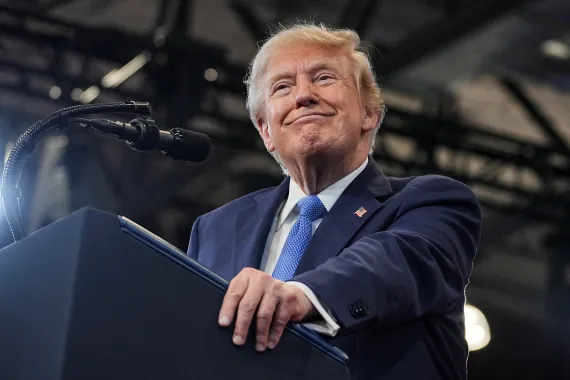
Tensions between the United States and Iran over the Strait of Hormuz intensified after American President Donald Trump said Washington would seek full control of the strategic waterway following Iran’s “defeat”, prompting Tehran to reject his remarks and insist that the future of the strait could not be determined through military force.
Trump said on Friday that he would declare the Strait of Hormuz “United States territory”, describing the US blockade of Iran as a “solid wall of steel” and saying no vessel would be allowed to pass without permission.
He accused Tehran of effectively placing regional countries under siege and described Iran as the “bully of the Middle East”. Trump also said Iran’s military capabilities had been severely degraded, citing damage to missile production, radar and intelligence systems, while pointing to high inflation and the collapse of the Iranian currency.
Tehran rejected the comments. “The Strait of Hormuz cannot be seized with a tweet, an aircraft carrier, an order or an election speech,” Iranian Deputy Foreign Minister Kazem Gharibabadi said, adding that Iran would not be intimidated by threats or displays of military force.
Foreign Minister Abbas Araghchi said negotiations with Oman and the question of reopening the Strait of Hormuz were separate issues, although he suggested that Tehran and Muscat could soon reach an understanding on the waterway. He added that Iran had not yet decided whether to resume direct negotiations with Washington.
The exchange highlighted a widening dispute over navigation through the passage linking the Gulf with the Arabian Sea. Iran maintains that management of the strait falls under its authority in coordination with Oman, while Washington argues that it is an international waterway and says US forces now exercise effective military control over it.
Tensions increased further after the United Arab Emirates said an Iranian attack had targeted a vessel operated by Abu Dhabi National Oil Company (ADNOC) while it was transiting the strait on Friday evening.
The UAE Foreign Ministry described the attack as a violation of UN Security Council Resolution 2817 and accused Iran’s Revolutionary Guards of using the Strait of Hormuz as a tool of “economic pressure or blackmail”. Kuwait also condemned the attack, calling it a violation of international law and a threat to freedom of navigation.
Inside Iran, President Masoud Pezeshkian acknowledged that the war with the United States and Israel had deepened the country’s economic difficulties. He cited falling oil revenues, damage to factories and industrial facilities, and higher import costs caused by the need to use less direct trade routes.
Iran’s Islamic Revolutionary Guard Corps commander Ahmad Vahidi, however, said Iranian forces had managed the battlefield effectively and imposed their will on their adversaries, arguing that six months of fighting had strengthened Iran’s position.
The broader dispute also remained linked to Lebanon. Iranian Parliament Speaker Mohammad Bagher Ghalibaf said what Tehran calls the “resistance front” and Lebanon had been included in the first provision of an earlier memorandum of understanding with Washington. He also said he remained in contact with Hezbollah fighters on the front lines.