

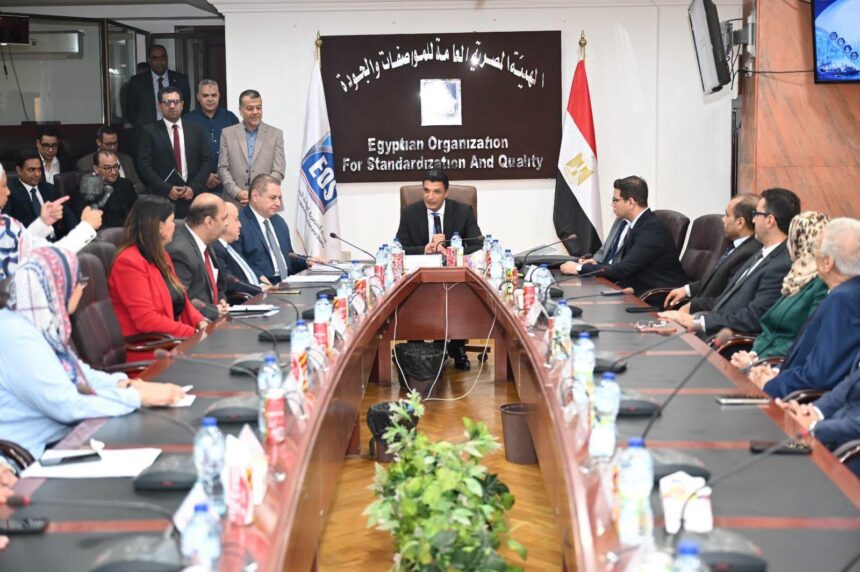
Egypt has updated its Industry Strategy 2030 by identifying five industrial groups, prioritising sectors aimed at increasing exports and integrating into global supply chains, Minister of Industry Khaled Hashem stated.
The priority industries were determined based on scientific foundations, comprehensive criteria, and measurable performance indicators, Hashem said.
“Without real quality, Egyptian industry will not be able to enter the race of global competitiveness and integrate into global manufacturing and production chains,” he added.
The minister’s remarks came during a visit to the headquarters of the Egyptian General Organization for Standardization and Quality (EOS), where he reviewed the authority’s activities and technical services provided to factories and companies. The visit was attended by EOS Chairman Khaled Soufi, Ahmed Osama, supervisor of the minister’s technical office, and company representatives.
Hashem explained that quality and standard specifications represent a primary enabler for achieving the strategy’s targets. He noted that quality has evolved from a regulatory requirement or certificate into a fundamental element of product competitiveness and a strict condition for integration into global value and production chains.
At the start of the visit, the minister met with EOS leadership and staff to review the authority’s tasks, activities, organisational structure, specifications governance mechanisms, and testing laboratory departments, in addition to presenting the authority’s strategy to support priority industries.
Hashem affirmed that the EOS acts as a primary arm of the ministry. He praised its pivotal role in improving product and service quality, enhancing the competitiveness of Egyptian industry, and supporting its access to domestic and international markets while cementing a culture of quality as a basic pillar of sustainable industrial development. He also commended the authority’s role in enhancing Egypt’s participation in international standardisation systems and supporting its presence in regional and international forums.
The minister stressed the need for EOS departments to adopt creative thinking and a comprehensive view of the quality system in industry. He highlighted the importance of establishing the concept of the “cost of quality” within industrial facilities, making it an integral part of management, design, and production rather than merely an end-of-line compliance check.
“The higher the quality of the Egyptian product and its commitment to approved specifications and standards, the greater the consumer confidence, the lower the cost of non-conformity, and the higher the product’s ability to access foreign markets,” Hashem stated.
Concluding his address, Hashem thanked Soufi and EOS staff for their efforts, expressing anticipation for further cooperation between the ministry, the authority, and industrial partners to build a more efficient, sustainable, and competitive Egyptian industry.
Meanwhile, EOS Chairman Khaled Soufi stated that the authority is developing an integrated system to serve the Egyptian industry through its expertise in standardisation, testing, calibration, conformity assessment, and training.
Soufi revealed that the integration of the National Quality Institute, the Chemistry Administration, and the Central Laboratories into the EOS represents a significant addition to its technical and scientific capabilities, enhancing its ability to provide comprehensive services to the industrial sector.
He indicated that the EOS seeks to strengthen its partnership with the industrial sector during the coming period, expanding technical solutions and services to meet various sector needs and support priority industries, thereby contributing to state targets for deepening local manufacturing and increasing exports.
During the visit, Hashem honoured 10 industrial companies that received EOS certificates. This included four companies awarded quality marks in the chemical (polypropylene pipes, paints), food, and textile sectors; one company awarded an energy efficiency certificate for instant water heaters; and five companies receiving environmental performance certificates in the automotive, food, packaging, and paint sectors.
The minister also welcomed the head of the Ugandan National Bureau of Standards and an accompanying delegation of authority employees, who were visiting the National Quality Institute to receive specialised training on issuing standard specifications and the operation of technical committees.


