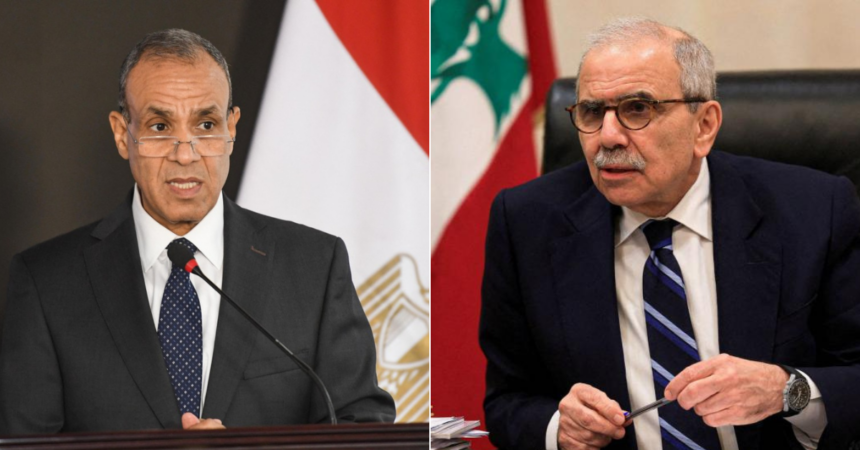
Egyptian Minister of Foreign Affairs and Emigration Badr Abdelatty affirmed Egypt’s solidarity with Lebanon and called for a complete Israeli withdrawal from all Lebanese territories during a phone call with Lebanese Prime Minister Nawaf Salam on Tuesday.
Discussing the ongoing Rome negotiations between Lebanon and Israel, Abdelatty stated that compromising Lebanon’s sovereignty violates international law and UN Security Council Resolution 1701. He stressed the importance of supporting state institutions, particularly the Lebanese army, enabling it to extend its authority over the entire national territory and limiting weapons to the state to protect the Lebanese people.
Prime Minister Salam expressed his appreciation for Egypt’s steadfast support of Lebanese state institutions.
The diplomatic engagement comes as the seventh round of US-sponsored negotiations concluded in Rome. Lebanese media reported that the latest round covered border issues, military aspects, and solidifying a ceasefire, with Lebanon presenting a proposal for demarcating land borders.
Presidential sources cited by LBCI television noted that the Israeli side retreated for the first time from its refusal to discuss land borders, accepting to work on “re-establishing internationally drawn borders.” However, the Lebanese delegation raised an urgent demand for a political guarantee regarding Israel’s commitment to a previously announced ceasefire. LBCI sources stated there is “no answer yet from the Israeli political leadership” regarding a commitment to halt fire and bombings.
The negotiations build on a trilateral Framework Agreement signed by the US, Lebanon, and Israel on June 26. The agreement outlines a sequenced process starting with two pilot areas where the Lebanese army will assume security responsibilities after verifying the disarmament and infrastructure dismantling of non-state armed groups. In return, Israel committed to a gradual, conditional reduction of its forces outside Lebanese territory.
Domestically, the ongoing talks triggered a fierce political dispute, coinciding with the anniversary of the Beirut port explosion. Hezbollah Secretary-General Naim Qassem delivered a speech criticising the direct negotiations, stating they “brought nothing to Lebanon but shame, humiliation, disappointment, and successive concessions.”
Qassem accused Lebanese President Joseph Aoun of becoming a partisan and divisive figure rather than an arbiter. He called on the government to halt “free concessions,” open a dialogue with the resistance, and work on the ground to achieve an Israeli withdrawal.
Prime Minister Salam issued a forceful response on the X platform. Without explicitly naming Hezbollah or Qassem, Salam said the greatest assistance to Israel was provided by those who “monopolised dragging Lebanon into absurd support wars,” granting Israel pretexts to violate sovereignty, destroy cities, and displace citizens.
“Whoever monopolised the decision of war and tries to continue confiscating the state’s decision, tying Lebanon to foreign calculations and axes while ignoring the interests of his environment and the Lebanese in general, cannot distribute certificates in patriotism, let alone in sovereignty,” Salam stated.
Salam stressed that state sovereignty relies on “one independent decision in a state that has one army, extending its authority over all its territories exclusively with its own forces.” He added that true dialogue requires the courage to take responsibility for reckless choices that have cost the Lebanese people, noting the state remains committed to removing the Israeli occupation and securing the safe return of displaced citizens.