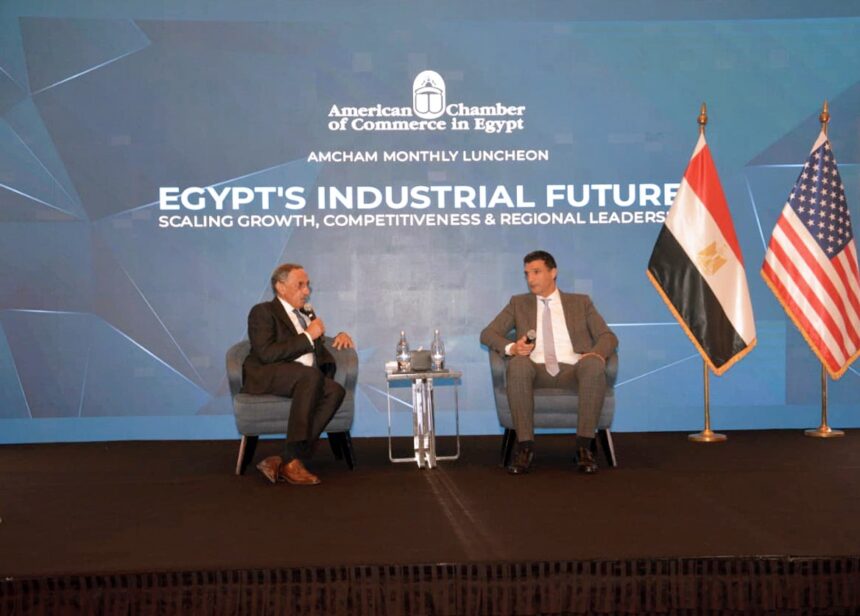
Egypt’s Minister of Industry, Khaled Hashem, outlined the latest developments in the updated Industrial Development Strategy 2030 during the monthly meeting of the American Chamber of Commerce in Egypt (AmCham), highlighting a series of initiatives aimed at transforming Egypt into a regional manufacturing hub and increasing industrial exports to $100bn by 2030.
Addressing business leaders, investors, and industry stakeholders, Hashem stressed the ministry’s commitment to maintaining direct and continuous engagement with the private sector to identify challenges facing manufacturers and develop practical, actionable solutions.
“The private sector is the government’s primary partner and the main driver of economic development,” he said, noting that the updated strategy was developed in response to the needs and recommendations of investors and manufacturers.
Seven Priority Industries Identified
Hashem revealed that the strategy focuses on seven priority industries selected according to a comprehensive set of criteria: ready-made garments, textiles, food processing, pharmaceuticals, automotive manufacturing, electrical and engineering industries, and electronics.
The strategy also seeks to develop enabling industries, including solar and renewable energy equipment, water-efficiency technologies, machinery and metal fabrication, and industrial robotics. Strategic sectors such as iron and steel, aluminium, chemicals and fertilisers, building materials, and mining will also receive targeted support.
In addition, the ministry plans to expand the adoption of circular economy practices and recycling across industrial sectors to improve resource efficiency and sustainability.
Solar Energy Initiative for Factories
Highlighting energy as a key pillar of industrial competitiveness, Hashem announced progress on the “Sun of Industry” initiative, which aims to install solar power systems in factories with a combined capacity of 1,000MW over the next two years.
The initiative forms part of broader efforts to increase the industrial sector’s reliance on renewable energy and enhance the competitiveness of Egyptian products in global markets.
As part of the government’s commitment to industrial development in Upper Egypt, the minister said the ministry is working on the implementation of a Productive Villages Programme in cooperation with governorates and civil society organisations.
The programme will identify the most suitable economic activity for each village based on local resources and workforce capabilities, while providing specialised training and integrating communities into national industrial supply chains.
Institutional Reform and Workforce Development
Hashem highlighted ongoing institutional reforms within the Ministry of Industry, including the establishment of a new performance monitoring and oversight unit to track the implementation of government decisions and assess performance across affiliated entities.
He also announced plans to revitalise the Industrial Modernisation Centre’s role in supporting factory development, technology localisation, and the adoption of artificial intelligence applications in manufacturing.
To address skills shortages, the ministry is establishing a new Centre of Excellence for Vocational Training that will offer internationally accredited programmes covering technical skills, communication, language proficiency, and practical industrial experience.
Digital Transformation and Investor Services
Hashem said the ministry is accelerating digital transformation efforts to simplify procedures and improve investor services. Preparations are underway to launch a dedicated digital platform for investors, alongside a coordinated mechanism among government entities to handle investor complaints more efficiently.
The ministry is also modernising industrial land allocation and licensing systems and introducing a sustainable financing mechanism through industrial investment funds, enabling citizens to invest directly in promising industrial projects. The first of these funds is expected to begin operations in the near future.
The minister underscored the importance of strengthening the competitiveness of Egyptian products through data-driven policymaking, enhanced regulatory oversight, expanded testing and certification capabilities, and the development of green supply chains that support access to international markets.
He added that the strategy’s key performance indicators will focus on industrial production growth, industrial value added, and the industrial complexity index.
Concluding the meeting, Hashem reaffirmed the ministry’s commitment to maintaining open communication with manufacturers and investors, enhancing Egypt’s industrial competitiveness, and positioning the country as a globally competitive manufacturing and export hub aligned with international standards.