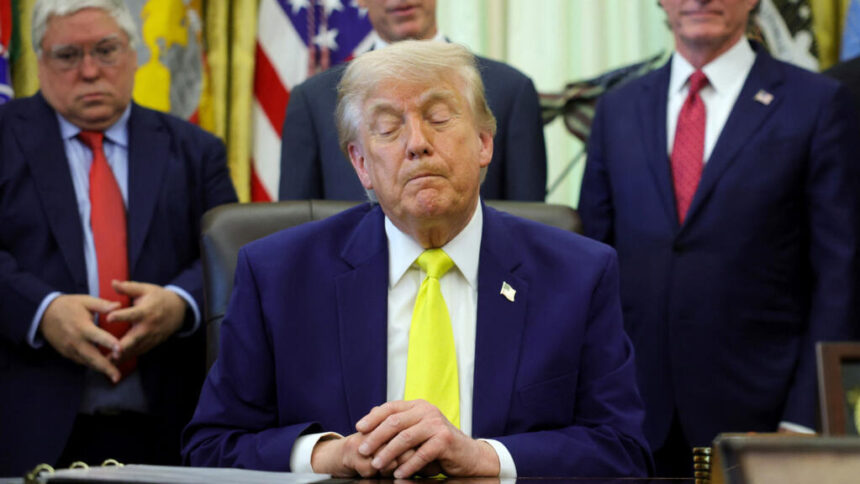
US President Donald Trump said on Tuesday that Washington would respond after Iran allegedly shot down an American Apache helicopter over the Strait of Hormuz, even as he maintained that negotiations with Tehran were entering their final phase and could produce an agreement within days.
“I have just been informed by our military that Iran shot down one of our Apache helicopters last night while it was conducting a patrol over the Strait of Hormuz,” Trump said. He added that the two pilots aboard survived unharmed but stressed that “the United States will have to respond to this attack.”
The reported incident came as diplomatic efforts appeared to gain momentum. Trump said negotiators had reached the final stages of talks aimed at ending tensions in the Middle East and predicted that an agreement could be concluded within “two or three days.”
“We are in the final stages of reaching an agreement that will be very good,” Trump told reporters after attending the NBA Finals in New York.
Later, speaking by phone at an election rally supporting Senator Lindsey Graham in South Carolina, Trump said the United States expected to achieve a “complete victory” over Iran within the next two weeks.
“We are negotiating now, and they want an excellent agreement,” Trump said. “They have shown a willingness to make all the concessions and accept our demand that they never possess a nuclear weapon.”
Despite the optimism expressed by Washington, Iran rejected a draft resolution on its nuclear programme submitted by the United States and the European trio of Britain, France, and Germany to the International Atomic Energy Agency’s Board of Governors, underscoring the challenges that remain before any final agreement can be reached.
Meanwhile, regional tensions continued to escalate.
Israeli military chief Eyal Zamir said Israel remained prepared to launch further military action against Iran if necessary, describing recent operations as only a precursor to “a much stronger and broader blow.”
“We are on high alert and ready to act forcefully wherever we identify a threat,” he said, adding that Israel would continue operations against Hezbollah and efforts to protect communities along its northern border.
The Israeli military also reported intercepting a “suspicious aerial target” launched from Yemen after warning sirens sounded in the Eilat area over concerns of a potential drone infiltration. Authorities later said the incident had concluded.
In Lebanon, Israel expanded military operations in the south, carrying out strikes on several locations around the coastal city of Tyre. Lebanon’s Civil Defence said eight people were killed in a strike on a residential area of the city, while three others were wounded in a separate attack on the town of Sharqiya, including two rescue workers.
The escalation coincided with a series of attacks claimed by Hezbollah. The group said it had targeted Israeli troops and a communications vehicle near Qantara using explosive drones and launched rockets at a newly established Israeli military position in Maroun al-Ras.
The Israeli military said 48 officers and soldiers had been wounded in fighting in southern Lebanon over the past five days. Since hostilities resumed in March, it reported that 30 soldiers had been killed and 1,291 wounded.
Iranian officials, meanwhile, signalled that diplomacy remained their preferred path while warning against any breach of commitments.
Iranian Parliament Speaker Mohammad Bagher Ghalibaf wrote on X that Tehran preferred “the language of diplomacy” but was “more fluent in other languages.”
“If you violate your commitments, we will resort to the language we know best,” he wrote, addressing both the United States and Israel.
The developments highlight the delicate balance between diplomatic engagement and military confrontation as regional powers continue to navigate one of the Middle East’s most volatile periods.