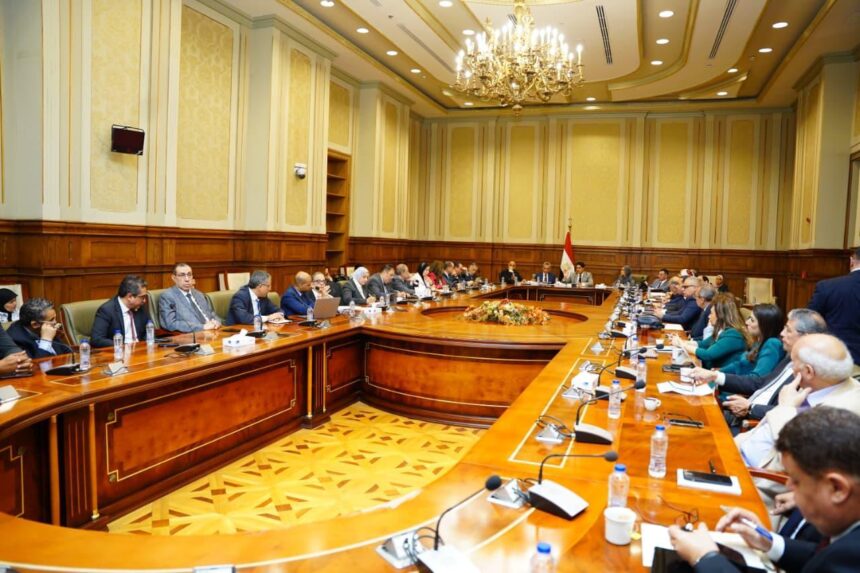
The Ministry of Planning and Economic Development has unveiled the key features of Egypt’s Economic and Social Development Plan for fiscal year (FY) 2026/27, as well as the medium-term development framework covering the period from FY 2026/27 to FY 2029/30. The plan was presented during a meeting of the Financial, Economic Affairs and Investment Committee of the House of Representatives, chaired by Ahmed Abou Hashima, and aligns with Egypt Vision 2030 and presidential directives aimed at improving citizens’ quality of life and boosting production rates.
The meeting was attended by Gamil Helmy, Assistant Minister for Monitoring Affairs; Kamal Nasr, Assistant Minister for Technical Office Affairs; Nehad Morsy, Assistant Minister for Infrastructure Affairs; Heba Abdel Moneim, Assistant Minister for Human Development Affairs; Mohamed Fathy Saqr, Adviser to the Minister for Plan Preparation; Ahmed Ashour, Adviser to the Minister for National Accounts; and Ismail Youssef, Senior Adviser to the Minister for Plan Implementation and Follow-up.
Ministry officials explained that the plan was formulated amid ongoing geopolitical uncertainty and persistent disruptions to global supply chains. It targets total investments of approximately EGP 3.7trn during FY 2026/27.
They noted that private-sector investments are projected to account for 59% of total investments for the first time, equivalent to around EGP 2.2trn. This reflects the government’s continued efforts to rationalise public investment while expanding opportunities for the private sector as a key development partner, with the goal of increasing the investment-to-GDP ratio to 20% by FY 2029/30.
Human development remains a central pillar of the plan. Ministry technical teams announced a 25% increase in allocations for the health and population sector, with a focus on completing digital transformation initiatives and accelerating the mechanisation of public and university hospitals.
The plan also provides for an 11.5% increase in allocations for pre-university education, an 11% rise for higher education, a 15% increase for scientific research, and a 27.6% increase for the Al-Azhar sector. Allocations for social housing are set to rise by 21%, alongside continued implementation of projects under the presidential Haya Karima initiative.
To support energy security and Egypt’s green transition, the plan includes a record 261.1% increase in allocations for the electricity and renewable energy sector. The additional funding is intended to strengthen the national electricity grid, accommodate new generation capacities, and advance strategic energy projects.
As part of efforts to stimulate the real economy, Ministry officials confirmed that the plan is anchored on five key sectors expected to drive investment-led growth: manufacturing industries, agriculture, telecommunications, transport, and logistics.
The plan also identifies several priority industries with strong potential to attract both domestic and foreign investment, including automotive manufacturing, green hydrogen, textiles, fertilisers, and chemicals. Projects in these sectors will be incorporated directly into Egypt’s Investment Map to facilitate investment promotion and implementation.
Officials further reviewed the integrated digital system used to prepare and monitor the national investment plan, which is linked to both the Ministry of Finance and the National Investment Bank. The system is designed to measure the developmental impact and efficiency of public spending.
They also highlighted the continued implementation of the Performance Excellence Incentives Initiative at the governorate level, aimed at promoting the equitable and efficient distribution of local investments based on development performance indicators and the State Ownership Policy Document.