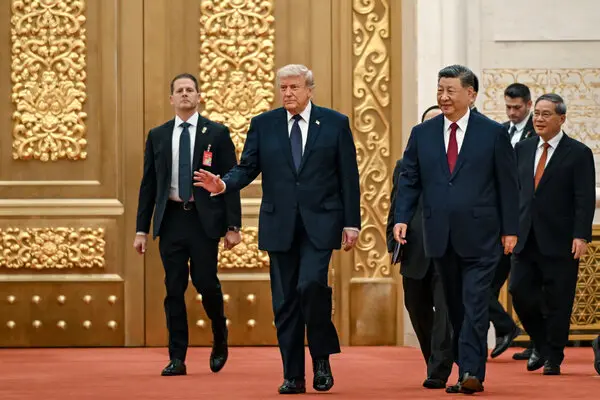
Not all political moments are captured by cameras. Some historic turning points are read in the silent details: in the timing of a visit, in the language of diplomatic statements, and sometimes even in official denials.
In international politics, denial can occasionally be part of the game. US President Donald Trump has officially denied requesting Chinese mediation regarding Iran during his recent visit to Beijing. Yet the timing of the visit, the nature of the issues discussed, and the simultaneous escalation in the Gulf have all prompted observers to ask a larger question: Is Washington beginning to view China as a partner that can no longer be bypassed in managing Middle Eastern crises?
From this perspective, Trump’s visit to Beijing was not merely a historic encounter between two strategic rivals or a diplomatic showcase between two great powers. It reflected a deeper transformation unfolding within the international system itself. The shift is neither the collapse of America, as some imagine, nor the rise of China as a traditional replacement empire. Rather, it lies in the changing nature of power itself. Today, power is no longer measured solely by military capabilities, but also by the ability to influence markets, energy flows, supply chains, and networks of economic dependency.
Even without an officially declared mediation request, the mere linkage between Beijing, Washington, and the Iranian file reveals an undeniable reality: China has become too influential to ignore in Middle Eastern calculations. Washington, which for decades acted as the sole power capable of shaping regional balances, now finds itself operating in a world where other actors possess genuine leverage in one of the most strategically sensitive regions on earth.
China today is not merely a trading partner for Tehran; it is a vital economic artery. It is the largest importer of Iranian oil, has massive strategic investments under the Belt and Road Initiative, and holds the ability to grant Tehran economic breathing space in the face of Western sanctions. This makes Beijing—unlike many other international powers—capable of addressing Iran in the language of interests, not threats alone.
However, reading the scene as a “complete Chinese victory” would be a superficial and hasty interpretation. China itself does not—at least not yet—seek to lead the world according to the traditional American model. Beijing is highly aware that any direct confrontation with Washington could threaten the global economic stability upon which its rise depends. Therefore, China’s strategy is based on quiet expansion: economic influence, commercial penetration, long-term investments, and flexible alliances, without engaging in large-scale military adventures.
As for Trump, he operates with a mindset different from that of classical American administrations. He does not place much faith in ideological alliances or grand slogans about democracy and human rights; he believes in the language of “the deal.” His political approach is deeply pragmatic: reducing tensions when necessary, protecting economic interests, and avoiding disruptions that could destabilize energy markets or global trade flows.

Yet behind this pragmatism lies a larger, undeniable truth: America is no longer able to manage the world single-handedly as it did after the collapse of the Soviet Union. In the 1990s, Washington acted as the “sole pole,” capable of imposing sanctions, igniting wars, and building international coalitions without needing genuine understandings with rival powers. Today, the landscape is entirely different.
The war in Ukraine exposed the limits of Western power. The escalation in the Middle East revealed the fragility of global energy markets. Meanwhile, China’s economic rise has created a web of mutual dependencies that makes isolating or bypassing Beijing extremely difficult. The world is gradually transforming into a more complex system in which centers of influence are distributed among Washington, Beijing, Moscow, and rising regional powers.
Most importantly, the Middle East itself is no longer what it once was. Countries in the region have become more pragmatic and more capable of diversifying their alliances. Saudi Arabia cooperates economically with China while maintaining its security partnership with America. The UAE moves flexibly between East and West. Turkey plays a balancing role between Russia and NATO. Even Iran itself is increasingly looking eastward.
In this context, Egypt stands before an important strategic opportunity. A multipolar world grants Cairo wider space for political and economic maneuver, away from the logic of sharp polarization. Egyptian-Chinese relations are expanding economically, while the security and military partnership with the United States continues. This ability to balance may become one of the most significant factors in Egypt’s strength in the coming years.
However, multipolarity does not necessarily mean greater stability. Sometimes a unipolar world is more predictable, while competition between major powers can lead to prolonged crises and open contests of influence. The real danger lies not in China’s rise alone, but in the absence of clear rules to regulate relations between the great powers in the coming phase.
The question that imposes itself here is not: “Has American hegemony ended?” but rather: “How will America behave in a world it no longer controls alone?”
Washington recognizes that Beijing has become its most serious economic competitor, yet it also understands that China’s role in global energy markets, trade networks, and regional diplomacy cannot simply be ignored. This complex relationship of rivalry and selective cooperation may become the defining feature of international politics over the next decade.
As for Iran, it is well aware of the value of its position within this equation. The higher the tension in the Gulf, the greater the importance of the Iranian role, and the greater the need for major powers to negotiate with it, directly or indirectly. Therefore, Tehran will likely continue using its regional pressure cards cautiously, without risking an all-out confrontation that could threaten the regime’s survival.
The Strait of Hormuz remains the true heart of the crisis. It is not merely a waterway, but a global energy artery through which a significant share of oil and gas exports flows. Any disruption there threatens not only the Gulf but the entire global economy. This is why the whole world watches this small area with anxiety that sometimes surpasses attention to the wars themselves.
In the end, Trump’s visit to Beijing may not be an official announcement of the end of the American era. Still, it is certainly a practical acknowledgment that the world has entered a new phase: a phase in which no power—no matter how strong—can manage international balances alone.
And perhaps this is the most important message the visit carried, far from official statements and diplomatic photographs: The world is changing… slowly, but profoundly.
Dr. Marwa El-Shinawy, Academic and Writer