

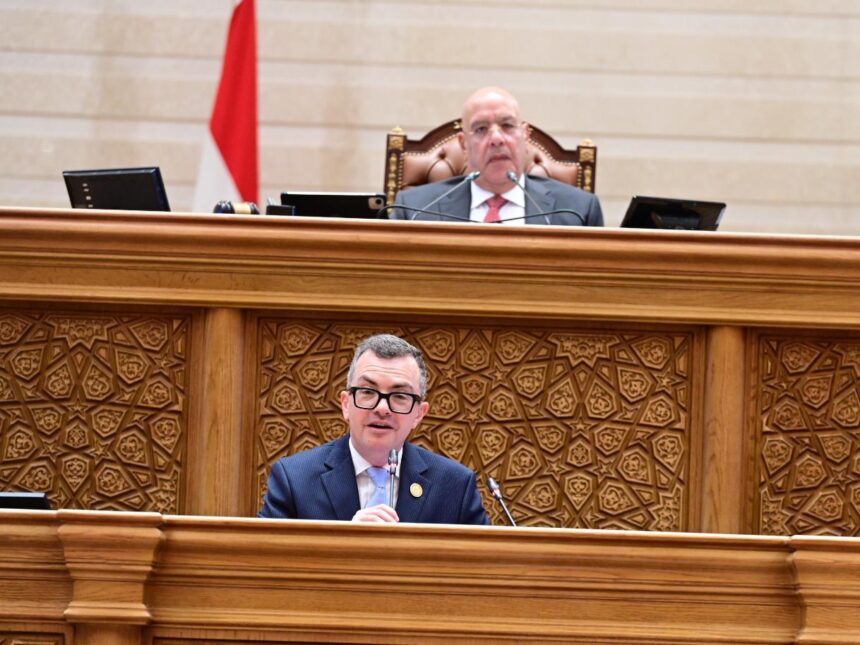
Minister of Planning and Economic Development Ahmed Rostom told parliament’s plenary session that Egypt’s economy is projected to grow by 5.4% by the end of the fiscal year (FY) 2026/2027, rising to 6.8% by the end of the medium-term plan in 2029/2030.
Rostom said the government has adopted a cautious growth scenario for both the upcoming fiscal year and the medium-term framework, reflecting ongoing regional and global uncertainty. Under a more conservative outlook, growth is expected to reach 5.2%.
He outlined the key features of the 2026/2027 economic and social development plan, alongside the medium-term framework covering 2027/2028 to 2029/2030. The targets, he noted, align with directives from President Abdel Fattah Al-Sisi and Prime Minister Mostafa Madbouly, focusing on improving economic conditions, enhancing quality of life, prioritising public services, boosting productivity, and strengthening food and energy security. The plan also emphasises human development, including accelerating the rollout of the universal health insurance system.
Rostom added that the presidential “Decent Life” initiative remains a central pillar, with plans to complete its first phase and begin the second phase in 2026/2027. The strategy also prioritises greater private sector participation, education reform, infrastructure development, and innovation.
The minister noted that the plan is being implemented amid persistent global challenges, including supply chain disruptions, slower trade growth, volatile financial markets, and rising energy, food, and commodity prices; factors that have increased import costs and inflationary pressures.
However, he said these challenges also create opportunities, particularly in import substitution, expanding agricultural and food exports, and promoting tourism.
Despite successive global shocks over the past two decades, Rostom said the Egyptian economy has demonstrated resilience, supported by proactive reform policies. Growth reached around 5.3% in the first half of the current fiscal year, despite the impact of the recent US-Iran conflict.
He added that five key sectors are expected to contribute around 64% of economic growth in 2026/2027. Manufacturing will lead with a 29% contribution, followed by wholesale and retail trade (11.3%), tourism (9.3%), construction (7.2%), and agriculture (7%).
Rostom stressed that the strong performance of real-economy sectors, particularly manufacturing, reflects the government’s focus on productive and service activities that generate employment, raise living standards, and enhance export capacity and competitiveness.
GDP at current prices is projected to reach EGP 24.5trn in 2026/2027, up from an expected EGP 21.2trn by the end of the current fiscal year, and rising further to EGP 36.8trn by 2029/2030. Agriculture, industry, construction, and wholesale and retail trade are expected to account for 62% of GDP, led by agriculture (16.7%), industry (16.2%), construction (15.3%), and trade (14.2%).
Total investments for 2026/2027 are projected at EGP 3.7trn, with public investment accounting for 41% (EGP 1.5trn) and private investment 59% (EGP 2.2trn). The investment-to-GDP ratio is expected to reach 17%, with a target of 20% by the end of the medium-term plan, alongside increasing the private sector’s share to 64%.
On human capital, Rostom announced a 25% increase in health sector allocations to support the expansion of universal health insurance, including the second phase covering Alexandria, as well as continued development of ambulance services and related projects.
Education spending will also rise, with an 11.5% increase in pre-university allocations to expand Egyptian-Japanese schools, build and upgrade classrooms, and rehabilitate technical schools in partnership with the private sector. Higher education allocations will increase by 11% to support the mechanisation of 60 university hospitals and the completion of 12 technological universities nationwide.
Social protection spending is set to increase by 57% to support the second phase of the national family development project and early childhood initiatives, while allocations to Al-Azhar will rise by 27.6%.
The plan also includes increased investment in basic services, including a 22% rise in utilities and water sector spending, 21% in social housing, 88% in irrigation and water resources, and a 261% increase in renewable energy investments to support the national electricity grid. Additional funding will be directed towards ensuring reliable electricity supply for strategic and national projects.
Rostom stressed that despite ongoing challenges and weaker global growth expectations, Egypt remains committed to advancing economic reform and sustainable development, building on gains achieved in recent years.
He concluded that the plan’s success will not be measured solely by GDP growth, but by tangible improvements in citizens’ wellbeing and the opportunities created for future generations.


