
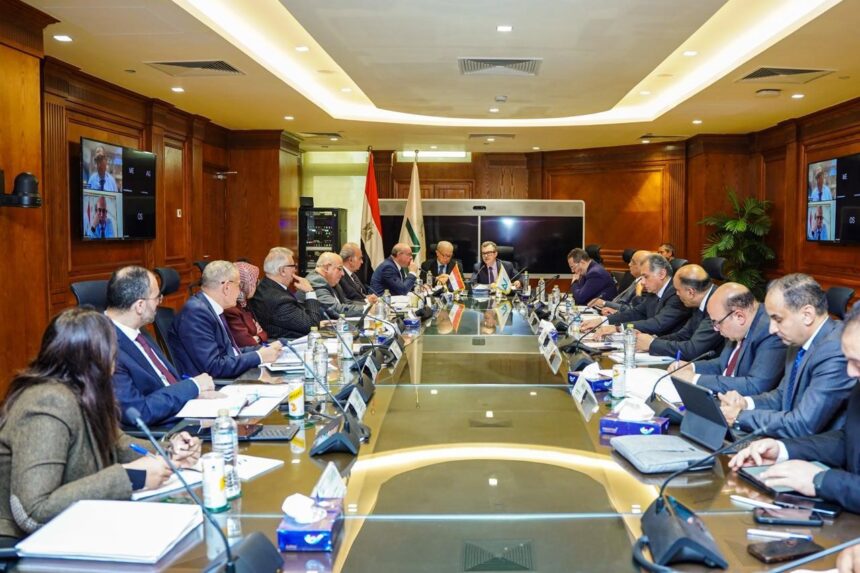
Ahmed Rostom, Minister of Planning and Economic Development and Chair of the National Investment Bank (NIB), chaired a meeting of the Bank’s Board of Directors to review progress on its ongoing restructuring, aimed at strengthening its role as the government’s development and investment arm.
The meeting was attended by Hussein Eissa, Deputy Prime Minister for Economic Affairs, and Mohamed Farid Saleh, Minister of Investment and Foreign Trade, alongside other board members. Discussions focused on enhancing the Bank’s contribution to implementing Egypt’s economic and social development plan.
Key deliberations centred on improving the efficiency of public investments by strengthening oversight of funding allocations and linking them to actual project implementation rates. The board also reviewed progress in digitally integrating databases between the Ministry of Planning and Economic Development, the Ministry of Finance, and NIB to support more effective decision-making.
Rostom stressed that restructuring the Bank remains a top state priority, with the aim of transforming it into a fully institutionalised tool that supports the execution of development projects. He highlighted the importance of leveraging the Bank’s affiliated companies to participate in newly launched initiatives in employment, entrepreneurship, and start-ups.
The board also examined proposals to maximise returns on the Bank’s investment portfolio and to support emerging investment opportunities across companies and financial institutions.
Rostom noted that the government is working to enhance the efficiency and effectiveness of public spending through closer coordination between NIB, the planning ministry, and the finance ministry. This includes linking databases in line with the shift towards programme- and performance-based budgeting, ensuring that financial allocations are tied to actual delivery rates and enabling more accurate performance measurement across government entities.
He also directed the provision of necessary resources to further develop the Bank’s digital infrastructure and adopt advanced technological solutions.
The minister added that strengthening NIB’s role aligns with presidential directives to accelerate economic development, improve overall economic conditions, and expand private sector participation in the national economy, ultimately contributing to higher living standards.
He emphasised that the government is pursuing a comprehensive development vision that places citizens’ priorities at its core, with a focus on ensuring that projects are underpinned by sound feasibility studies, innovative financing mechanisms, and sustainable partnerships. This is closely tied to strengthening public investment governance through clear project prioritisation, rigorous monitoring, and impact evaluation.
Rostom also pointed to directives from the prime minister to adopt clear performance indicators, ensuring that resources are channelled towards projects delivering the highest economic and social returns, while improving execution efficiency across the development plan.
The board reviewed the future restructuring roadmap for NIB, including its role in implementing public investment governance reforms and delivering projects in line with national priorities.
The Bank’s board includes a number of prominent figures, among them Hussein Eissa, Deputy Prime Minister for Economic Affairs; Mohamed Farid, Minister of Investment and Foreign Trade; Ashraf Negm, Vice Chaitpersin and Managing Director; Osama Saleh, former Minister of Investment; Mohamed El-Etreby, Chief Executive Officer of the National Bank of Egypt; Sherif Ashour, representative of the Central Bank; Aboubakr Hassan, Adviser to the Minister of Finance; Sherif Sami, former Chairperson of the Financial Regulatory Authority; Medhat El-Madany, human resources and institutional development and governance consultant; Ahmed El-Gendy, Managing Director of TCV Holding for Financial Investments; and Salah Helal, Vice President of the State Council.