Russian President Vladimir Putin and the Ukrainian Armed Forces have ordered a mutual three-day ceasefire starting midnight Saturday to facilitate peace negotiations, as US envoys Steve Witkoff and Jared Kushner arrived in Moscow to present a proposal aimed at ending the five-year war.
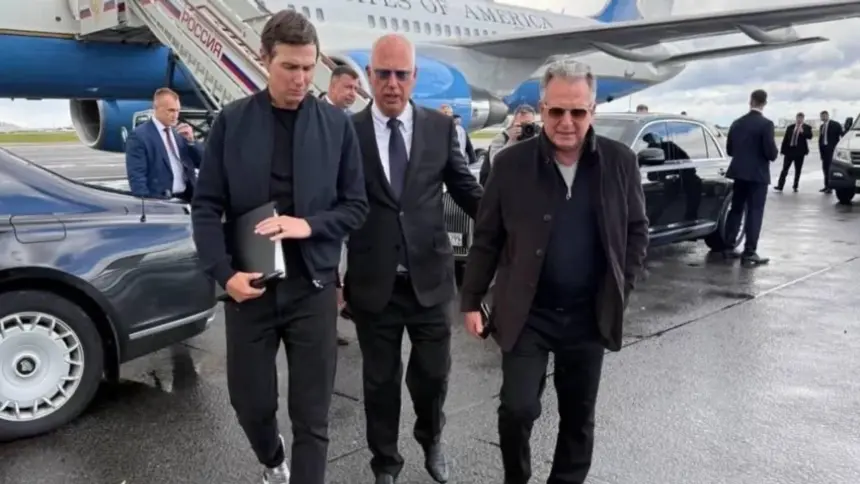
The US envoys, representing President Donald Trump, were received by Russian envoy Kirill Dmitriev at Vnukovo International Airport, according to the Russian state news agency TASS. Putin is scheduled to meet the envoys later on Saturday before their planned departure to Kyiv on Sunday, a city neither Witkoff nor Kushner has previously visited.
Kremlin spokesman Dmitry Peskov confirmed that the suspension of Russian strikes on Ukraine will last for three days. Earlier, Ukrainian media reported that Kyiv’s armed forces had similarly announced a ceasefire from midnight on September 5 until September 8. Ukrainian President Volodymyr Zelenskyy stated on Friday that his forces would not conduct airstrikes on Russia during the envoys’ visit, urging Putin to take a corresponding step.
The visit marks the first time US envoys have travelled to Russia since January. Peace negotiations between Moscow and Kyiv, which were backed by Washington, entered a deep freeze a month after that visit following the outbreak of the war waged by the United States and Israel on Iran.
Since taking office in January 2025, Trump has deployed Witkoff for regular meetings with the Russian president, with Kushner joining the talks late that year. Speaking to reporters at the White House on Friday, Trump hinted at a concrete proposal to end the conflict but withheld specific details.
“We have an idea for peace,” Trump said. “I sent Steve Witkoff and Jared Kushner, and they are great negotiators. They have done a great job, and we sent them to see if we can reach something. There might be a good chance to achieve that.”
Peace Proposal and Russian Demands
The arrival of the envoys follows a recent trip to Moscow by CIA Director John Ratcliffe. According to The New York Times, Ratcliffe presented a pessimistic assessment of Russia’s prospects in the war and urged Russian officials to end the conflict.
While Peskov praised the “goodwill of the Americans” and their readiness to mediate on Friday, he reiterated that Russia will continue to insist on the withdrawal of Ukrainian forces from the eastern Donetsk and Luhansk regions before agreeing to any permanent ceasefire—a demand Kyiv consistently rejects.
These remarks followed comments by Putin on Thursday, in which he stated that regardless of American mediation efforts, “Russia and Ukraine must first reach an agreement between themselves.”
Both nations are facing mounting financial pressures to fund the increasingly costly war while struggling to keep pace with advanced military technologies, including jet-powered drones and ballistic missiles.
Since April, Ukraine has engaged in a campaign targeting Russian oil, fuel, and logistics infrastructure. Conversely, Russia has capitalised on Ukraine’s dwindling stockpiles of air defence interceptors to strike an increasing number of targets across the country. On Friday, a drone struck the headquarters of Ukraine’s internal intelligence service in central Kyiv.
Ukraine Faces Winter Defence Shortages
As diplomatic efforts resume, Ukraine is preparing for another harsh winter under the threat of escalating Russian air raids, with a severe lack of Patriot missiles limiting Kyiv’s defensive options, Bloomberg reported.
Attempts to mitigate the shortage—including utilising Elon Musk’s Starlink satellite internet, developing alternatives to US-made air defences, and creating methods to alter the trajectories of incoming projectiles—have failed to provide a rapid or sufficient solution.
Meanwhile, Moscow has ramped up its production of ballistic missiles and Shahed jet drones, threatening Kyiv with a near-continuous barrage of strikes over recent days. Russia is actively exploiting the growing capability gap by introducing new weapons, such as the “Banderol” hybrid missile-drone, which has proven difficult for Ukrainian forces to intercept.
Kyiv has urgently requested further support from Western allies, but many remain hesitant to dispatch additional Patriot systems. Global stockpiles have been heavily depleted by the war on Iran, leading to years-long delays in production orders. Furthermore, Russia’s current production of ballistic missiles significantly outpaces the United States’ capacity to manufacture interceptors.
“We have now reached a stage where we have effectively exhausted our missile defence capabilities compared to the growing threat,” said Michael Kofman, an analyst at the Carnegie Endowment for International Peace in Washington. “Not much can be done this winter if Ukraine does not receive additional interceptor missiles.”
Interceptor Production and Allied Pressure
Zelenskyy has stated that Ukraine requires 300 missiles to survive the winter, a figure he claimed represents only 5% of the US Patriot stockpile. Recent estimates indicate the United States holds approximately 800 of the latest PAC-3 missiles and “several hundred” of the older generation PAC-2 missiles.
On Thursday, Zelenskyy announced he is focusing on “accelerating all necessary processes to produce high-speed interceptor missiles” to counter advanced Russian drones, noting on the social media platform X that prototypes are currently in development.
US Secretary of State Marco Rubio said on Wednesday that a licensing agreement to allow Ukraine to manufacture American interceptor missiles is “currently under negotiation,” though he cautioned it would not serve as an immediate solution to the country’s urgent needs.
In the interim, NATO and European Union member states are applying pressure on Spain and Greece to transfer Patriots from their reserves, which are among the largest held by Ukraine’s allies, according to sources familiar with the matter. Ukraine has also reached out to other nations, including South Korea and Japan, though these efforts have yet to yield results.