

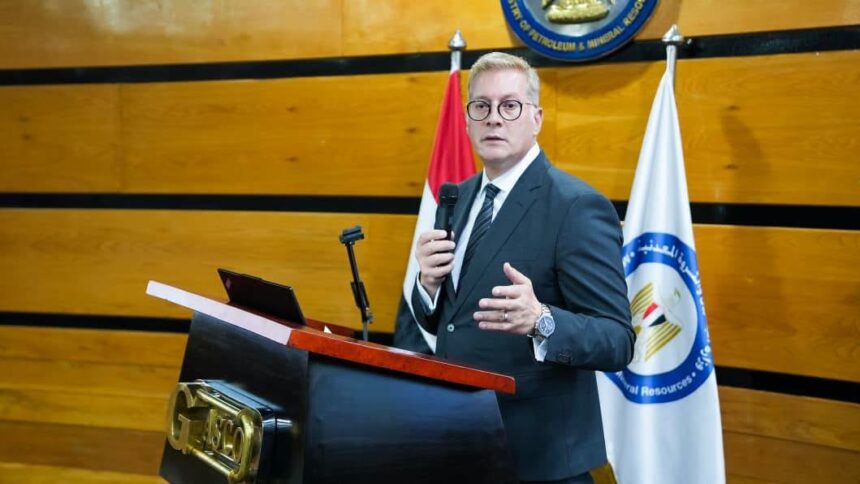
Petroleum and Mineral Resources Minister Karim Badawi said the regular settlement of partners’ dues, together with the incentives and corrective measures introduced by the government, has helped rebuild investor confidence and paved the way for increased drilling, exploration and field development, supporting efforts to boost domestic production and reduce the import bill.
Badawi made the remarks during a meeting with the heads and managers of international and Egyptian oil companies that are partners in Egypt’s oil and gas exploration, production and development activities. The meeting was held at GASCO in the presence of senior officials from the Ministry of Petroleum and Mineral Resources, the Egyptian General Petroleum Corporation (EGPC), the Egyptian Natural Gas Holding Company (EGAS) and the South Valley Egyptian Petroleum Holding Company (GANOPE).
The meeting reviewed current performance indicators for exploration and production activities, as well as work plans, field development programmes and production growth targets over the next five years. It also covered new investment opportunities and targeted work programmes through 2030.
Badawi said the commitment of oil and gas partners to continue their operations and investments in Egypt, despite challenges arising from accumulated dues and delays in settling monthly invoices, demonstrated their confidence in Egypt, the future of its oil and gas sector, and the country’s position as a safe, stable and attractive investment destination.
The minister expressed his appreciation for the strong support provided by President Abdel Fattah Al-Sisi in resolving the issue of accumulated dues. He stressed that addressing the challenge had not been easy, but partners’ outstanding dues were fully cleared in June in line with the government’s targeted timetable.
Badawi also referred to the messages delivered by President Al-Sisi to investment partners during the Egypt International Energy Show (EGYPES 2026) in March, in which he underscored the state’s appreciation for their commitment to maintaining operations and investments despite the dues challenge, while reaffirming the government’s determination to resolve the issue—a commitment that has now been fulfilled.
He said the incentive measures and continued cooperation with investment partners, together with the resulting increase in drilling, exploration and production activities over the past two years, had helped curb the natural decline in gas production that began in 2021 and maintain current output levels.
The minister stressed that without these corrective measures, gas production would have continued to decline to significantly lower levels, resulting in a substantial increase in Egypt’s energy import bill.
He noted that the impact of the measures had become evident more quickly in crude oil production because a large share of Egypt’s oil fields are located onshore or close to existing production facilities, particularly in the Western Desert, Eastern Desert and the Gulf of Suez. This enables new wells to be brought into production more rapidly and at lower cost.
By contrast, he said, much of Egypt’s natural gas production comes from offshore and deepwater fields, which require larger investments and longer development periods before discoveries can be connected to production facilities. He added that ongoing development and drilling programmes are expected to gradually return gas production to a growth trajectory.
Badawi also announced preparations to launch a new seismic survey in a frontier area of the Western Desert near the Libyan border. The survey aims to collect updated geological and geophysical data to support efforts to attract oil and gas exploration investment to the region, which has not previously witnessed petroleum exploration activities.
The survey area covers approximately 110,000 square kilometres, equivalent to around 11% of Egypt’s total land area. Badawi said a tender had been completed and Saudi Arabia-based Ardisys, a company specialising in seismic survey services, had been selected to carry out the project.


