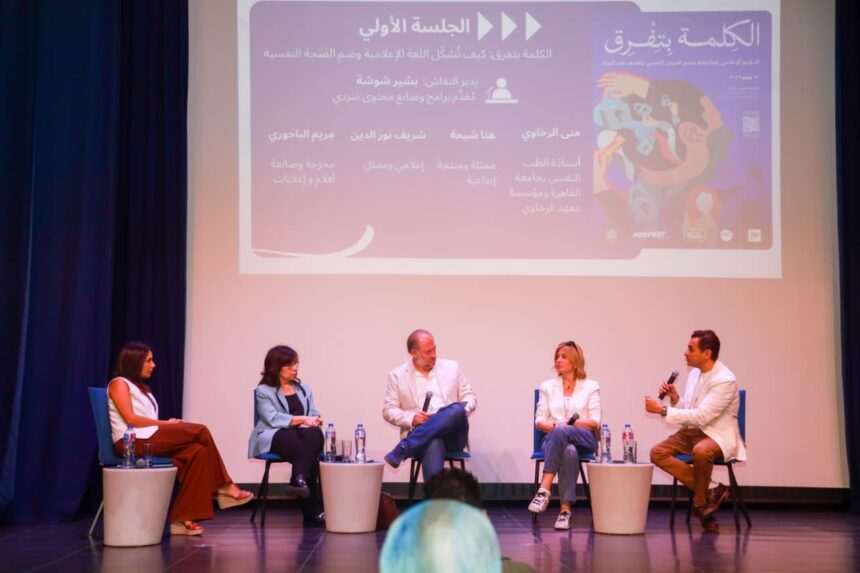
Arab media and dramatic arts are undergoing a genuine awakening in their treatment of mental health, shifting from historical stigmas that labelled mental illness as “madness” toward a more nuanced and separate evaluation of individual disorders, media professionals and psychiatry experts said at a Cairo conference.
Speaking at the inaugural session of the “Al-Kelma Betefraq” conference, panellists examined how media language, headlines, and narrative styles can either entrench or dismantle social stigmas surrounding psychological conditions. The session, titled “How Media Language Shapes Mental Health Stigma,” was organised by the Centre d’Études et de Documentation Économiques, Juridiques et Sociales (CEDEJ) in cooperation with the French Institute in Egypt and the MedFest Egypt festival.
The Evolution of Public Discourse
Panellists traced the shifting cultural and social factors that have historically surrounded mental health with silence and reservation, outlining the responsibilities of traditional and digital media platforms in delivering more humane coverage. Session moderator and content creator Bashir Shousha noted that public perceptions are fundamentally shaped by societal dialogues, stating that the discourse has transitioned from describing mental illness as madness, to speaking about it with significant caution, to the current landscape where each psychological disorder or illness is highlighted individually. Shousha added that this trajectory reflects positive development and demonstrates that society is moving toward greater awareness and openness.
Mona El-Rakhawy, Professor of Psychiatry at Cairo University and founder of the Rakhawy Institute, clarified the distinction between psychological well-being and clinical conditions. El-Rakhawy explained that mental health represents the normal baseline state that empowers an individual to confront sadness and pain while maintaining a functional social life. This does not imply the absolute absence of pain or difficulties but rather the capacity to coexist with them and manage life in a balanced manner. Conversely, she defined mental illness as the other side of the spectrum, characterising it as a pathological state or deep suffering that directly impairs the individual or those within their immediate environment.
Drama as a Tool for Human Understanding
Filmmakers and actors on the panel emphasised that dramatic works should function as mechanisms to comprehend human behaviour rather than platforms for moral judgment or direct lecturing. Several modern Arab productions illustrate how contemporary narratives approach mental health themes. The film “32B,” discussed by Hana Shiha, details the relationship between a father and his teenage daughter. The production illustrates that despite the father’s proximity to his child, he lacks the appropriate language to communicate with her on basic matters, thereby showcasing intergenerational communication gaps and family vocabulary deficiencies.
Another example highlighted during the panel was the television series “Midterm,” directed by Maryam El-Bajouri, which examines a group of young people facing various psychological stressors. The project focuses specifically on a character dealing with pathological lying to explicitly contrast general everyday psychological pressures with defined, clinical mental illnesses. Additionally, the series “Al-Saba’ Wasaya” was presented as an example of the intense psychological study required by performers, with Shiha noting that the persona was entirely distant from her own personality, requiring significant effort to enter the character’s psychological world, followed by a demanding process to psychologically detach from the role afterward.
Shiha observed that the Tribeca Film Festival award-winning film “32B” highlights the critical importance of family communication, particularly given the lack of sufficient awareness within many households regarding such matters. She argued that art remains one of the simplest and most potent vehicles for conveying sensitive and complex themes to the public because it presents them indirectly, avoiding direct rhetoric that can alienate audiences. El-Bajouri stated her total rejection of using mental illness as a source of mockery or comedic punchlines in dramatic works, asserting that drama must build awareness by presenting mental illness as a single component of human experience rather than an individual’s entire definition.
The Digital Challenge of AI and Self-Diagnosis
While panellists welcomed the broader societal openness, they issued warnings regarding the unintended consequences of readily accessible online information. Media presenter and actor Sherif Nour El-Din warned that the ease of accessing information via the internet has led some individuals to self-diagnose or diagnose others without consulting professionals. This practice frequently results in a flawed understanding of psychological conditions, and Nour El-Din stressed the critical importance of raising public awareness about the necessity of seeking professional medical consultations instead of rushing to conclusions.
El-Bajouri noted that she deliberately showed characters in “Midterm” turning to the artificial intelligence tool ChatGPT to search for answers about their symptoms. She stated that this inclusion reflects a rising real-world behavioural trend where people rely heavily on internet search engines and digital tools to interpret their psychological struggles.
Media Awakening and Institutional Reform
Nour El-Din stated that direct television programming and dramatic storytelling require distinct artistic tools to engage audiences effectively. He affirmed that a genuine awakening is occurring through various public initiatives and drama series, which has prompted audiences to research and understand these issues more thoroughly. Furthermore, Nour El-Din reported that issues such as mental health, domestic violence, and violence against women are now heavily featured across media, drama, and community initiatives, noting that individuals are increasingly demonstrating the courage to share personal stories publicly, effectively breaking down long-standing barriers associated with stigma.
El-Rakhawy identified several critical areas requiring sustained educational and clinical focus, including parental communication methods with children, comprehensive sex education, and coping skills for managing psychological pressure. She also drew attention to emerging dependencies, specifically internet addiction and electronic gambling, which she warned pose severe psychological and social risks to younger generations.
Reflecting on classical cinema, El-Rakhawy praised older films that addressed psychological disorders without resorting to stereotyping or defamation, while emphasizing that creative freedom must be preserved. She called for a structural framework that respects the human message of artistic works and provides accurate information supporting the cause. Nour El-Din echoed this sentiment, noting that several classic cinematic works tackled these complex issues at times when public awareness was significantly lower than it is today, expressing hope for the continuous refinement of how both mental illness and psychiatrists are portrayed in contemporary drama. Al-Bajouri concluded by stating that when addressing any psychological issue, she prioritises starting from the human narrative and individual personal accounts, listening to those living the experience before applying medical explanations, as the human story remains the primary gateway to understanding.