

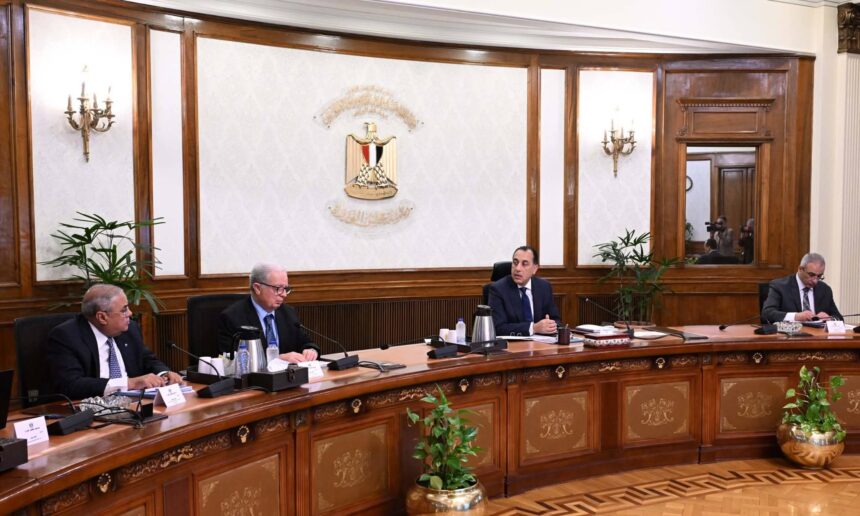
Prime Minister Mostafa Madbouly chaired a high-level meeting on Sunday to review executive plans for developing the Sinai Peninsula and boosting investment inflows, as part of the government’s broader strategy to achieve balanced urban growth and strengthen the national economy.
The meeting brought together Minister of Water Resources and Irrigation Hani Sewilam, Minister of Agriculture and Land Reclamation Alaa Farouk, and Presidential Advisor for Military Affairs Osama Askar, alongside senior officials from relevant ministries. Minister of Local Development and Environment Manal Awad and the governors of North and South Sinai participated via video conference.
Madbouly said the meeting aimed to accelerate development efforts in Sinai and increase population density, describing the peninsula as “not only a precious part of Egypt, but also a gateway for development and a promising opportunity to drive economic growth and urban balance.”
He added that the government is working to attract investors by expanding development projects, creating job opportunities, and establishing integrated urban communities supported by essential infrastructure.
Egypt has already invested billions of pounds in Sinai, with ongoing projects spanning agriculture, industry, tourism, and infrastructure, including upgrades to Arish Port and the peninsula’s airports.
The prime minister also referred to his recent visit to North Sinai, highlighting tangible progress achieved by state institutions while acknowledging existing challenges. He noted that coordination among relevant entities is ongoing to address these obstacles and sustain development momentum.
Officials revealed during the meeting that between 2014 and 2026, a total of 975 projects have been implemented across Sinai, with total investments reaching EGP 638bn.
These projects cover key sectors including education, healthcare, youth services, supply systems, culture, and postal services, in addition to agricultural, industrial, and urban development.
Efforts have also focused on improving the investment climate through upgrades to transportation networks, water and sanitation systems, electricity, petroleum and gas infrastructure, and telecommunications.
For his part, Osama Askar highlighted directives from President Abdel Fattah Al-Sisi to expand development projects in Sinai. He outlined ongoing initiatives and underscored the region’s strong investment potential, particularly in tourism and agriculture, calling for expanded livestock and poultry production in North Sinai.
Hani Sewilam reviewed major water and irrigation projects, including the Sheikh Jaber Canal, which serves around 275,000 feddans and supports development in areas such as Sahl El-Tina, South Qantara East, and Bir El-Abd.
He also highlighted the Bahr El-Baqar water treatment system, which irrigates more than 270,000 feddans through 17 pumping stations, alongside development clusters targeting the reclamation and cultivation of over 10,000 feddans across North and South Sinai.
Alaa Farouk reaffirmed the Ministry of Agriculture’s commitment to enhancing food security and integrating Sinai residents into sustainable development plans aligned with Egypt Vision 2030.
Meanwhile, Manal Awad outlined local development initiatives, including infrastructure upgrades, sanitation projects, and economic empowerment programmes. She also pointed to the development of slaughterhouses in South Sinai—specifically in Ras Sudr and Abu Redis—as well as in Arish, with plans to involve private sector operators.
Awad further reviewed progress on the Holy Family Trail project, noting that one of its key sites in North Sinai holds significant historical and tourism value, with plans to develop it into an integrated investment destination in line with international environmental standards.
The governors of North and South Sinai also presented updates on local development efforts and major projects, including green hydrogen initiatives and industrial zone infrastructure.
Concluding the meeting, Madbouly directed officials to accelerate the operation of services supporting development projects, streamline procedures for investors and citizens, and improve transportation links to and from Sinai to further enhance its appeal as a key investment destination.


