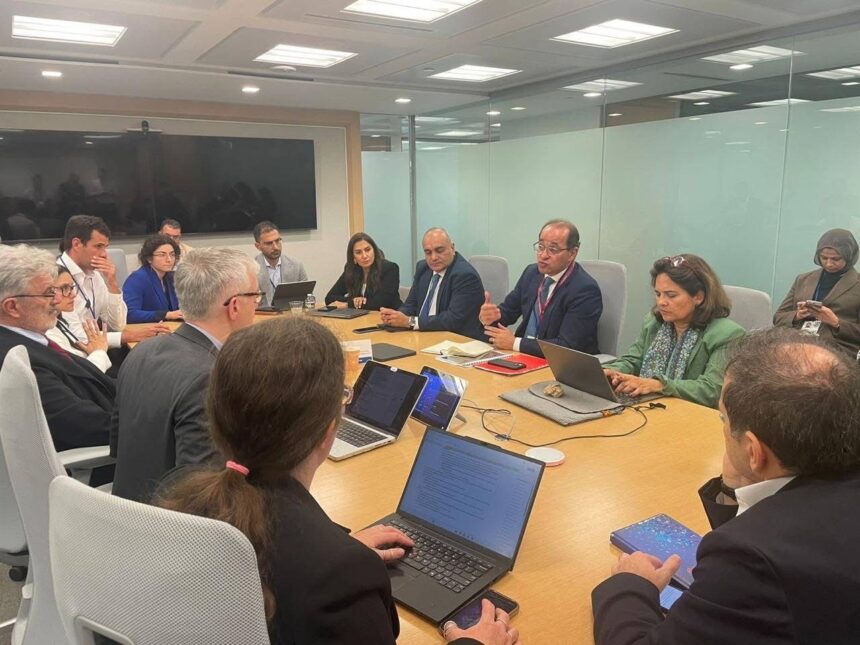
Egypt’s economy expanded by 5.3% in the first half of the current fiscal year, Finance Minister Ahmed Kouchouk told international investors during a meeting in Washington, attributing the growth to private sector investments.
Speaking at an open dialogue organised by Jefferies International and Societe Generale on the sidelines of the International Monetary Fund and World Bank Spring Meetings, Kouchouk outlined the country’s proactive response to recent economic challenges.
According to a Ministry of Finance statement, the minister detailed a series of improving economic indicators to attendees, noting that Egypt’s overall budget deficit narrowed to 5.2% of gross domestic product (GDP) during the July-to-March period, down from 6% in the previous fiscal year.
During the same nine-month period, Egypt recorded a primary surplus of 3.5% of GDP, supported by an active policy to increase domestic revenues. Tax revenues surged by 29% from July to March, which Kouchouk attributed to growing private sector activity and enhanced trust within the business community.
Addressing the country’s debt profile, Kouchouk stated that the external debt of budget agencies fell by approximately $4bn in June 2025 compared to 2023. Over the past two fiscal years, Egypt’s debt-to-GDP ratio decreased by approximately 13%, contrasting with a 6% average increase across emerging markets. He noted that updated reports from credit rating agencies reflect a stable, positive outlook for the Egyptian economy.
The minister also highlighted noticeable improvements in the performance of the tourism sector, non-oil exports, expatriate remittances, and foreign direct investment.
Kouchouk told the Washington gathering that Egyptian authorities had managed the current crisis with a rapid methodology that earned the appreciation of international institutions. He emphasised that full coordination exists among all government agencies to ensure quick decision-making and robust communication with markets and investors.
Outlining the country’s medium-term fiscal policy, Kouchouk detailed four priorities: ensuring financial discipline, reducing debt, and enhancing economic competitiveness, while balancing this discipline with economic support and highly targeted social protection programmes.
“We are committed to the path of economic reform, and we are continuing with initiatives to support tourism, production, exports, and entrepreneurship,” Kouchouk said.