

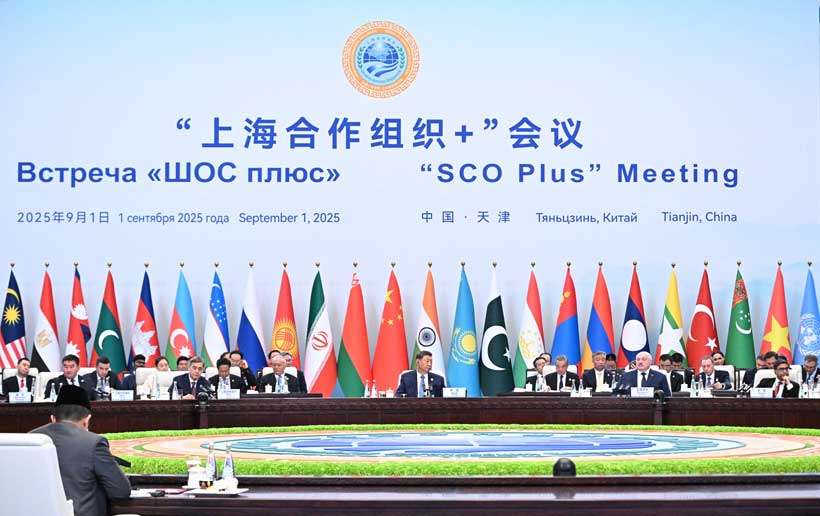
A few days ago, leaders of 20 nations convened in Beijing for the largest summit of the Shanghai Cooperation Organization (SCO) since its establishment 24 years ago. Among the attendees were the Presidents of China and Russia, as well as the Prime Minister of India.
The SCO summit charted the contours of a new map of political and economic alliances that could become one of the most influential—if not the most powerful—on the global stage. The bloc represents a consumer market of 3.2bn people, roughly 40% of the world’s population, with a combined economy of around $25trn, accounting for a quarter of global GDP. In addition to its economic heft, the organisation possesses strategic resources in food security, energy, and industry, as well as substantial military power.
Russian President Vladimir Putin, whose decline many in the West had considered irreversible following the Ukraine war, has reasserted his influence, proving that political games are often decided in the final rounds. Putin continues to consolidate gains—both through his “special operation” in Ukrainian territories and on the global diplomatic stage, following earlier summits such as the one in Alaska with US President Donald Trump.
The emerging alliance, spearheaded by China, Russia, and India, shares a common grievance: all three nations have suffered under successive US administrations’ policies. India, in particular, was recently hit with sanctions by Trump after becoming a major buyer of Russian oil. Trump’s tariffs also disrupted trade for many countries represented at the summit. The bloc’s leaders issued the “Tianjin Declaration,” which carried a veiled rebuke of Washington, denouncing “unilateral coercive measures”—including those of an economic nature—that “undermine international law” and violate World Trade Organization norms and the UN Charter.
India’s inclusion in the SCO could upset the bilateral balance between Moscow and Beijing, especially given that Sino-Indian relations remain strained. Politically, tensions persist over renewed border disputes; economically, India has become a haven for US tech companies fleeing China over the past five years.
India’s membership also poses a challenge to Russian and Chinese dominance of the SCO. Despite their commercial ties, India is unlikely to meaningfully support Russia’s war in Ukraine or China’s claims over Taiwan and the South China Sea.
India has long sought a permanent seat on the UN Security Council but has received only lukewarm support from Beijing and Moscow, likely to preserve their own influence over the West. However, New Delhi risks little so long as Washington continues to project uncertainty over trade relations.
Earlier this year, India refused to sign a joint statement at a June SCO defence ministers’ meeting, objecting to what it saw as a pro-Pakistan bias after the omission of the April 22 mass shooting of tourists in Indian-controlled Kashmir.
Successive US administrations have courted India as a counterweight to China, actively driving wedges between New Delhi and Moscow, and between New Delhi and Beijing, fearing the very rapprochement now taking shape. The image of the three leaders literally holding hands is, at minimum, a symbolic blow—and perhaps a diplomatic slap in the face—for Trump, the likes of which no US president has faced.
Indian Prime Minister Narendra Modi’s remarks reinforced American concerns. He described the summit as an “opportunity” for India, praising its emphasis on connectivity and trade among member states. “India has always believed that strong connectivity not only boosts trade but also opens doors to growth and trust,” Modi said. For him, the summit is a platform to assert India’s status as a formidable player with influential partners—a standing expected to grow further.
Modi confirmed that India will continue purchasing Russian oil and has taken serious steps to mend relations with Beijing, especially with President Xi Jinping. India has frozen plans to acquire US weaponry and cancelled a high-level defence visit to Washington, potentially undermining over a decade of American efforts to strengthen its partnership with New Delhi as part of its China-containment strategy.
While Sino-Indian relations are entering a thawing phase, they are far from warm. The scars of the deadly 2020 border clashes remain, alongside disputes over technology, regional influence, and contentious issues such as North Korea.
Washington’s concerns extend beyond bilateral dynamics. The summit saw the adoption of several landmark documents, including the Tianjin Declaration and a 2026–2035 development strategy for the SCO. Leaders also issued statements supporting the multilateral trading system, commemorating the 80th anniversary of the end of World War II and the founding of the United Nations, and endorsed 24 additional agreements to deepen cooperation in security, economics, and people-to-people ties.
Chinese President Xi Jinping proposed a Global Governance Initiative built on five principles: adherence to sovereign equality, respect for international law, multilateralism, a people-centred approach, and concrete action. The SCO’s long-term strategy positions it to play a more assertive role in maintaining regional peace and stability—a role that directly challenges the United States’ unrivalled influence over global crises since the fall of the Berlin Wall and the collapse of the Soviet Union.
Dr. Hatem Sadek – Professor at Helwan University

