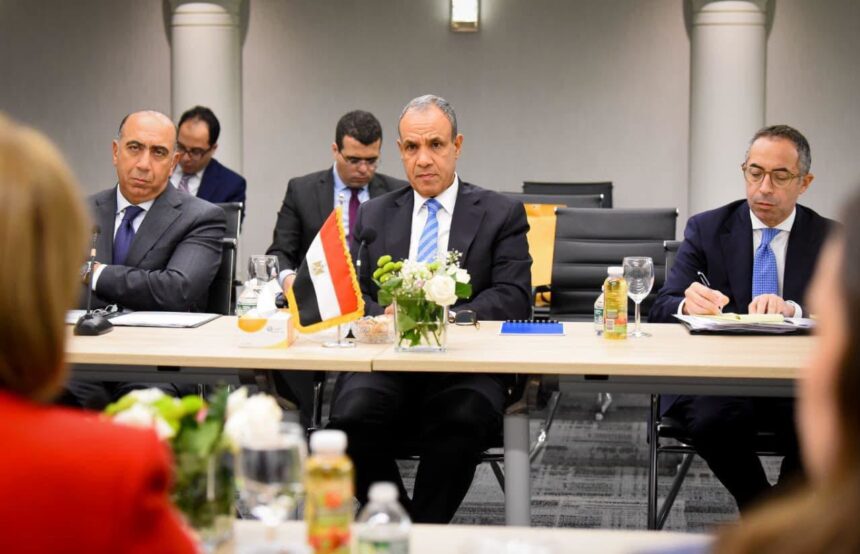
Egyptian Foreign Minister Badr Abdelatty called for de-escalation and a return to political negotiations over the Iran crisis and developments in Yemen, while stressing the need to protect freedom of navigation through the Strait of Hormuz, during a series of meetings on the sidelines of the United Nations General Assembly in New York.
Abdelatty discussed Iran, Yemen and the Strait of Hormuz with European Union Special Representative for the Gulf Luigi Di Maio, saying political dialogue and negotiations were needed to strengthen regional security and stability. He also stressed that maritime security and freedom of navigation should be protected in accordance with international law.
The two officials also discussed expanding Egypt-EU cooperation in trade, investment and energy.
Abdelatty delivered a similar message in talks with International Crisis Group President Comfort Ero, with discussions covering Gaza, Sudan, Yemen and Iran, as well as efforts to contain regional crises through political and diplomatic channels.
On Gaza, Abdelatty called for full and sustained access for humanitarian assistance and continued international support for early recovery efforts.
He also reiterated Cairo’s position on Sudan, calling for an end to the conflict and a political settlement that preserves the country’s unity, sovereignty, territorial integrity and national institutions.
In a separate meeting, Abdelatty discussed expanded cooperation with UNOPS Executive Director Jorge Moreira da Silva, particularly on projects in health, transport, infrastructure and digital transformation.
The foreign minister said Cairo wanted to make greater use of UNOPS technical expertise in project implementation and management, as well as in mobilising development finance and partners.
Abdelatty also backed reform of the United Nations, saying changes should be based on transparent and objective assessments of operational efficiency, economic viability and measurable impact.
Moreira da Silva is attending the UN General Assembly high-level week in New York and also leads a UN task force dealing with disruptions in the Strait of Hormuz and their potential impact on food security, trade and supply chains, according to UNOPS.
Abdelatty also met Rebeca Grynspan, Costa Rica’s candidate for UN secretary-general, to discuss the future of multilateralism and the organisation’s ability to respond to international crises. Costa Rica formally nominated Grynspan for the post in March 2026.
Abdelatty said the United Nations should give greater priority to problems affecting developing countries, including development finance, debt burdens, climate change, food security and energy security.
Current Secretary-General António Guterres is due to leave office at the end of 2026, with the Security Council responsible for recommending a candidate to the General Assembly.
In another meeting, Abdelatty held talks with Columbia University professor Jeffrey Sachs, who chairs the UN Sustainable Development Solutions Network, on climate change, sustainable development, and cooperation between Egyptian universities and research institutions and the network.
Abdelatty said developing countries faced a financing gap that was constraining progress towards the Sustainable Development Goals and called for greater efforts to mobilise resources and expand cooperation with research and development institutions.