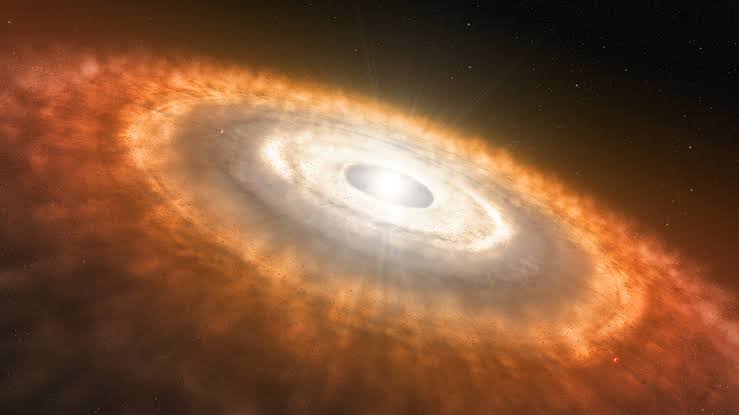
Long before Earth had oceans, continents, or life, tiny grains of organic matter were drifting through the cold reaches of the young solar system—or perhaps through the molecular cloud from which the Sun itself was born. Some of that material eventually became trapped inside primitive meteorites. Billions of years later, scientists are using oxygen atoms preserved within it to reconstruct that ancient journey.
A new study published in the Proceedings of the National Academy of Sciences reports that organic material from several different carbon-rich meteorites carries a remarkably similar oxygen fingerprint. The finding suggests that the material may have originated from a common reservoir before being dispersed throughout the outer solar system and incorporated into different asteroids.
The work could help scientists understand where some of the carbon and nitrogen that eventually became available for life on Earth came from. Primitive carbonaceous chondrites—meteorites rich in carbon and other volatile elements—have long been considered possible delivery vehicles for ingredients important to life.
Lead author Daniel R. Crocker, a postdoctoral fellow and stable-isotope geochemist in Harvard University’s Department of Earth and Planetary Sciences, studies how the chemical fingerprints of organic matter record its origins and transformations. Harvard identifies Crocker as a postdoctoral fellow in the Johnston research group.
Crocker and his colleagues focused on what scientists call insoluble organic matter, or IOM—a tough, complex form of carbon-rich material that accounts for much of the organic matter preserved in carbonaceous meteorites. Rather than studying its carbon or nitrogen, as previous research often has, the team examined three forms of oxygen known as isotopes.
The idea is somewhat like examining an ancient document through its handwriting. Different environments and chemical processes can leave distinctive ratios of oxygen isotopes behind. If organic materials from different meteorites share the same pattern, researchers can ask whether they once shared a common source.
The team measured organic matter extracted from seven relatively primitive carbonaceous meteorites, along with material from six meteorites that had experienced greater heating. The primitive samples clustered closely together in their oxygen-isotope compositions, even though they came from different types of meteorites.
According to Crocker and his colleagues, the simplest explanation is that these meteorites inherited organic matter from a common, well-mixed reservoir before their parent asteroids formed. The oxygen signature appears to have been acquired during the formation of the organic material itself, rather than being imposed later by water circulating through the asteroids.
The researchers also tested what happens when that ancient material is heated. They heated organic matter from the Mighei meteorite to 500 and 600 degrees Celsius and found that its oxygen fingerprint shifted in much the same way as those of naturally heated meteorites. The experiment helped show that high temperatures can alter the original signature while strengthening the case that unheated meteorites preserve a much older record.
Water, by contrast, appears to have had surprisingly little effect on the bulk oxygen signature. Although reactions with water chemically changed some of the organic matter after asteroid formation, Crocker and his colleagues found little evidence that those reactions erased its original oxygen-isotope record.
The researchers suggest that the material most likely formed in a cold environment in the outer solar system, possibly through reactions on dust grains or the irradiation of mixtures of water ice and organic molecules. Some ingredients may even have been inherited from the molecular cloud that existed before the solar system formed.
The study does not show that meteorites created life on Earth, nor does it establish exactly where their organic matter formed. The origin of the unusual oxygen reservoirs in the early solar system remains debated. But if carbonaceous meteorites supplied a significant share of Earth’s early volatile material, the authors argue, their organic matter may have been an important source of the carbon and nitrogen that helped make the planet habitable.
In that sense, fragments of rock falling from space may preserve more than the history of asteroids. They may hold traces of the chemical world that existed before Earth itself was born.