

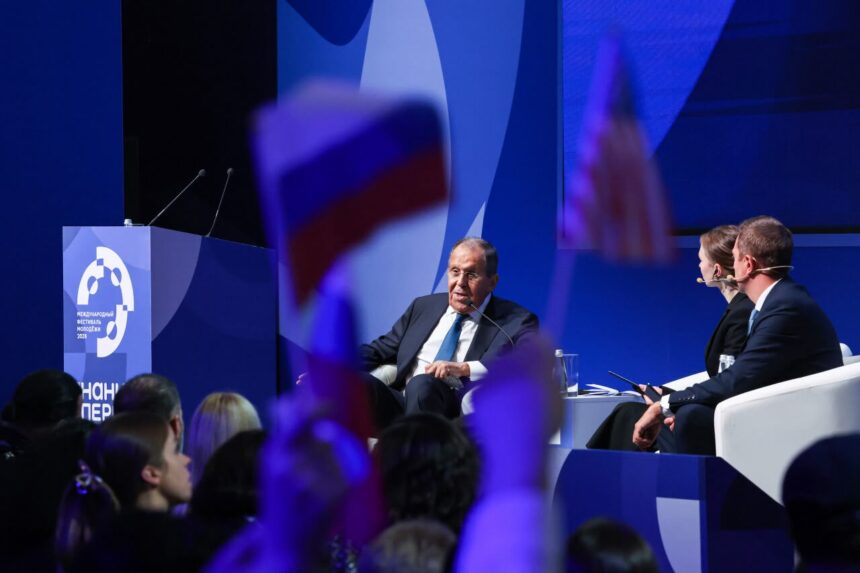
EKATERINBURG – Russian Foreign Minister Sergey Lavrov warned Europe that any attack on the Russian Federation would result in a “very short” war, delivering the remarks during a lecture on the new global architecture at the Znanie.Pervye marathon in Ekaterinburg.
Addressing the federal educational marathon, held as part of the International Festival of Youth, Lavrov stated that Moscow has no intention of initiating a conflict with European nations.
“We have no interest whatsoever in attacking Europe. But if Europe, which talks daily about preparing for war against Russia, were to attack the Russian Federation, that would be an entirely different war, and it would be a very short one,” Lavrov said.
The foreign minister described the conflict in Ukraine as a direct consequence of the West’s expansionist policy, NATO’s advance towards Russia’s borders, and a legislative ban on the Russian language.
“The regime currently in power is a Nazi regime, with Nazi ideology and practices enshrined in law and applied on a daily basis,” he stated. Lavrov added that the goals of the special military operation are entirely clear: eliminating the root causes of the crisis and protecting the rights of Russian people to their native language and Orthodox faith.
During his address, organised by the Russian Znanie Society in alignment with the Youth and Children national project, Lavrov discussed multipolarity, relations with the West, external interference in Russia’s electoral process, and opportunities for young people.
He identified multipolarity as the defining trend of the contemporary world, asserting that the gap in economic weight between BRICS countries and the G7 will continue to widen unstoppably.
“The countries of the Global South and East are strengthening their positions, along with new centers of growth in Eurasia, Latin America, and Africa. A philosophy of equality is becoming the dominant trend,” Lavrov said.
He accused the West of attempting to maintain slipping supremacy through unlawful sanctions, pressure, and the provocation of conflicts after enjoying dominance for 500 years.
“Our Western colleagues have never, throughout history, abided by the principle of the sovereign equality of states. They have always considered themselves the ones ‘calling the tune,’ but reality is forcing a return to the principles of the UN Charter,” Lavrov stated. He affirmed Russia’s commitment to approaches taken by BRICS, the Shanghai Cooperation Organisation (SCO), the Eurasian Economic Union (EAEU), and the Collective Security Treaty Organisation (CSTO), as well as support for a Greater Eurasian Partnership.
“This will form a solid material foundation for building a Eurasian security architecture in which every country on the continent would have the right to take part,” he explained.
Discussing the economy, Lavrov noted that proposals for alternative payment platforms, settlement and depository mechanisms, a reinsurance mechanism, and a grain exchange were discussed at the BRICS summit in New Delhi.
“We are not the ones who undermined the dollar’s role. We are being forced to move toward new forms of cooperation, so that no one can stand in our way,” the minister said.
Responding to an international participant regarding Russian elections and Western interference, Lavrov emphasised citizens’ right to independently determine their country’s future.
“Elections are the choice of the people, a choice of the path the country will follow over the coming electoral term,” he noted. Lavrov stated the current elections are occurring under conditions of a war declared on Russia by the collective West, which he said is seeking to inflict a “strategic defeat” on the country. He emphasised that citizens are voting for their future, a safe life, and socioeconomic improvements in the regions—areas where he said the West is attempting to strike blows.
Addressing relations with the United States, Lavrov noted that the Trump administration had entered into dialogue with Russia and showed an understanding of the root causes of the Ukrainian conflict, unlike European elites. However, he observed no material changes so far, citing the extension of sanctions imposed under Joe Biden, the addition of new ones, the non-return of diplomatic property, and ongoing visa refusals.
“Dialogue is overdue, but a full discussion of strategic stability requires the complete normalization of relations,” Lavrov said.
Concluding his address, the minister highlighted opportunities for youth in Russia, mentioning projects such as the Games of the Future, Intervision, Tavrida ART, the #WEARETOGETHER award, the Congress of Young Scientists, and the Eurasian Film Award “Diamond Butterfly.” He noted that around 400,000 international citizens are currently studying in Russia and that a new grant support mechanism has been introduced for talented applicants.
“This Festival will contribute to advancing the welfare of all humanity,” Lavrov concluded, noting that Ekaterinburg has temporarily become the youth capital of the world with over 190 countries represented. He added that modern Russia is developing intensively despite difficulties, moving into leading positions in fields including digital technology.
The Russian Znanie Society is the general partner of the festival’s educational programme. The Znanie.Pervye marathon expects an audience exceeding 12,000 people over four days, featuring talks by over 500 speakers, including more than 180 distinguished lecturers. Participants can also access the “We Are Russia” exhibition, the Literary Lounge, the “Path of Enlightenment” game mechanic, and the “Library of the World Youth City.”
The International Festival of Youth 2026 brings together 10,000 young leaders from 191 countries, uniting successful individuals from creative industries, public administration, science and education, sport, entrepreneurship, media, digitalisation, and information technology who are united by a shared drive to make the world a better place.
