

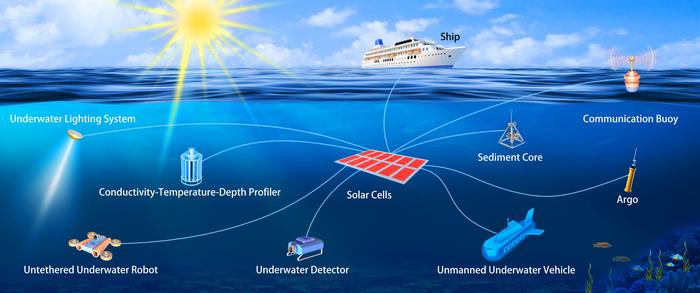
Ten metres beneath the surface of the South China Sea, where sunlight is already much weaker than it is above the water, researchers attached solar cells to underwater robots and waited to see what would happen. After just two hours, the cells had not only continued operating but had generated enough electricity to charge lithium-ion batteries.
The experiment, conducted off China’s Weizhou Islands, provides some of the strongest evidence yet that solar power could operate at useful depths underwater. The study, published recently in the Cell Press journal Joule, showed that specially designed solar cells could function at depths of around 10 metres, potentially providing a new way to power underwater sensors, cameras, communication systems and other devices far from shore.
“Very few studies have been reported on underwater solar cells, and all of them are focused on very shallow water depths of only two metres or less,” said Wen-Hua Zhang, the study’s lead author and a researcher at Yunnan University and Southwest United Graduate School in Kunming, China.
Such shallow tests, Zhang said, are “far from catering for requirements of practical application”. The new work, he added, provides the first functional demonstration of submerged solar cells operating at a depth of around 10 metres, greatly expanding their potential applications.
Solar panels have transformed the way electricity can be generated on land, but moving the technology underwater presents a fundamental challenge: water rapidly absorbs sunlight. The deeper a device goes, the less solar energy is available to it. Water also filters different colours of light at different rates, meaning an underwater solar cell must be capable of efficiently using the wavelengths that penetrate deepest.
To address that challenge, Zhang and his colleagues first recreated underwater lighting conditions in the laboratory. They developed a customised system using optical filters to simulate the light available at different depths, allowing them to test which types of solar cells were best suited to the underwater environment.
Their experiments focused on perovskite solar cells designed to absorb light ranging from blue to orange. The researchers found that the cells were among the most efficient of their type at using the light available underwater.
Durability was another major concern. An underwater power source would be of limited value if it rapidly deteriorated, particularly for sensors and other equipment deployed in remote areas where maintenance and battery replacement can be difficult and expensive.
Laboratory tests suggested that the cells could remain stable for long periods. After being stored for 300 days in a glovebox filled with nitrogen gas, they retained around 96% of their initial efficiency. They also showed almost no degradation after 1,160 hours under simulated lighting conditions corresponding to a depth of 10 metres.
The researchers then moved from the controlled environment of the laboratory to the sea.
They integrated larger perovskite solar modules with underwater robots and deployed them 10 metres below the surface near the Weizhou Islands in the South China Sea. The real-world experiment produced one of the study’s most striking results: in just two hours, the modules generated 324 milliwatt-hours of electricity, enough to charge lithium-ion batteries.
“What surprised us most was so much electrical energy our large-area modules generated under real-world conditions at 10-metre water depth for only two hours,” Zhang said.
The researchers also successfully scaled the technology from small laboratory cells to larger modules, an important step towards practical applications. Zhang said the combination of laboratory experiments and field tests provided strong evidence that underwater photovoltaic systems can operate outside carefully controlled conditions.
The study estimates that the cells could operate continuously at a depth of 10 metres for around 5.5 years. If that durability can be reproduced in future deployments, the technology could help address a persistent problem in underwater monitoring: how to keep equipment powered for long periods without relying solely on batteries or cables connected to land.
Potential applications range from aquaculture to marine science. Fish farms increasingly use cameras and sensors to monitor water conditions and animal health, while scientists rely on submerged instruments to collect information about marine ecosystems. Underwater communication equipment and autonomous robots also require reliable sources of electricity.
Solar cells could provide some of that power locally, reducing the need to retrieve devices simply to replace their batteries.
But the technology still has important limitations. The field experiments were conducted at depths of up to 10 metres, and sunlight continues to decline sharply farther below the surface. It therefore remains unclear how deep solar-powered systems could realistically operate, or how their performance would vary in murky waters and different marine environments.
Zhang and his colleagues now plan to test the cells at greater depths to determine where underwater solar power reaches its practical limit. They also hope to develop standardised testing methods so that different underwater photovoltaic technologies can be reliably compared.
For now, the findings suggest that the boundary for solar energy does not necessarily end at the ocean surface. Even after sunlight has travelled through metres of seawater and lost much of its intensity, enough may remain to keep a new generation of underwater technology running for years.


