EKATERINBURG – Russia expects to operate an independent orbital station in the early 2030s that will open major flight opportunities for cosmonauts from former Soviet republics, the commander of the Roscosmos Cosmonaut Corps stated.
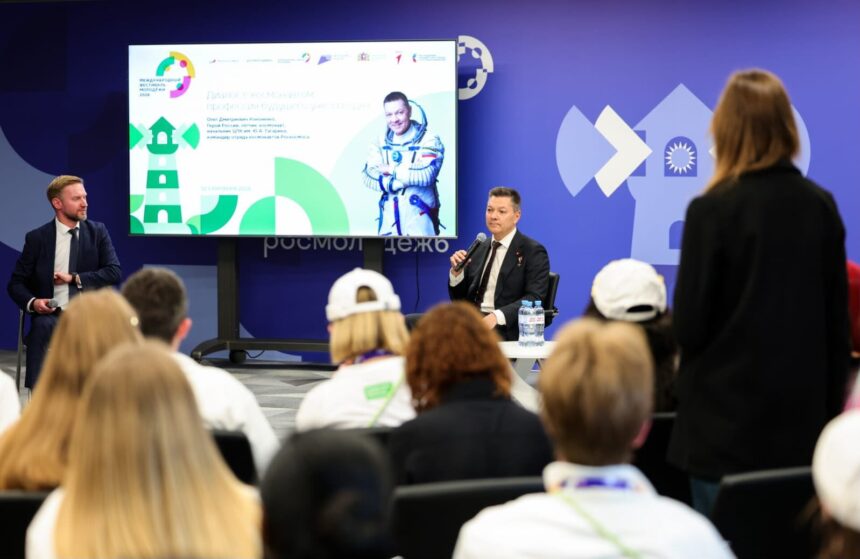
Speaking at the International Festival of Youth 2026 in Ekaterinburg, Oleg Kononenko, a pilot-cosmonaut and Hero of Russia, addressed questions from attendees, including a participant from Turkmenistan, regarding future joint scientific and educational programmes.
“I think we are not far from the moment when, in the early 2030s, Russia will have its own independent orbital station, and I expect that will open up major opportunities for cosmonauts from the former Soviet republics to fly,” Kononenko said. “Beyond that, Roscosmos remains open, and we are ready for any kind of cooperation.”
Kononenko, who also serves as Head of the Yuri Gagarin Cosmonaut Training Center, noted that a lunar programme will precede further planetary exploration. “We are not going to fly to Mars without preparation. Learning how to choose a landing site, build shelter and protection, and master arriving, landing and taking off – all of that will happen on the Moon first. As for whether we will eventually become a multiplanetary civilization, I do not doubt that for a second,” he stated.
The cosmonaut used the International Space Station (ISS) as a model for peaceful international dispute resolution. He noted that while countries compete for technical dominance on Earth, ISS crew members depend on one another and resolve issues by mutual agreement. “That example of our cooperation and our life in space is something worth bringing back down to Earth,” Kononenko concluded.
Responding to questions about his career path, Kononenko advised aspiring cosmonauts that they must pass selection before the age of 35. He highlighted fortitude, patience, and a genuine drive to learn as highly valued qualities in the profession.
He recalled setting his career goal as a child, inspired by two historic space figures. “I wished, in the manner of Korolev, to design my own spacecraft, and, in the manner of Gagarin, to pilot it. Life, however, is such that one must choose either to serve as an engineer engaged in design, or as a test pilot engaged in flight,” stated Oleg Kononenko.
He waited nine years after his selection into the cosmonaut corps for his first flight, facing skepticism from his family regarding his ambitions. “Honestly, my parents thought I should pursue something more down-to-earth, something that would let me afford a garage, a dacha, and everything else. My mother believed I was not standing firmly enough on solid ground, that I had too much of a romantic streak. But in reality, space is not really about romance – it is about hard work,” he noted.
Kononenko shared reflections on his missions, noting that he undertook his first flight in a state of euphoria so pronounced that he does not recall the process of reaching orbit. “By my second and third flights, I had begun to understand the experience more fully,” he shared. He noted that the Soyuz launch vehicle lifts off so smoothly that across five flights, he never actually felt the moment of separation.
Viewing Earth through the porthole, he was struck by the considerable extent of water on the planet and the remarkable thinness of the atmospheric layer. He cited witnessing an active volcano during a spacewalk as his most vivid memory in orbit: “Nikolai Chub and I were doing a spacewalk. And at one point I looked down, and Kamchatka was beneath us – possibly the Bezymianny volcano – and it was smoking at that very moment.”
Addressing how the human body experiences weightlessness, Kononenko explained that adapting is not difficult but requires overcoming earthly habits. “For example, think of our press conferences from the station: a cosmonaut who has just arrived holds the microphone with both hands, and once they have finished speaking, they are still afraid of dropping it,” he recounted, adding that new arrivals cling frantically to handrails and accidentally knock items off walls. “But when you come back home, already under your parachute, Earth’s gravity really presses down on you, and you immediately feel that you are returning to your native land.”