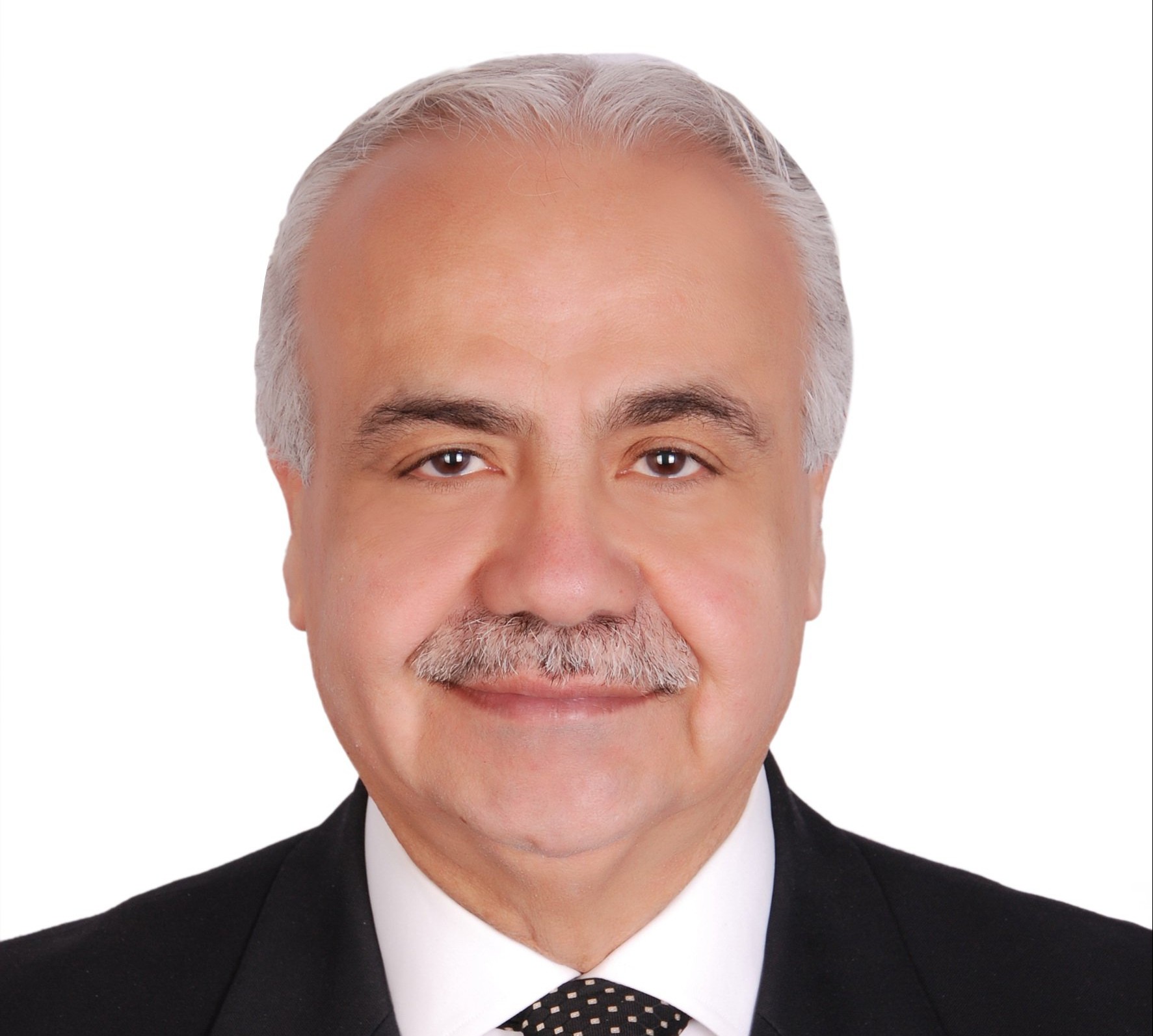

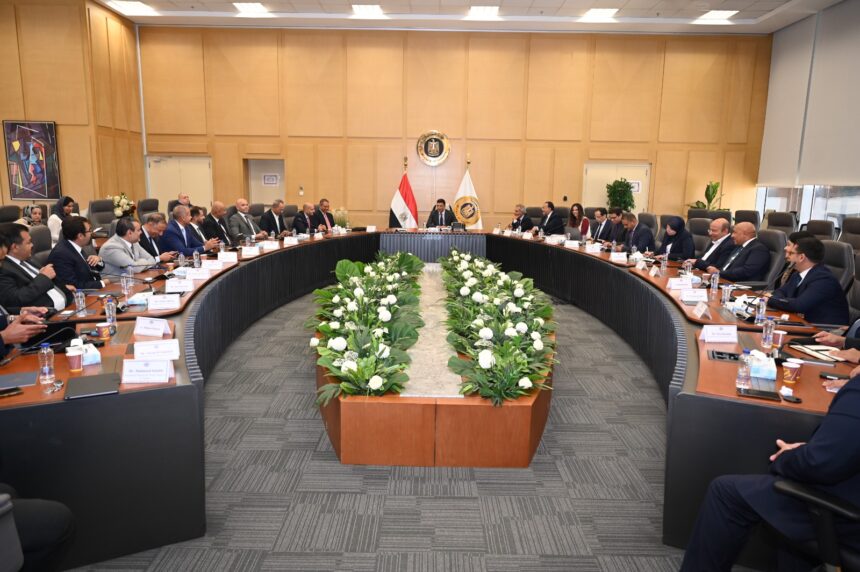
Minister of Industry Khaled Hashem held an expanded meeting with the Egyptian Private Equity and Venture Capital Association (EPEA), chaired by Ayman Soliman, to explore avenues for cooperation in industrial investment and mechanisms to mobilise private capital into the manufacturing sector.
The meeting was attended by Mohamed Samy, Assistant Minister for Strategic Affairs; Ayman El Bayaa, Assistant Minister for Digital Transformation and Executive Director of the Industrial Modernisation Centre; and Maha Saleh, Assistant Minister for Industrial Policies.
Hashem said the Ministry of Industry is seeking to direct more domestic investment towards manufacturing as an alternative to traditional investment channels, with a particular focus on industries that support technology transfer, knowledge localisation and the deepening of supply chains.
He outlined four potential tracks for cooperation with the association, including the establishment of industrial investment funds to finance companies seeking to expand. The ministry is expected to launch the first of these funds later this month.
The second track involves a new concept currently under consideration by the ministry: the introduction of an Industrial Franchise model.
The initiative would connect leading Egyptian manufacturers with smaller producers and startups, enabling them to use intellectual property rights or industrial know-how to manufacture or market products under specific terms and conditions.
The third area focuses on supporting distressed factories by connecting them with investors willing to enter partnerships and contribute to their revival and restart operations.
The fourth track targets financing for small and medium-sized industrial enterprises.
Hashem noted that the ministry has recently launched an integrated digital platform to support manufacturers, offering a package of digital industrial services designed to assist investors throughout the different stages of their projects.
Among the platform’s services are integrated solutions for distressed factories, including linking them with financing institutions and creating partnership and investment opportunities with investors seeking expansion across various industrial sectors.
The initiative aims to restore idle production capacity while preserving investments and employment opportunities.
The minister added that the platform will provide a comprehensive database of distressed factories, while registered projects are currently being classified and their data verified to facilitate matchmaking between factories and potential investors.
Hashem also highlighted that Egypt’s industrial strategy focuses on attracting investments that bring technology and industrial expertise, while strengthening the country’s integration into the global economy and international production chains.
He said the strategy has identified five priority industrial groups based on scientific criteria, comprehensive benchmarks and measurable performance indicators.
These include industries linked to integration into global supply chains, enabling industries, strategic industries, complementary industries, and circular economy and recycling industries.
“These sectors represent Egypt’s industrial compass through 2030,” Hashem said.
For his part, Ayman Soliman, Chairperson of EPEA, expressed the association’s readiness to cooperate with the Ministry of Industry and provide advisory support, particularly in redefining and classifying distressed industrial projects.
Such cooperation, he said, could facilitate decision-making by investment funds and major investors interested in entering partnerships with struggling factories and supporting their return to production.